

I've been meaning to write a piece about a wing of the "left" (or marginally left-of-center, I guess) in Asian America that I feel may be getting too caught up in "political" organizing and party politics (see here for an example of this, through the decent but still heavily Democratic Party-focused Asian Pacific Americans for Progress). These guys aren't the enemy for the grassroots movement building efforts - not at all, and probably a lot less so than some of the mainstream organizations, but they are picking up a lot of steam and interest from the younger set, and I wonder if this is going to have an impact on people who could get involved in grassroots/organizing work for Asian American communities. Throughout this piece, the "political" organizing I refer to is connected political campaigns, not peoples' political power (though of course, I'm not saying they are always mutually exclusive).
I'm a bit worried that if people begin to buy that the only way to affect real change is by getting involved in the strictly political arena, the legitimate outsider voice -- the one that should more accurately represent where the communities themselves are at -- may lose support from the younger generation. Political organizing is pretty mainstream, and I can't really figure out how people move community agendas with all the concessions they have to give up through party politics. These groups seem to be pushing that it is only through political organizing that we can really have an impact on how government policies affect our communities. Beyond that, voting and PAC stuff is very citizenship status specific: non-citizens, even permanent legal residents, are barred from a lot of activities. So how do you make sure your work still represents the interests of these folks when they aren't part of the pool you're drawing in for your trainings/activities/fundraisers?
I think they may be conflating access for some with power for all. I just don't subscribe to the idea that just because there are more Asian faces in political campaigns and appointments, that that will somehow translate to community power: the American political system is too confusing and removed from the people to actually give folks access to power solely through this mainstream approach. And that's in the best possible scenario, when the party operatives that are trained by APAP and other efforts, are actually grounded in community-based beliefs. I don't know if I buy that they all (or even most of them) come from that perspective. After all, aren't John Yoo and Wan Kim Asian Americans who were/are in influential roles in the Department of Justice? So I'm not feeling it.
For a while, I have had this feeling that there are three different things happening in the Asian American "community" of groups/efforts (not counting the PACs and outliers like Committee of 100 or the 80-20 Initiative):
1) Mainstream policy/service organizations. These are mainly local, with their requisite national group in DC: there are Asian ethnic group-based coalitions/groups (NAKASEC, SAALT, OCA, JACL), issue-based groups and coalitions (APIAHF, AAJC, NAPAWF, National CAPACD), and a range of others. This is kind of the old guard - they are more traditional in focus, and almost wholly 501(c)(3) organizations, which gives them the government, foundation, and individual moneys, but makes it tough for them to take more aggressive stances (or actions) against government action. In addition, the younger folks involved in these organizations tend to be more of the professionalized community worker - one or more graduate degrees, theory and academic skills, but often, distance from the communities that they are working with (or in their parlance, "serving"). I was one of these folks - buying into the idea that you need to have the advanced degree to move forward (part of it is just survival as the field gets crowded with people).
2) Organizing/Radical Collectives. There is a small but growing national network (API Movement, I think it's called) of radical/left groups and collectives, and I think more of an effort to bridge the distance between them. Many of these focus on movement building, taking their cues equally from the heyday of the Asian American Movement in the 70s and other liberation movements. But they are generally poor, not as concerned with the big political or national policy stuff, and sometimes not as easily accessible or visible to the younger folks rising up looking for somewhere to plug in. In desi communities, the best efforts have trained young people through programs like YSS and OY! But it seems like those efforts are more or less on hiatus right now, and it's not clear how these different groups reach out to the unconnected who are interested in being more active.
3) "Political" Organizing. This phenomenon, which is not new but seems to be picking up a lot of steam, really comes from political operatives who have been involved in campaigns for key Democrats (it's always the Dems for this kind of work - money attracts money for the Republicans, and folks organize in other ways for that side of the duopoly). I don't have too much against these folks, except that sometimes it's hard to talk to people without feeling like they have been totally co-opted by the Democratic Party and have a lot of faith in a system that does not care about the less fortunate in their and other communities (see, immigration reform, voting rights, American military conflicts, and a whole host of other things that are more important to our community members than to government electeds and their operatives). That said, there's something sexy about elections and "political power" that draws in the younger, middle class folks with a lot of energy.
Again, I don't think this is a bad place for some focus - it's just that it feels like more and more people go to this work without any experience in grassroots/community-based work, whether that be service delivery or straight-up organizing. So they bring their own interests to the table. Civil rights, check. Affordable housing and access to government benefits? Not so much. Glass ceiling? Check. Rights for the undocumented that extend beyond slogans? Not if it's not going to "win us seats." The calculus of big-party, big-money political organizing is not grassroots and it's not community-based. And I'm worried that the "best and brightest" who are trained to go out and get engaged are looking towards mainstream spaces as the source for power rather than the real communities that they claim to represent.
That all said, there's a space and place for all of these - but they aren't talking to each other. The political folks think they have everything figured out, but aren't far left enough to take more aggressive stances (like creating PACs that actively push a strong Asian American community agenda that comes from the people). So they are seen as sell-outs by the left and too "political" for the non-profit sector. The Left groups get too negative on everyone and often just don't engage the mainstream groups - so there's neither accountability nor dialogue. And the mainstream groups? Well. They tend to just be oblivious until you knock some sense into them. And the neverending quest for funding (blame both the foundations and the groups themselves) leads them to bring more conservative people onto their boards who are uncomfortable with things that aren't even that controversial. So in a community that isn't that large, we have at least these three major things going on, no one's talking to anyone else, and so, where are we going?
Maybe things are better on a local level?
Jun 27, 2008
APAP, "Political" Organizing, and the Movement(?)

Jun 26, 2008
National Coalition of South Asian Organizations; NFIA
This past week, 30 South Asian community-based groups around the nation launched a policy platform and national agenda for the South Asian American community at a press conference in NYC. I haven't had a chance to look through the whole agenda/policy platform (that mofo is 65 pages long!!) but it's pretty cool that this many groups have actually signed onto something with substance, that talks about issues from a progressive lens (i.e. recognizes the undocumented population that is a significant part of our community, speaks outright about women's rights, and has a platform concerning the LGBTIQ community).
Think about it - a lot of these groups are not the far left of center groups we all know and love -- many are service and advocacy groups. It's hard enough to get a few desis to agree on a place to eat, let alone have 30 groups sign onto a comprehensive, progressive policy agenda.
Definitely better this than just adding their names to yet another telephone directory and counting themselves as part of some large "federation" in name alone. Speaking of which, seems like the National Federation of Indian-American Associations (NFIA) chair is a little upset over this launch. Check out his comment, posted here on the SAJA Forum as soon as the Media Advisory for the NCSO launch hit their site. Actually, I'll reproduce the whole thing after the jump, it's just so rich.The National Coalition of South Asian Organizations (NCSO) is not a new concept nor is a new effort for Indian Americans to unify and speak with one voice. In 1980, the National Federation of Indian American Associations (NFIA) was founded with the main goal of unifying the diverse community under one umbrella. Currently, the NFIA has over 200 member associations from all parts of the United States making it the largest umbrella organization representing 2.8 millions Indian Americans here in America. The NFIA has played a leading role in reforming the Immigration policy of the country, has appeared before the Senate Committees to Represent the interest of Indian Amereicans, has raised funds for natural disasters in the United States and India, advocated the strengthening of US-India relations and has presented a collective Indian American Agenda. The Asian American Hotel Owners Association (AAOHA,) the American Association of Physicians from India (AAPI), Indian American Forum for political Educarion (IAFPE) and Global Organization of People of Indian Origin (GOPIO) took their birth at the NFIA Conventions held every two years. Many leaders of the NFIA have been bestowed the highest awards in the land and have received the highest public service appointments. By and large, it has done a remarkable job in the service of the community.
We welcome the new associations with similar objectives. The more associations crop up the better we will be served. However, every new effort must acknowledge the hard work of many in the past and should not pretend to be a new kid on the block.
One can call these associations as Coalitions, National Federation or by any other name. One must not forget that the primary aim of any such organization is to improve the quality of life of its constituents and not aim at any personal glory or gains.
Rajen Anand
Chair NFIA
Where to begin on this one? First, a little history (biased, of course). NFIA is indeed a group that has been around for a long time. But what does it do? What do people know of it? I can't remember, but I can guarantee that it's the successful uncle set. Actually, his email says most of what you need to know: photo-op focus, overwhelmingly well-off, male leadership, model minority pushing, and perhaps less secular and "inclusive" than they will admit in all the accolades they list. And is anyone under 40 involved with that group? But not to be ageist - it's just a question about how they oriented.
One can call these associations as Coalitions, National Federation or by any other name. One must not forget that the primary aim of any such organization is to improve the quality of life of its constituents and not aim at any personal glory or gains."
This statement seems kind of at odds with the range of self-congratulatory remarks in the long paragraph above it. Beyond the statement's many shortcomings, the most obvious is that this Coalition is not just about "Indians" but about South Asian Americans - recognizing that some of the nationalistic ties that groups like NFIA and the wide assortment of photo-opportunity groups (PACs included) are less useful to people who are still actually struggling in the United States. People in groups like NFIA still don't understand that there's more to the work than photo-ops and getting awards (or pushing for the India-US Nuclear treaty, which is a key NFIA agenda item).
And that brings me to: what is NFIA's public policy agenda? It does seem like they mention some things of concern like hate crimes and civil liberties, but what has the organization done to promote access to services in our communities? Where has it been when there are conversations about true immigration reform that takes into account how broken the current system is and actually pays attention to the undocumented and low-wage workers in our communities? Where is NFIA's statement that recognizes and pushes for real inclusion of LGBTIQ and other wholly marginalized communities with the "South Asian community"? Actually - wasn't it the group that spawned NFIA - the Federation of Indian Americans (FIA) in NYC that actively discriminated against SALGA and created one of those moments in the late 90s that we still talk about as being an important moment in the formation of a more pan-issue progressive South Asian movement in NYC? Hey, thanks FIA/NFIA!
But on that tip, does anyone know who the NFIA affiliates are? They say that they have 200 member organizations, but where's the list? How many of those groups actually serve the community directly? How many have Hindutva ties? If you missed it, here's their statement that they were "disappointed" that the Butcher of Gujarat, Narendra Modi, was denied a visa the first go around with the State Department.
Oh, and remember this charming line from NFIA's congratulatory press release on Bobby Jindal's election: “it is a great moment in the history of America when some one who looks like us becomes the Governor of Louisiana. We should all be dancing in the streets to display our pride.” It's just ridiculous that groups like this still get the ear of members of Congress - it's only because they throw their money around and play out that they represent community interests. Looking deeper at their website, they did have a celebration to recognize "Gadar heroes". Different president at that time, though.
Meanwhile, hats off to the groups that signed onto this policy and action agenda. It's a good step in the right direction.
Joe Lieberman Must Go!
I just came across this petition and "best of" video. I don't appreciate the rabid hate speech that follows any candidate who is different just based on their background, but you know, slam the man for his fucked up policies all you want. I can't believe this guy is a committee chair. Yet another reason to change the 2 party duopoly that made this possible. Anyway, check out the video, sign the petition, tell as many friends you have in Connecticut to get this man out of office.
I still think he may get tapped by McCain as a running mate.
Jun 19, 2008
Vincent Chin, 26 Years Later
I wrote about Vincent Chin a little when I found out about the film called "Vincent Who?" I don't want to revisit that discussion, read it here if you care to.
Just taking today to reflect a minute: hate crimes are a terrible, dangerous breed of crime. There are many people who just don't want to recognize that there is a special kind of intent behind these crimes, and a broader impact than just on the immediate victim. Part of their logic is that there are already statutes and laws in place to deal with the crime committed - that of beating someone up, killing them, or in the "lucky" situations, merely ridiculing or harassing someone.
But the point of hate crimes is that they affect communities - the victim is a symbol, and so are the acts. By not embracing much more strict hate crime laws, we're basically saying, you can hate all you want - just don't cross the line of beating or killing someone. But the kind of intimidation that naturally flows from these acts is also behavior that we should actively be pushing against. We don't want to - or at least shouldn't want to - allow people to act out their hate in the public arena without knowing that the society we live in won't tolerate these individual acts against groups of people. That's not the America we want to live in.
But it's all a policy discussion, and in this country, substantive policy discussions quickly devolve into surface political sparring. That's not going to change anything.
So what did Vincent Chin die for? Nothing. His death, just like his attack and his attackers, have become symbolic to some people. But in the end, it means nothing more than that striking, heart-breaking image in Christine Choy's original film about his killing, when his grief-stricken mother said solemnly, fighting back the tears, "We want justice. We want justice."
That we organize, that we coalesce around these watermark moments (or build them into focal points to help us rally for our work), is not a bad thing. It's just sad that it takes this kind of event, and the countless others - small and large - to rally people around creating a more safe, respectful, and polycultural society.
It's sad that mothers who understand their kids' English at home, but didn't have to make public statements in that tongue, have to come forward and put their grief on display in an awkward language, in words wholly inadequate to capture what they are feeling.
***
People gather in Strawberry Fields in Central Park every year to sing and remember John Lennon on December 8th, the day he was murdered in 1980. I used to think, wow what a wonderful thing that people do that, and that they get together in that way. But Yoko Ono has asked people not to - she said the day was not a day people should commemorate - it was the day that he was taken from us. Remember his birthday instead.
People often create monuments for those who have fallen - from formal statues to street art tributes. The best of these remember the lives of those who we have lost, but often, it's the day that they die that we remember and commemorate. And stories of their lives are superseded by the sad/angering memories of how they were killed/taken from us. While these things are important, we can't lose sight of the stories behind these stories - the stories of triumph, strength, or just people (flawed as they may be) just trying to live their lives.
But I couldn't find Vincent Chin's birthday anywhere - Wikipedia only says that he was born in 1955, and that he was adopted by his parents in 1961. Vincent Chin wasn't trying to be a hero or a martyr. He was at a strip club, celebrating his bachelor party with some of his friends, before his wedding, which was supposed to be on June 27th. Maybe I'll just remember June 27 from now on and think about his loss then instead.
***
Regardless, remember Vincent, or at least the story of his life and how he was killed. Remember that something is happening to someone right now - whether Asian, black, Latino, white, gay, woman. That person feels alone, feels trapped, feels angry/suicidal/unknown, unheard, unseen. That person may be someone you know, or someone you don't know, but it is someOne.
Jun 14, 2008
Co-opting Struggle?
I had a really interesting conversation with a good friend last night about Palestine/Israel that got me thinking. She was saying that a good number of her Pakistani friends really take the issue of Palestine to heart - but as a matter of Israel/America and Muslims. She said that the conversation is sometimes couched as a matter of faith, as if the "holy war" narrative that we hear sometimes is actually true (if even just because Muslims feel like they are under attack and Israel/Palestine is the front line). But she felt, and said that a lot of people she's spoken to, that this is more of an anti-Arab thing that's happening in Israel - that the Israelis couldn't really care less about other Muslims, as long as they aren't attacking (physically or verbally) the state of Israel. She said her feeling was that Israel was more concerned about getting rid of the Palestinians - Muslim, Christian, whatever.
I found that to be so interesting, and didn't anything to say that added to the conversation, an outsider myself to all sides of the question. But it made me think more about my recent posts about Palestine and the way that the cause of Palestinian people is so below the radar, and so politically unpalatable in the U.S. that we don't hear or see much. Why have I taken up the issue now - can I just attribute that to having more friends who talked about the right of return, widespread human rights abuses, and family members who are directly affected?
Or is it just a badge of being "down" and/or radical (enough?) by taking an alternative position to the norm in U.S. dialog (from the elections to most other conversations about race/religion in liberal spaces here). I don't want to question it too much - but it made me think about it more - motivation is important.
Maybe I've just really whole-heartedly accepted that Zionism is the new white colonialism, and if I'm anything, I'm anti-colonial, and Palestine is ground zero for that.
Jun 13, 2008
Sometimes I really wish I could just have one of those moments where, after a long and protracted argument with someone who takes a wholly opposite (and wrongheaded) position on a critical issue like racism or power or the various impending environmental holocausts that right wing nuts continue to ignore, the person is hit with a zinger and has to actually acknowledge that they were wrong. I mean, we go on and on with these debates, but does anyone ever actually move from their ideological line in the sand? And even if people eventually do, can't we just have one of those moments once in a while? Not necessarily one where someone is ridiculed or anything - just where they see the truth and take it from there, rather than just save face and act like nothing's changed.
Maybe it's too hopeful.
But we're all about hope nowadays, aren't we?
Jun 10, 2008
To Work (or Not) in the Community: That is the Question
Although I'm studying for the bar, the question about what comes next has been on my mind a lot. With it came the question of whether I should move from working in the South/Asian American community where I have some experience to a more mainstream poverty/movement organization.
The plus for the latter is that there are few Asian American (and far fewer South Asian) groups that have adequate infrastructure to train or even give requisite substantive support for particular poverty law disciplines (public benefits, housing, economic justice). Going to a mainstream organization could be a good place to cut my teeth as a new lawyer, just trying to figure out how things work and trying to learn how to actually be a lawyer (notwithstanding whether or not I want to do that for the long term, or whether I feel that's the best pathway to real change - we'll cross that bridge when I find it).
While it's not always a deal-breaker, one of the things I've felt coming up was that you were basically damn lucky if you found a mentor in the APA community who gave a shit about whether you were, 1) learning anything and growing; and 2) afforded the opportunity to actually develop and take on more responsibilities. Nonprofits as a whole aren't that good at this, but frankly, at least on the East coast, this is a real problem. I've seen so many of my friends and comrades drop away from working in APA organizations in their late 20s/early 30s just because they were sick of the new glass ceiling they encountered in these groups, something I like to call the APA Charlton Heston school of leadership: upper management that won't relinquish control or power to the younger set at any cost... "from my cold, dead hands," as it were.
I've spent a lot of time getting over how I felt about this problem. I've met some West Coast folks who just don't seem to have the same chip on their shoulders. They also tend to be people who were actually active in more radical/community-based activism in the 60s and 70s. There are other issues with APA stuff from the West Coast (namely, where are the South Asians at?!) but this leadership thing is a killer. I don't want to assume control/a leadership position. I just don't want to be shut out because I'm not part of the little clique of revolving EDs in some of the organizations (East Coast locals and nationals). It's time we brought a radical change, son.
But this question of where to start after this course of study really bothered me. It's not about selling out - after all, it's still public interest of some kind. It's not about being uncomfortable amongst clients/co-workers who are not of "the same community" - because let's face it: Asian American communities are more or less a convenient (or necessary?) fiction, at least in the client base/community level. The only folks who really embrace that identity are folks who are community workers - it's safe, it's known, it's necessary to justify the work we're doing, and it helps to orient our work in broader immigrants' rights/people of color/poor peoples' campaigns.
So what is it? I think I still have that sense of selling out the community in some way if I'm not working directly in it. There's a real difference between volunteering when you have time, and being able to do this work full time, no matter how much we want to think otherwise. I'm not as young as I used to be - I still have energy, but the more distractions/disparate projects, the less effective I'm going to be in my primary work and even in my personal life.
I still think the revolution is never going to be funded, and that volunteer/micro-organizing is incredibly effective, but I want my work life and my volunteer/DIY life to overlap in some basic ways. The people we meet/work with in one arena could easily place multiple roles in multiple projects if there's enough resonance between projects for which we're wearing different hats. I think.
At the same time, am I just working in a comfort zone and limiting my ability to do more in my program areas because I'm not moving beyond this space? It's hard to tell (and isn't that what coalitions are for, anyway?).
So we'll see how this pans out.
Jun 9, 2008
Prez-o-dink
I'm not really in the mood to study right now, but I'm going to push ahead because I have to make it past this last hurdle. I feel painfully out of the loop about what's happening in good ol' Asian America (or just plain vanilla America) at this point. Do we have a new president yet? Feels like November will never come.
But if you find yourself getting nostalgic for Bush Jr., you should check out this site that maintains a good database of fabulous flubs by the leader of the free world. The best part is the commentary by the person who maintains the site, and definitely check out the audio clips.
Sometimes, when I'm feeling particularly down about getting through all this work and to the other side, I'll visit this site for a pick-me-up, and it just seems to do the trick every time. I don't know what people did when we had boring, or - gasp! - articulate Presidents.
Jun 6, 2008
Obama and AIPAC/Israel
 There's a lot of excitement around Obama right now. Some of the folks who have been waving his flag for more than 2 years are feeling pretty good about themselves. Even some of the folks who have been on the fence at least since Edwards left the race (but likely far longer than even that) are slowly coming around and supporting him too. And it's easy to point at HRC's mistakes and flubs and get kind of comfortable in thinking that Obama represents something different, something new, some kind of change. In other words, a lot of people are starting to buy the hype. Persuasive marketing, done long and hard enough, works.
Even I got caught a little, though not directly. A few days ago, I posted this angry response to Clinton's address at the AIPAC convention. I didn't get a hold or an earful of Obama's speech, but just felt compelled to write something after hearing her live on C-SPAN. But now I've read/heard Obama's comments. And he's not much better, and I would argue, possibly worse than HRC on the whole issue of Israel/Palestine.
Check out some of his comments here. Of course he's not going to be wholly critical of Israel with this audience, but there's not a single word in here and Israeli restraint, curtailing the settlements, or anything else of its kind. It's as if the issue has only one side: that of the Israeli lobby and the hard right government folks there (not the general public, IMHO). It's scary how easy it is for him to just dismiss Palestinian rights the way that he has been doing - and so publicly.
It leaves a very bitter taste in the mouth, and I really hope that people who seem to be losing all perspective start to remember that the way he deals with this question and issue may reflect how he'll deal with a slew of things domestically: the most powerful, well-funded group, or at least that which he fears the most, will pull the strings. It is for this reason, specifically, that I cannot support him.
Just thinking more about the plight of the Palestinian people - they are a people displaced and now vilified for their displacement. It's really kind of crazy. And you know - the rhetoric has made all Palestinians into threats or "terrorists" - women, children, and men. Kind of reminds me of how Jewish people were so discriminated against around Europe (Germany's particular legacy makes it easy for Spain, France, and all the rest to hide from their own shameful histories). After WWII and Hitler, guilt set in a bit and there were some steps to try to ameliorate the harm of the earlier animus.
But nowadays in this age of permanent news cycles that magnify small or isolated incidents into mass conspiracies, where this "war on terror" is never-ending and forever pitted against the eternal enemy, with an olive complexion and Muslim name, I don't know if there's any "redemption" in sight for the besieged and embattled common Palestinian people, at least in the U.S. and Britain. Who in the world community will champion their cause and relieve them from their precarious position: caught between a small minority set on severe violence, and one of the most deadly state military presences in the world?
There is little hope that that champion will be the next American President. And the only former President who makes much sense on their future is a peanut farmer from Georgia who is part of an old guard, at least generation preceding Prez Clinton.
It's all pretty depressing, really. So please don't tell me to get on the Obama bandwagon, unless the driver shows me he isn't driving off the cliff on this issue.
Wonderful Piece on NY'ers and Our Attitude
 I don't have a lot of original thoughts right now, with BarBri owning my brain for the next 2 months, but thought I'd share this article that I really enjoyed from last month's Smithsonian Magazine about the bad rap that New Yorkers get about our attitudes.
The piece highlights that in NYC, people act in public how most people act in their private spaces. Read the piece - her observations totally made sense to me - I have waited around when an outsider asked someone else for directions or tips, just in the hope that I could say something. I've struck up conversations (brief, because we always know when to stop talking, which is more than I can say for yappers from other parts of the country) with complete strangers about something we're experiencing, something they're reading, whatever.
Her conclusion? It's because of a sense of common cause. I've read it before, but I think her examples kind of jumped off the page for me. There is definitely something like that - it reminds me, to be honest, of India and other places where people don't have such weird feelings about interacting with strangers. But what I love about the City, still, is that you just shut that off when you want to. You can pretend to not want to engage with people, and go about your bizness. And when you're ready to plug back in, there are opportunities abound as soon as you walk out your door.
But the comments on the article are even more interesting. It really comes down to the difference between people who've never spent much time there (the occasional visitors are so easy to pick out, what with their incessant comments about crime) and those folks who recognized something in the author's observations. There's also an undercurrent of commenters completely not getting that there are spaces for most folks in the city (though we're all getting priced out at this rate). If you put together the honesty and the grit of struggling to be on top each day, you start getting people who either don't know how to look up and enjoy anything or those who take solace in dependable habits, unique moments, chance encounters.
The whole idea of going from boxes where you live to boxes where you work in the bellies of smaller boxes that consume fossil fuel, which you take to big boxes on the weekends to buy boxes filled with stuff: well, count me out. Okay, I'm rambling. I intended just to share the article, not to read the comments, but those comments underscore what I've always felt: people just don't get NYC.
And the real city is disappearing as I write this, with the working people and immigrants (whose faces and (sending) places may change with the decades, but whose stories still turn the engine of what makes the place so special) getting pushed out. How many boutique hotels will we have in Chinatown by the end of this year? How many new condo buildings in Manhattan, Brooklyn, and even Queens? And when they move out of the city, without the public transportation infrastructure from NYC that keeps these communities connected and people in more direct contact with one another, is the future just more suburban ethnic enclaves that revolve more around consumerism than residence and shared experiences?
Jun 5, 2008
HR Clinton and AIPAC/Israel
Had I the time or the inclination, I would go ape-shit (in a bad way) about Clinton's speech to the American Israel Public Affairs Committee (AIPAC) tonight. I didn't hear Obama's, but I'm sure it was adequately fucked up, as I'm sure Bush and his underlings and all the others are as well.
But I got to hear HRC on C-Span live, and her terrible characterizations of Palestinians and her chauvinistic statements about fully supporting Israel ($2 Bn a year for "defense"?!) boiled my blood.
I guess it's a quintessential American value: the brutal subjugation of an entire people on the justification that "this land is now our land, now get the fuck off or die." Like I've said before, Manifest Destiny, anyone?
So I'm not surprised, but she even got the "debacle in Durban" -- the first global conference on racism, where there was a motion to characterize Zionism (the militant political ideology to expand Israel at any cost - human or otherwise) as racism, that resulted in the U.S. happily (and conveniently) walking away from the discussion. We're going to get to a point where the U.S. and Israel are alone in their inability to fully confront the evils associated with their founding, while the rest of the world moves on. I mean, even Australia is moving closer to understanding that its shameful legacy with its own aboriginal populations must be confronted. But it's easy to stick your head inthe ground when no one else can bully you into accepting the brutal truth of your own nation's sins.
Thing is, many Israelis know better, and there's definitely some level of understanding with regular people about how the question of Israel/Palestine should move beyond "they don't want to recognize our right to exist" to a more detailed parsing of the issues. I don't know if Americans can do the same with the legacies of slavery, decimation of the native population, and everything that came after these things.
But that speech was intolerable, and I'm so sick of hearing every politician with any aspiration to keep or advance in their political careers remaining 100% wholly uncritical of Israel's actions. Shit, I'd consider it something noteworthy if they even mentioned anti-Arab racism and xenophobia in the same speech as antisemitism (no hope for the same paragraph or sentence of course, and disregarding the fact that Arabs are also Semites, but somehow that has been lost in every modern discussion at this point).
The state of Israel is not just a victim: it's also an aggressor in this whole situation. Perhaps the image of besieged state fighting for survival is romantic, or perhaps some kind of national guilt from America's failure to intervene in the treatment and slaughter of the Jewish people for years before finally getting involved in WWII has permeated American politics (I doubt it). Whatever it is, this one-sided approach to the whole thing is incredibly troubling. How can America have any moral authority when it is so totally biased in an arena where one side is using sophisticated war technology that we've provided and the other is using the military equivalent of slingshots and bows and arrows?
What happened to "We are all Palestinian"?
May 23, 2008
Mississippi Workers Hunger Strike: Day 10... to what end?
 At this point, many people in the progressive desi/Asian American community have heard about the Indian H-2B workers who were brought in to work at a shipyard in Mississippi for post-Katrina rebuilding. They faced brutal, abusive conditions, and it’s pretty clear that they were trafficked – misled by recruiters to pay thousands of dollars on a fraudulent assertion that they would get permanent residency and the ability to sponsor their families within months. There are much better accounts of this, such as this excellent recent piece by Svati Shah in SAMAR Magazine, so I’m not going into details here.
The basics details: some 100+ workers (of the total 550 at Signal International) walked off the job at the beginning of this year, risking so much but stepping up because they couldn’t take it anymore. They had connected with the New Orleans Worker Center, headed by (young) South Asian leftist Saket Soni from Chicago. The workers have since engaged in a number of actions, including a satyagraha “march” from the deep South to Washington, D.C., where they stopped to meet and build solidarity with civil rights leaders and African American communities on the way. They rallied in D.C. and presented their requests and demands to the Indian Embassy (for the Indian government to intervene on their behalf as it has with nations in the Middle East), DOJ (for the granting of continued presence status), and members of Congress. That was at the end of March. And nothing moved between that time and May.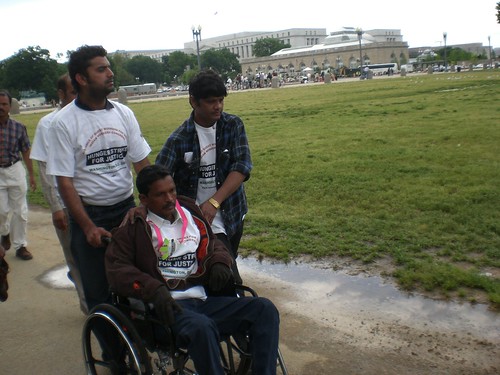
So since May 14, about 30 workers went back to D.C., escalating their campaign into a hunger strike, where 5 workers swore off of food until their pleas for intervention and justice were heard. It has been 9 days. While more workers have come from New Orleans to join in the hunger strike and/or to participate in actions this week, three of the original hunger-striking workers have been hospitalized, and it’s not really clear what the end point to this process will be. There are a number of supporters who have been around the workers in D.C. from the beginning, but they are tired, and morale seems low.
From a distance, and perhaps to the bookish/armchair revolutionary who longs to be part of an epic struggle against the oppressive state like third world uprisings around the world and even the attempts in the America of the 60s and 70s, the workers’ struggles and brave actions may seem heroic and completely worth supporting: this is the people uniting for a common cause against oppression after all. I know I felt that, even though I haven’t had any real connection to what’s been happening.
But I’m also beginning to wonder about some things, particularly with the organizing strategy. I’ve heard Saket Soni speak a couple of times in person about this campaign, and I’ve seen a bunch of videos through the campaign blog where you can hear his rhetoric and see the strong united front of the workers behind him. He hits all the right notes, connecting this terrible situation with the legacies of slavery and indentured servitude. He rallies the workers behind him and gives what seems to be adequate space to hear the workers’ voices and stories. It is hard not to admire an organizer who is fighting something that is this criminally unjust, and it is easy to hear the workers’ individual stories and think that while they are the brave people taking the risks, the organizers are critical to help them achieve justice.
But what’s really going on here? While the work of the New Orleans Workers’ Center for Racial Justice seems to be legitimate, and the workers seem to be participating, are people asking critical questions of this campaign? For example, the workers are seeking continued presence while their trafficking claims are investigated – at this point, their immigration status is not clear, and when pressed by media or others, the organizers, Soni in particular, state that “it is our belief that they are the victims of trafficking and should be granted continued presence in the United States.” That’s fine – but what is their actual status, and what risk are they running by being explicitly visible? I’m not saying they should hide and let the corporation get away with this – I’m asking if the workers realize that if they are found to have unlawful presence and are deported by ICE, they could be prevented from re-entering the U.S. for up to 10 years. This is a real impact that they should know: but does it run counter to the organizing strategy, and therefore, is it diminished in importance when the workers are briefed before making decisions?
As a second point, what is the narrative that they are crafting with this series of actions? Calling the bus journey from the South a satyagraha sounds great – invoking a particular (innocuous old man) image of Gandhi that may rally South Asians (or at least garden variety liberals) to the workers’ cause. It’s good media sense to tap into something familiar this way and invoke that the workers’ struggle for justice is neither isolated nor unfamiliar to South Asians. But then is the hunger strike a natural step in the actual organizing campaign, or is it the next step to get the press interested? Who are the targets that are supposed to be moved by this hunger strike?
1) The DOJ isn’t going to bend for this one case – no matter how egregious – because that sets it up to do the same for all of the other folks in similar or even more dire situations.
2) The Indian Embassy is too concerned about India’s endgame to wedge itself between the U.S. and Pakistan, get on the U.N. Security Council, and get recognized as a world nuclear and economic superpower with the help of the U.S. It’s not going to jeopardize those goals with the U.S. on account of these workers, no matter how terrible the situation. Let the U.S. courts sort it out: there’s big business to attend to.
3) The Congressional targets need to be made much more directly aware of the crisis and how they can intervene by pushing for an investigation and looking at the H2B program as a whole. But I can’t really see action alerts for allies to raise the pressure, and will the targets care if non-citizens are starving themselves for justice when they have constituents (and voters) who may be anywhere from ambivalent to wholly hostile towards migrant workers “taking their jobs”?
Basically, how is the hunger strike going to move hearts and minds, and if it’s not, why the hell are you endangering the workers’ health, safety, and ability to stay in the country for non-achievable goals (within the context of this particular timeframe).
On top of these strategy questions, which may be discussed internally and not disclosed to the rest of us, I also want to ask the question of how much power the workers actually have in making these decisions. It seems like they support Saket Soni and the Center, but what do we know? And what I’ve seen from desi and other left groups is fairly uncritical – just either staying away from the issue, or just forwarding along the information as an FYI. Has anyone actually directly asked Soni and the other organizers from the Center about this? My contacts who have visited the workers a few times have said that the workers have a lot of questions about the effectiveness of this campaign, the plan for the future, and legitimate concerns about how this whole thing has been managed, but that the questions are deflected internally, and things haven’t changed.
Are we giving Soni a free pass because he’s a man of color who is working with co-ethnics rather than a white wo/man in a community of color? Is he getting that free pass from white “progressives” who recognize their own privilege/are fearful of being called out and so they don’t criticize/come out publicly, and brown/black/yellow “progressives” because there is always a question of our own legitimacy in this kind of work, regardless of the racial/ethnic bonds we may have with the communities that we work with – and we don’t want the tables to be turned and the microscope to be on us and our work?
But what about the workers, then? Is the cult of personality enough to protect someone and his possibly flawed and dangerous strategy – or should we recognize that we too would be partially responsible if something terrible – that was avoidable – happens to the workers after they’ve taken the brave steps to leave the abusive work conditions and speak out? Why aren’t more people asking these questions instead of just “supporting” the struggle? Are we supporting the idea of the struggle – or the workers who are taking this effort on their backs: is it the same thing?
May 13, 2008
Indian Fraternities and Sororities
This past academic year, I spent more time at a large public undergraduate college, where there is a pretty significant Asian American community. I got to interact with some of the college-aged South Asians - though they were primarily Indian American, of course. Although the school has multiple South Asian organizations, based on religion, ethno-national identity, and even cultural groups (singing troupe, dancing group) a lot of the folks were part of the ever-growing South Asian (really, Indian) "greek" life that seems to have blown up over the last 5 years.
I know that the first Indian fraternity started in 1994. It was called Iota Nu Delta (IND) and started at SUNY Binghamton. Their website is quite a trip. I particularly enjoy this call-out quote on the sidebar: “February 7th, 1994 would be the birth of an organization where eight great men laid the foundation for the entire South Asian Greek cpmmunity (sic)...”
Okay - where to start with these groups? I guess the first thing is that the groups were marginal at best when I was an undergrad, and even in the years following. We laughed at their initial steps, not realizing that they would grow and multiply. I think there are about 10 Indian/South Asian fraternities and sororities now, and the students I spoke with were very energized about their organizations - far more, in fact, than they were about being part of any traditional college organization organized around ethnic or ethno-national origin. Far more, in fact, than they were about attending workshops or taking classes that explored South Asian American history, organizing, and struggles in the U.S.
So what is it with these organizations? Speaking as an outsider, I guess I thought they were fairly harmless when I was first exposed to them. Just replications of the mainstream white "greek" groups, not really following in the footsteps of the Alphas or the other strong Black and Latino/a fraternities and sororities that really focused on service and building a different kind of community. Those groups really focused on academic excellence, built around a fundamental understanding that shit is fucked up and that the man is trying to push us down, so this is another site for political and personal growth, solidarity, and identity. Again, as an outsider, that's just what I saw, in comparison to the watered down animal house hijinks of the white frats and the vacuous self-absorption of the white sororities. I remember the Black and Latino/a organizations worked hand in hand with the political organizations - there were differences, but they were connected as well.
But it doesn't seem to be the case with the new Indian greek life. The organizations seem separate, the students seem like they are in their own worlds, and just when I thought the Long Island cluelessness that had seeped into the consciousness of so many suburban desi kids was the outer limit of their uselessness, these folks often push the envelope further. And I haven't seen an outpouring of critical thinking or even serious community service come out of these groups - it's just more of the same from the mainstream frats. With more of these organizations coming up, I wouldn't be surprised if they just get stuck in their own turf competitions, and fully check out of any other campus engagement.
I know, I'm old and I'm out of it. But these groups are no longer on the fringe where they exist, and honestly, political campus organizations have not caught up and created something that matches the powerful effect of the pledging process: particularly how the rites of passage make folks feel connected (artificial community development). Once they get the incoming students to pledge/join up, they don't need to explore different identities and ideas - they can stay in the comfort zone of these uber-cliques.
I'm genuinely fearful for the future: I wonder if even the Indian Student Associations of the American college scene (never mind the pan-South Asian groups) have the same pull they once did. Not to mention that these groups actually re-emphasize the "Indianness" of the whole thing - as campus South Asian spaces become more heterogeneous, the frats and sororities may reflect the circling of the wagons for the privileged middle class Indian kids from suburbia, whose picture of what brown people in college should be is being rattled by urban, working class, non-Indian, non-Hindu, non-conformists. Rather than find common ground, the mainstream folks have moved into different configurations and "safe spaces" where they can continue to push the falsely monolithic "Indianness" of their parents that's not as threatening.
And what will that mean for social justice organizations in the future? Does it limit their pool for recruiting and/or building consciousness, or were these folks the already/traditionally uninterested, so there isn't much loss related to this development? Are there other effects when the active South Asian population is so fragmented on campuses - so that you have the "cultural" groups that attract foreign students and folks who grew up around all or no South Asians, the growing greek groups, the religious groups (I have to post on this separately, because this is also a newer development that is interesting/troubling), and the (quasi-)political groups (do they even exist anymore?). How can these folks advocate together around common concerns for South Asian American communities (on campus and off)?
On a different angle, if pan-South Asian work looks like it's failing, will that move more of the progressive South Asians on campus to the pan-Asian and pan-POC spaces out of frustration and their own search for community? Maybe that's a good thing... I have no idea if this is also happening in non-South Asian, APA spaces in colleges: and I really don't think this is likely on the West coast, where the history of student activism is so rooted. But I could be wrong, of course...
May 10, 2008
Is There Anybody Online Out There?!
I'm back, kind of. Finals, closing out my school gig, and trying to figure out what's next have kept me off the internets, at least as a poster, for a while. I don't think I'll be writing that much until August, actually, just given that the monopoly that makes us test and take exorbitantly expensive prep classes will own my ass until about 6 PM on July 31. I found out that Blue Scholars are actually playing NYC on 7/31, but we already got tickets to the Bruce show in NJ, so I'm not going to make it. First time I could catch them on a tour of the East coast, and the bullshit exam is in the way.
But forget all that. I've been thinking about what to do with this site. I've had it up for a few years now, and I enjoy writing here and trying to build community with the good folks who stop by once in a while, but the format (and the lack of design!) are limiting at best. I'm also feeling like I want to consolidate my attempts at writing and reflection under one banner, instead of the different sites and handles I'm using at this point.
This site has allowed me to feel more comfortable putting some basic criticism and thoughts out there, especially about the incredibly small APA community, but it's not quite how I'd want to do it - it's easy to hide behind a blog/pseudonym and just write stuff without taking heat for your opinions/observations. Usually, no one cares, and I've been pretty careful, but it's also not really moving a dialog with anyone. Blogs are fun ways to stay in touch with people, but the format I've been using with this isn't really going to move anyone or push for change because I've been conscious that it's cowardly to take what look like potshots at groups and individuals from behind something like this. And honestly, I want to build community with people - not be stuck in my own little silo.
So I'm thinking about that with this transition. I'll likely keep writing here for a while, as an outlet, but I'll figure out how/what comes next as soon as I have a moment to plan it out. Till then - keep on keeping on, ya'll. And enjoy the weather - rain washes it all away, and the sun keep us growing.
Apr 23, 2008
The Formation of Damnation: Testament
 The new Testament drops next week, but they have (graciously, awesomely) put up the whole album for free streaming on MySpace this week. They totally convinced me through this awesomeness to buy the CD on the spot directly from them. And you know, I'm through about half of the songs and this album RIPS. I am really excited to get my copy and play this thing to death. It sounds like a very good mix of their old style and the newer, more aggressive stuff they'd been playing since.
Testament are the best of the best. No one else has this much talent and ability to change tempo so effectively. I think having a real singer on the mic, instead of just a screamer/Danzig wanna-be, makes all the difference. And Alex Skolnick writes leads that fit. I really hope I can catch them after the bar this summer, if I don't go away. They're on tour with Priest, Motorhead, and Dio-Sabbath.
If you listen to metal, buy this album.
5/02/08 Update: So I put in my order the day that I put up this post, and I actually got my CD in the mail on 4/30, which was a day after it was available in stores. That means the Testament crew popped it in the mail on 4/28. On top of that, they gave me the original CD in full shrink wrap plus an extra copy of the booklet that was signed by the band (the signatures were the pre-sale promotion through the website, but I didn't expect the extra booklet). Damn cool. Wish I could say that the album was my favorite, but it just isn't. I'll do more of a breakdown once I'm through finals, but I realized a few things about the band through looking at the booklet (I think I haven't owned a real Testament CD in a long time, so I haven't really looked at the lyrics). It isn't the slam dunk I was hoping for, but you should still buy it.
Apr 22, 2008
Choose One? False Choice.
This post will not be news to the few and faithful readers, but I'm going to post again to pile on about how annoying it is to be around otherwise fairly smart people who have been wholly co-opted by this false set of "choices" presented to us in the corporate duopoly (hat tip, Chedda) in which we reside.
Basically (stop me if you've heard this one before) I was at a nice dinner with some folks, as a bit of a send-off before we graduate. Somehow, the Pennsylvania results came up, and someone asked me who I was supporting. When I said "still deciding between Nader and Mckinney," I got dumped on. "ohhh - you're voting for McCain" and "We saw this with Bush in 2000." I wanted to be quiet, I didn't want to engage. But it's just not easy.
"My people come from a country with 500 political parties, so I'm okay with breaking out of the so-called two-party system we have here." End good night out with decent people. This is why it's getting harder and harder to mix "progressives" with "radicals."
Apr 11, 2008
Where Are the South Asians: "Vincent Who?" Preview and Critique
I just caught wind of this new documentary, directed by Tony Lam and produced by Curtis Chin/Asians Pacific Americans for Progress, called "Vincent Who?" which looks at the legacy of the murder of Vincent Chin and the activism that galvanized some Asian American communities afterwards (it was 25 years in 2007). Here's the preview:
Okay - so I have some issues with this, and I'm hoping that they won't play out the same way once I see the full film, but I'm not hopeful. First, for Asian American activists of any color/ethnic configuration, Vincent Chin's story represented a senseless murder that underscored the sometimes severe anti-Asian sentiment that remained in the United States (i.e. passing new laws to get rid of racist old laws didn't get rid of Asian as foreign and other sentiments). The film "Who Killed Vincent Chin?" really captured the spirit of the time; the pain on his mother's face still haunts me, and the images of Asian activism around this particular hate crime were very important for me to feel connected and understand the injustice involved.
But the raising of Vincent Chin's story to this level of importance also does the same thing as focusing heavily on the 1960s and 1970s APA activism (I Wor Kuen, I-Hotel, Third World Student Strike, Basement Workshop, the Internment reparations movement and various other things): they shut out the importance, activism, and organizing in newer immigrant communities. Vincent Chin's story is the touchstone, but Navroze Modi, Balbir Singh Sodhi, Rishi Maharaj, and the many Southeast Asians who have been senselessly murdered are forgotten.
This film's preview tells me two things: first, the question is posed to a lot of South Asian students as well as other Asian students. They're as ignorant of Vincent Chin as anyone else, it seems, and I think the point should be that they should know. But second and more importantly, the people who are interviewed about the impact of the case and the resulting activism only includes (in my quick review of the preview and the written materials) one South Asian, who's on the WEST COAST (and who I've never heard of). Anti-Asian violence has been a huge deal in South Asian communities, and organizers and activists continue to use the lessons of the Vincent Chin advocacy to guide their ongoing work. But they are ignored in this new documentary. People who have no direct connection with the case are asked about how it affected them. I know a lot of people that it affected who committed their time and work to fighting anti-Asian/anti-immigrant/anti-gay/anti-black hate crimes. But they aren't included here (or at least, don't have any marquee presence, and I would think some of them would).
This just makes no sense to me at all - it seems like a glaring mistake that could have easily been rectified. I will wait to pass final judgment, but it was a great opportunity, I can come up with a long list of names of people who could have been interviewed, and I can't understand why, if the purpose was to show ways that APAs now are affected and could still be connected to this story, that step wasn't taken. Shut out again, even when hate crimes against South Asians have risen tremendously in the years after 9/11. I'm not whining here, just asking what gives, and wondering why there aren't more truly representative efforts out there by non-South Asians in things that are very obviously relevant.
Maybe I'm wrong. I'm not saying it's deliberate, but is that an excuse?
Apr 7, 2008
Taiyo Na: Love is Growth
 I heard about Taiyo Na through the feedBACK collective, APA poets and musicians who came together in the late 90s at the Asian American Writers' Workshop and even put out a cool CD with some of their work.
Taiyo Na has finally finished his debut album, which started out as a wholly hip-hop joint, but now fluidly integrates soul and a range of other kinds of music into the vibe. I heard him in an interview on Asia Pacific Forum (where, incidentally, I first learned about Blue Scholars, who I can't even imagine my life without at this point). The album was put out/produced by Issilah Productions, one of the many projects of former Queens laureate (and damn good singer/scribe herself), Ishle Park. Man - there's talent oozing out over all the boroughs!
So check out some of the tunes, and show the brother some love - I've ordered up my copy, and have been listening to the tracks on his MySpace patiently until the disk arrives. You should too. I mean, the man wrote a love song to his immigrant moms. That's keeping it real.
Hipsters and Metal, Again?

Okay - so it seems like Metal Inquisition has found a hipster (or it may be streetware of some other kind) clothing line that has co-opted a classic death metal band's logo. See the post here for details (and the picture for the visual evidence).
A few things about this post, briefly.
1) I thought it was hilarious (again). But it also combines that whole "hipsters suck" thread with something I'd been thinking earlier: metal isn't supposed to be cool. It's supposed to be a close-knit, kind of brooding space (though some people are very giving if you're in it).
2) I thought the pictures and commentary were golden.
3) I actually really liked the race analysis that they had at the end of the piece (36 Mafia sporting Maiden shirts still has some redeeming and understandable side to it - given all the appropriation that happens the other way around with black culture). I'm telling you - these folks have more smarts to them than they let on.
4) Chuck Billy got cornrows?! WTF?!?!
Apr 6, 2008
Support the Fight for Asian American Studies at Hunter College
 I'm writing this in response and in support of the righteous students and organizers at Hunter College, part of the City University of New York, who are organizing and pushing to protect and expand Asian American studies at their school. I stand with these students and urge any reader here to check out their information (here's an article to start) and see how you can be supportive of their cause. I'll post more information up as I get it about how allies and supporters around the nation can show them love and let them know that we stand with them in this struggle. Though some of the private schools in NYC such as NYU and Columbia have been able to maintain and expand Asian American studies program and initiatives, the City University sites at Hunter and Queens College have not had the resources or the support from Administration to do as well. They are struggling, and with them, students from families throughout NYC, many of whom grew up in the city and know the communities well, have fewer opportunities to connect those communities to larger struggles in the way that only solid and resourced Asian American studies courses and programs can do.
I came up through public schools, up until this stint in graduate school. The fight for Third World Studies and curriculum came out of righteous struggle in public schools, with the partnership of the broader community, recognizing that we needed our peoples' struggles to be represented in the classroom for a lot of reasons. It is really serious if history is taught devoid of the specific activist and organizing legacies that have been at the root of social change, from the hard-fought labor victories that gave us the 40 hour work week, benefits, minimum wage and the right to organize to the civil and immigrant rights gains that the conservative movement is trying to roll back.
Ordinary and extraordinary people, far beyond the few known individuals like Dr. King and the others chosen by the mainstream to represent these mass movements, committed their lives and risked everything to move things forward. By ignoring or simplifying this context, the people - specifically the oppressed and powerless - are expected to stay in their place and play by the rules in place. They do this without knowledge that there has always been a strong and present resistance in the United States, and one that has made progress, even if it hasn't reached the revolution.
The prominent narrative in America is that the founding documents were all we needed to get the "freedom" and "liberty" we live with: the importance of peoples' power, and movements, are frequently undercut or actively contradicted. Why else would labor unions, which were so critical in so many ways, suffer from mediocre celebration and membership (though I'm not saying internal corruption is not also a factor).
This is even more pressing for communities of color and immigrant communities. Feeling powerless, they often don't know that there have been generations of struggle led by immigrants -- in the fields, in the factories, and on the streets -- that have changed this country. Asian American community contributions are one such place for these histories, which still remain hidden within the canon of American civil rights and resistance thought, literature, and studies.
While I think that Asian American studies can be a space that is self-indulgent, detached from the real community connections that it should have, and far too theoretical when there's a world outside for it to engage, it is also a space for reflection, revelation, and resistance. Asian American studies that engage the local communities, and that open up a dialog with those communities -- literally, and through the texts and pedagogy -- are our only hope to moving beyond simple identity politics to something more transformative.
I applaud the students at Hunter for saying "hell no!" and for holding on and fighting for Asian American studies. Hunter has had a long and difficult tradition with its Asian American studies programs, and I know there are some alumni out there who were part of earlier struggles, and should plug back into what's happening on campus.
To the students, your struggle is our struggle. Your struggle is a struggle that many of us forget is still going on at campuses where it matters. Your organizing is not in vain, nor is it lost on those of us who believe in the struggle and in the cause. It's not just about finding ourselves in the curriculum - it's asserting that we belong there, that our stories and community members should be in these institutions, and we should have the ability to learn from the past so that we can be connected to those struggles as we move forward.
Keep ya head up, and let us know how we can help.