

You know - the thing that irks me far more than Wilson's outburst last night? It's that the actual policy point that is being hammered again and again, both by the right wing fringe and mainstream conservatives AND the liberal media establishment (Keith Olbermann and the rest of them) as well as the spin doctors for the dopey Democrats, is that "illegal" immigrants are not going to get any kind of Federal subsidy for healthcare.
On the policy point, this means they may be forced to make decisions between breaking the new law because they didn't know or they can't afford the coverage, if maintaining healthcare coverage becomes mandatory through health reform, or paying full rates for health care coverage and not having money to send back home to their families, or not paying rent, or not feeding their families. The backwardness of this proposition, which is just an extension of wrongheaded policy decisions made as part of the 1996 Welfare Deform legislation, boggles the mind.
You know, if we have to outline who shouldn't get any government money for health care premiums, I would suggest it should be Federal income tax-evaders. But make sure we're clear: that would be people who actually have to pay taxes and don't, rather than just assuming that includes all undocumented folks. Because so many undocumented immigrants don't make a lot of money, those who do not file tax returns could be saving the Feds money by not claiming their Earned Income Tax Credit as very low income families.
But the biggest loss here is that democrats, liberals, "progressives" - they are all just willing to blindly accept that it's okay to leave out the undocumented in this debate. Sure! They aren't going to vote, they aren't going to donate, so let's scapegoat and toss them around as the political hot potato that we can all agree to ignore (or worse, talk about as if we're harder on them than the crazies on the right).
The "immigrants rights" people should be burning buildings down at this point. But I don't know if liberal white women do that kind of thing. So will the real immigrants' rights movement please stand up? There are people impersonating you, waiting quietly and patiently in the wings as the healthcare fiasco winds its way through the legislative halls until they can get a chance at gazing upon their icon and selling off large pieces of the movement as part of a "coordinated strategy on comprehensive immigration reform"... or at least their thinly veiled audition for coveted positions within the Administration. This anemic "movement" has no real vision, no real balls to take on the Administration the way that the right does every step of the way.
Dare I say it: they could learn something from the self-proclaimed "progressive caucus" of the House that is claiming that no health reform bill without a public option will be acceptable. They will likely be shut down (the President conceded more to the other side of the aisle than members of the "progressive caucus" last night, folks), but at least they finally said something. Will immigrants' rights folks do the same to stand up for our communities? The world waits to find out... or perhaps most sadly of all, they don't even know that this is an issue.
Sep 10, 2009
Framing is Everything: Where is the Immigrants' Rights Movement Now?

May 8, 2009
Post #8: Movement is in the Heart
Carrying over from yesterday's post, I had a piece of a conversation with a coworker about what some of the older movement folks did: living and working alongside the "community" they spoke about and advocated/organized with. She seemed skeptical of the whole thing: suggesting to me that there was still appropriation and//or crossing of lines in her mind: those with the privilege to decide where they want to live, and the ability to decide that they want to work as a laborer, even though they possibly had other options, was questionable to her.
I think part of it may be related to something I read in my poverty law class when I was in school: while other groups can coalesce around an identity, as a source of power and a foundation for organizing, the author argued that poor people are not proud to be poor, and poor people don't want to remain poor, particularly in the American system, but likely anywhere you go in the world. And for immigrants, the extrapolation goes, that should go double, because many were poor back home, and after years of backbreaking work in a hostile environment, the last thing they want is to remain in that same condition. I don't know either way.
But while I don't think that I idealize the harsh conditions that workers (or low-income renters) deal with every day, I do think that a part of me always feels disingenuous as I do the work that I've done and even as I do what I'm doing now. It's still a "career" to practice public interest law, and I'm still very much in a (c)(3) box. No matter what my message about peoples' power is while I'm at work, nor even if my personal vision for this work were crystal clear, it still feels like an act sometimes. Perhaps it's just because it's hard for me to reconcile "movement" with "career" - I think you could say this is a defining part of your life, but if you get paid for the work, and if you are not in control of how you spend all of your time, then there is a gap between that theory and practice.
I don't know if there's an ideal, but sometimes I wonder if people who volunteer are, in a way, more pure than those people who work on community-based projects as a paid job. I raise this only because it's so easy to be distracted by the day-to-day, or to get too comfortable (particularly as a lawyer, because you have that club card that non-lawyers do not have, even if firm big-shots don't acknowledge that you have the same training as they did.
For a long time, I've been saying that "policy" positions and jobs are bullshit: ultimately, you're just getting paid to spew your opinion in a more formalized, backed-by-quantitative-facts kind of way. But I'm seriously wondering if all community-based "jobs" are bullshit as well. As long as we make a career out of this work, there are potential conflicts between a more pure vision of what a movement or peoples' struggle should be, and what the constraints of your employer are and how they limit actions to support a radical social change agenda.
Perhaps movement is in the heart, to borrow from Carlos Bulosan, and not in the effort to get more funded positions to talk about it. And perhaps that movement is dying with those who are leaving us so quickly (Richard Aoki, now Manong Al Robles).
May 7, 2009
Post #7: The Snake Dance of Asian American Activism
 I mentioned earlier in this "series" that the SAALT Summit made me think about some things a little more than I have for a while. I won't be able to go in depth here, but I want to explore some of these points over the course of the next couple of weeks. Today, rather than get on my computer and muddle through even more work in the evening, I decided to just start reading, which I haven't done in a long time. I pulled out the relatively new book, "The Snake Dance of Asian American Activism," written by Michael Liu, Kim Geron, and Tracy Lai to add some context to the "Asian American Movement" that we keep hearing about.
The book was a surprisingly quick read - perhaps I was skimming some of the things I knew, but I felt like they did a good job of moving quickly through the material. As academics with pretty solid personal histories of organizing and activism, they seemed to know when to move on from a point or moment in history, citing to source material and not lingering too long. The interesting thing about this book is that rather than give me yet another academic tome to criticize for how it has completely left out South Asians from the framing of the "Asian American Movement", I had other things to ponder once I got through this book.
The authors' premise is that there are critical pieces of history and context for what is now referred to as the Asian American Movement that are often hidden beneath the more common accounts of identity formation and struggle for "equality" that take up much of the space in Asian American studies circles. I found the way that the framed when the Movement started interesting yet frustrating, because they actually went as far back as labor organizing on the West Coast in the '30s, but ignored the revolutionary Ghadar movement work that had happened in the early South Asian communities in the Pacific Northwest. Perhaps the idea was to trace the arch from labor organizers who were somehow connected to the Chinese and Japanese Americans who were involved in the '60s and early '70s (though the labor organizers were also Filipino and may not have been so connected).
My other issue was that while the authors mentioned South and Southeast Asians, there was little time spent investigating or thinking about the radical work that was happening in these communities as early as the 80s, and definitely further along into the 90s. Granted, a great deal of the professionalized organizational work (which the book does a good job of critiquing and discussing from the context of the earlier AAM organizations) in South Asian communities have not been driven by an ideology of broad systemic change, but there have been some interesting, and important developments over time that should have been explored.
In addition, some of the specific critiques of the hard-Marxist approaches that some organizations took on, with professionalized "organizers" trying to distance and legitimize themselves in contrast with less doctrinarian counterparts in service and advocacy organizations. This was particularly offputting in some of the organizations that the book's authors bring up, and the reason for some of the fissions that occurred in the 80s and 90s between groups, organizers, and different approaches to the work.
I think what I found the most interesting and thought-provoking, however, was that a lot of the activists in the 70s actually lived in the SROs and hotels with the low-income tenants. The organizations shared space in those buildings as well, sometimes run out of apartments. Activists took jobs in the labor industries to both make a living, and live the same life as the people whose voices they thought should lead or guide the movement. This is so different from what we all do now: we are professionalized, making a career out of talking about and minutely affecting the conditions that real working people deal with every day. The difference between this approach and that taken by some of the folks from the 70s is enormous, and something I plan to think and write a lot more about in this space.
For now - this is enough. Check out this book if you get a chance.
May 3, 2009
Day #3: Margins and Margins
There is always an uncomfortable gap between the "professionalized" Asian Americans who make it their living to speak on behalf of the communities that live within our imperfect, big-tent nation, and the people who they speak of (or ignore altogether). But I think there are even further divisions that separate us than just the elite and the non-elite.
There is also an elitism within community-based work that has created schisms in most major cities between people with different approaches and frameworks about working with immigrants, with the poor, and with the historically and currently oppressed. My personal priorities often align me with people who believe in peoples' movements and a move away from the successful immigrant class taking up all bandwidth when talking about "community issues" to policy-makers.
However, I have issues with both "sides" and still think there is a holier-than-thou attitude from some people on the left about what it means to be "real" and conscious when thinking about and addressing the significant class/gender/orientation/age/language/immigration status differences that can separate our communities and splinter our voices.
I believe that it's possible to be righteous about these important differences without always being self-righteous. I think if we work from a position that there is something to be gained for everyone if we find cooperative or collaborative ways to address shared concerns and stay out of each others' ways for things that don't affect one another, we can move things further and faster. By fully dismissing the prospect of working together, or for some kind of transformative process that can move people who have privilege to use that privilege to support a humanist, fully progressive agenda, we will continue to work in small silos and actually force our privileged, (and white-washed) static understandings of class differences upon a situation where that may not be the right answer.
I'm so tired of South/Asian marxist-leninists regurgitating white formulations of class struggle. What does that say to co-ethnics who are both class oppressors and relatives of people who are poor? Or those who have gone from one end of the poverty/realized power spectrum to the other? Do we assume that we can't move (or force) some of them to see the light and support poor peoples' struggles as their own? Why can't they be allies like we are? Is this all about the ego and insecurity of the "organizers," lest they be identified with the privileged, who they most likely more closely resemble?
Whatever it is, I'm not afraid of conflict at all, but I don't think we always have to start there. And I think using old, rigid ideologies to understand the current situation and condition of our communities is intellectually lazy and consciously insincere.
Apr 22, 2009
Post #667: Building a Rep
Yeah, so this is one after 666. For a lifelong (well, 20 years or so) Maiden fan, that's gotta have some significance. Anyway, today's quick funny/surreal moment: when a friend told his boss in government that I should be part of the "secret effort" to save her worthless job, he read her extremely negative reaction to be an "indictment" on my "radical reputation."
Ha. That made my day. Live what you feel, ya'll. And break those uncomfortable conversations out of the small circles where people nod their head in agreement with all that we say. These messages have to get out further.
Be well, enjoy the rain or moon or mud, because living this life is a blessing. And sticking your foot up the ass of anyone who gets in the way of your movement is a joy worth repeating.
Meanwhile, I'm gonna look into this co-op idea with my man KC.
Nov 14, 2008
New Modes of Organizing the Left
I went to a panel recently in DC in which different folks were asking critical questions about what the election results mean for the Left in the United States. I thought it was an interesting dialogue with new and respected voices from the Left - all of them people of color - responding to the question of what this could mean. There were some very different takes on what direction we should go in, or even what support of Barack Obama in the recent election means.
One of the folks spoke about how he supported the Green ticket, and it was now up to the people who supported Obama to make sure to hold him to the promises he made and change people believed he would bring. Another, longtime labor organizer Bill Fletcher, said that it was not practical to support a third party candidate in American democracy, where the system is one of the least democratic of any so-called democracy. He argued, instead, that there needed to be a massive Left project that brought together hundreds of thousands of people into a viable block that could and should move the Democrats leftward. He stated that "without a hard Left, the middle always collapses."
Fletcher's other point was that we had to drop some of our purist attitudes about the "Left." That to bring about some of the change that we actually want, we may have to work with people who we don't fully agree with. The Right did that well for Bush, with fiscal conservatives and social conservatives, who aren't very similar actually, but who came together to get their endgame to work. That's since kind of fallen apart because Bush ended up spending and expanding government more than the fiscal conservatives could stomach (witness the Ron Paul revolution).
Finally, Fletcher said that traditional organizations may not be the way to go. But he also said that a new political party may not be where to start either. He suggested 501(c)(4) organizations, which could get "politically engaged" were the way that people were starting to get organized, and used an example from Northern Virginia: Virginia New Majority, which was created by a (c)(3) organization to get out there and take a more aggressive electoral/political role. It was very effective at registering working people of color and immigrants and getting them out to vote.
I would argue that (c)(4) organizations are still too limited. They get the federal tax exemption, but at the cost of having to report to the Feds a lot more than other organizations, and still being limited in their ability to really support candidates or ballot initiatives. I think the aggressive ground game for the Left is in political organizations - which include Federal, State, and other kinds of Political Action Committees (PACs), as well as the well-known but misunderstood 527 groups (which is actually a misnomer because the 527 group that people talk about: the Swift Boat Veterans for Truth kind of groups, are only one kind of 527 organization - all PACs are another). PACs are usually organized solely to channel money to candidates and campaigns. But there's a way to create a PAC in some jurisdictions that can be involved in electoral politics, particularly locally, in ways other than dumping money at someone. PACs can call whoever they want and support whatever or whoever they want: they don't have the detailed rules governing them that the IRS imposes on tax exempt organizations. You can go to town.
I would argue that for the immigrant Left, engagement of this kind can create longer-term empowerment for individuals involved than just bundling money, getting photo opportunities, and not really seeing the influence on politicians or their policies. PACs that don't focus solely on money but rather on messaging and influence by people power and issues that are important to working people and immigrants can be a game changer. And because the level of reporting and hoops to jump is not as crazy as 501(c) organizations, maybe more regular people of color and immigrants can take this on than the very white "non-profit Left" that's still talking about how we should put socialism on the table this January.
Yes, as a long aside, that was a comment at this event from an audience member, which made me laugh out loud - these folks need to retire, move to Sedona, stop gumming up the new movement with old retreads - I believe in socialist ideals, but I think we need new ways of talking about them, particularly with immigrants who fled brutal, deadly regimes run under the guise of "socialism" that have forever embittered them to anything remotely similar in name, if not function. Yet another example of white and American privilege in our bizarre, out of touch Left.
Aug 25, 2008
Blue Scholars are in Denver
DotBS revolutionary hip-hop faves, the Blue Scholars, are in Denver this week, performing at and checking out the anti-, agit-, and alterna-convention activities going on outside of the "main event." Check out this great post on Day One by Geo with images by Sabzi. Geo has sung about participating in the 1999 Seattle uprising, but also about how the last thing he wants to do is get arrested at these things, unlike many of the white radicals who agitate and wear their arrests as badges of honor. Geo alludes to this again in the post, where there were a handful of folks of color who just stood back and let the white folks do whatever they wanted to do to aggravate the police in riot gear.
"We all agree that while direct action is necessary in principle, its practice must be timely and tactical."
A lesson to live by.
Jun 27, 2008
APAP, "Political" Organizing, and the Movement(?)
I've been meaning to write a piece about a wing of the "left" (or marginally left-of-center, I guess) in Asian America that I feel may be getting too caught up in "political" organizing and party politics (see here for an example of this, through the decent but still heavily Democratic Party-focused Asian Pacific Americans for Progress). These guys aren't the enemy for the grassroots movement building efforts - not at all, and probably a lot less so than some of the mainstream organizations, but they are picking up a lot of steam and interest from the younger set, and I wonder if this is going to have an impact on people who could get involved in grassroots/organizing work for Asian American communities. Throughout this piece, the "political" organizing I refer to is connected political campaigns, not peoples' political power (though of course, I'm not saying they are always mutually exclusive).
I'm a bit worried that if people begin to buy that the only way to affect real change is by getting involved in the strictly political arena, the legitimate outsider voice -- the one that should more accurately represent where the communities themselves are at -- may lose support from the younger generation. Political organizing is pretty mainstream, and I can't really figure out how people move community agendas with all the concessions they have to give up through party politics. These groups seem to be pushing that it is only through political organizing that we can really have an impact on how government policies affect our communities. Beyond that, voting and PAC stuff is very citizenship status specific: non-citizens, even permanent legal residents, are barred from a lot of activities. So how do you make sure your work still represents the interests of these folks when they aren't part of the pool you're drawing in for your trainings/activities/fundraisers?
I think they may be conflating access for some with power for all. I just don't subscribe to the idea that just because there are more Asian faces in political campaigns and appointments, that that will somehow translate to community power: the American political system is too confusing and removed from the people to actually give folks access to power solely through this mainstream approach. And that's in the best possible scenario, when the party operatives that are trained by APAP and other efforts, are actually grounded in community-based beliefs. I don't know if I buy that they all (or even most of them) come from that perspective. After all, aren't John Yoo and Wan Kim Asian Americans who were/are in influential roles in the Department of Justice? So I'm not feeling it.
For a while, I have had this feeling that there are three different things happening in the Asian American "community" of groups/efforts (not counting the PACs and outliers like Committee of 100 or the 80-20 Initiative):
1) Mainstream policy/service organizations. These are mainly local, with their requisite national group in DC: there are Asian ethnic group-based coalitions/groups (NAKASEC, SAALT, OCA, JACL), issue-based groups and coalitions (APIAHF, AAJC, NAPAWF, National CAPACD), and a range of others. This is kind of the old guard - they are more traditional in focus, and almost wholly 501(c)(3) organizations, which gives them the government, foundation, and individual moneys, but makes it tough for them to take more aggressive stances (or actions) against government action. In addition, the younger folks involved in these organizations tend to be more of the professionalized community worker - one or more graduate degrees, theory and academic skills, but often, distance from the communities that they are working with (or in their parlance, "serving"). I was one of these folks - buying into the idea that you need to have the advanced degree to move forward (part of it is just survival as the field gets crowded with people).
2) Organizing/Radical Collectives. There is a small but growing national network (API Movement, I think it's called) of radical/left groups and collectives, and I think more of an effort to bridge the distance between them. Many of these focus on movement building, taking their cues equally from the heyday of the Asian American Movement in the 70s and other liberation movements. But they are generally poor, not as concerned with the big political or national policy stuff, and sometimes not as easily accessible or visible to the younger folks rising up looking for somewhere to plug in. In desi communities, the best efforts have trained young people through programs like YSS and OY! But it seems like those efforts are more or less on hiatus right now, and it's not clear how these different groups reach out to the unconnected who are interested in being more active.
3) "Political" Organizing. This phenomenon, which is not new but seems to be picking up a lot of steam, really comes from political operatives who have been involved in campaigns for key Democrats (it's always the Dems for this kind of work - money attracts money for the Republicans, and folks organize in other ways for that side of the duopoly). I don't have too much against these folks, except that sometimes it's hard to talk to people without feeling like they have been totally co-opted by the Democratic Party and have a lot of faith in a system that does not care about the less fortunate in their and other communities (see, immigration reform, voting rights, American military conflicts, and a whole host of other things that are more important to our community members than to government electeds and their operatives). That said, there's something sexy about elections and "political power" that draws in the younger, middle class folks with a lot of energy.
Again, I don't think this is a bad place for some focus - it's just that it feels like more and more people go to this work without any experience in grassroots/community-based work, whether that be service delivery or straight-up organizing. So they bring their own interests to the table. Civil rights, check. Affordable housing and access to government benefits? Not so much. Glass ceiling? Check. Rights for the undocumented that extend beyond slogans? Not if it's not going to "win us seats." The calculus of big-party, big-money political organizing is not grassroots and it's not community-based. And I'm worried that the "best and brightest" who are trained to go out and get engaged are looking towards mainstream spaces as the source for power rather than the real communities that they claim to represent.
That all said, there's a space and place for all of these - but they aren't talking to each other. The political folks think they have everything figured out, but aren't far left enough to take more aggressive stances (like creating PACs that actively push a strong Asian American community agenda that comes from the people). So they are seen as sell-outs by the left and too "political" for the non-profit sector. The Left groups get too negative on everyone and often just don't engage the mainstream groups - so there's neither accountability nor dialogue. And the mainstream groups? Well. They tend to just be oblivious until you knock some sense into them. And the neverending quest for funding (blame both the foundations and the groups themselves) leads them to bring more conservative people onto their boards who are uncomfortable with things that aren't even that controversial. So in a community that isn't that large, we have at least these three major things going on, no one's talking to anyone else, and so, where are we going?
Maybe things are better on a local level?
Jun 14, 2008
Co-opting Struggle?
I had a really interesting conversation with a good friend last night about Palestine/Israel that got me thinking. She was saying that a good number of her Pakistani friends really take the issue of Palestine to heart - but as a matter of Israel/America and Muslims. She said that the conversation is sometimes couched as a matter of faith, as if the "holy war" narrative that we hear sometimes is actually true (if even just because Muslims feel like they are under attack and Israel/Palestine is the front line). But she felt, and said that a lot of people she's spoken to, that this is more of an anti-Arab thing that's happening in Israel - that the Israelis couldn't really care less about other Muslims, as long as they aren't attacking (physically or verbally) the state of Israel. She said her feeling was that Israel was more concerned about getting rid of the Palestinians - Muslim, Christian, whatever.
I found that to be so interesting, and didn't anything to say that added to the conversation, an outsider myself to all sides of the question. But it made me think more about my recent posts about Palestine and the way that the cause of Palestinian people is so below the radar, and so politically unpalatable in the U.S. that we don't hear or see much. Why have I taken up the issue now - can I just attribute that to having more friends who talked about the right of return, widespread human rights abuses, and family members who are directly affected?
Or is it just a badge of being "down" and/or radical (enough?) by taking an alternative position to the norm in U.S. dialog (from the elections to most other conversations about race/religion in liberal spaces here). I don't want to question it too much - but it made me think about it more - motivation is important.
Maybe I've just really whole-heartedly accepted that Zionism is the new white colonialism, and if I'm anything, I'm anti-colonial, and Palestine is ground zero for that.
May 23, 2008
Mississippi Workers Hunger Strike: Day 10... to what end?
 At this point, many people in the progressive desi/Asian American community have heard about the Indian H-2B workers who were brought in to work at a shipyard in Mississippi for post-Katrina rebuilding. They faced brutal, abusive conditions, and it’s pretty clear that they were trafficked – misled by recruiters to pay thousands of dollars on a fraudulent assertion that they would get permanent residency and the ability to sponsor their families within months. There are much better accounts of this, such as this excellent recent piece by Svati Shah in SAMAR Magazine, so I’m not going into details here.
The basics details: some 100+ workers (of the total 550 at Signal International) walked off the job at the beginning of this year, risking so much but stepping up because they couldn’t take it anymore. They had connected with the New Orleans Worker Center, headed by (young) South Asian leftist Saket Soni from Chicago. The workers have since engaged in a number of actions, including a satyagraha “march” from the deep South to Washington, D.C., where they stopped to meet and build solidarity with civil rights leaders and African American communities on the way. They rallied in D.C. and presented their requests and demands to the Indian Embassy (for the Indian government to intervene on their behalf as it has with nations in the Middle East), DOJ (for the granting of continued presence status), and members of Congress. That was at the end of March. And nothing moved between that time and May.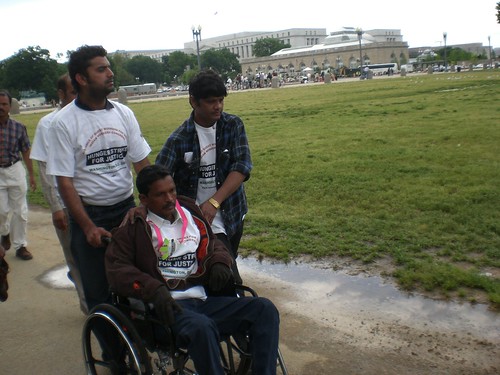
So since May 14, about 30 workers went back to D.C., escalating their campaign into a hunger strike, where 5 workers swore off of food until their pleas for intervention and justice were heard. It has been 9 days. While more workers have come from New Orleans to join in the hunger strike and/or to participate in actions this week, three of the original hunger-striking workers have been hospitalized, and it’s not really clear what the end point to this process will be. There are a number of supporters who have been around the workers in D.C. from the beginning, but they are tired, and morale seems low.
From a distance, and perhaps to the bookish/armchair revolutionary who longs to be part of an epic struggle against the oppressive state like third world uprisings around the world and even the attempts in the America of the 60s and 70s, the workers’ struggles and brave actions may seem heroic and completely worth supporting: this is the people uniting for a common cause against oppression after all. I know I felt that, even though I haven’t had any real connection to what’s been happening.
But I’m also beginning to wonder about some things, particularly with the organizing strategy. I’ve heard Saket Soni speak a couple of times in person about this campaign, and I’ve seen a bunch of videos through the campaign blog where you can hear his rhetoric and see the strong united front of the workers behind him. He hits all the right notes, connecting this terrible situation with the legacies of slavery and indentured servitude. He rallies the workers behind him and gives what seems to be adequate space to hear the workers’ voices and stories. It is hard not to admire an organizer who is fighting something that is this criminally unjust, and it is easy to hear the workers’ individual stories and think that while they are the brave people taking the risks, the organizers are critical to help them achieve justice.
But what’s really going on here? While the work of the New Orleans Workers’ Center for Racial Justice seems to be legitimate, and the workers seem to be participating, are people asking critical questions of this campaign? For example, the workers are seeking continued presence while their trafficking claims are investigated – at this point, their immigration status is not clear, and when pressed by media or others, the organizers, Soni in particular, state that “it is our belief that they are the victims of trafficking and should be granted continued presence in the United States.” That’s fine – but what is their actual status, and what risk are they running by being explicitly visible? I’m not saying they should hide and let the corporation get away with this – I’m asking if the workers realize that if they are found to have unlawful presence and are deported by ICE, they could be prevented from re-entering the U.S. for up to 10 years. This is a real impact that they should know: but does it run counter to the organizing strategy, and therefore, is it diminished in importance when the workers are briefed before making decisions?
As a second point, what is the narrative that they are crafting with this series of actions? Calling the bus journey from the South a satyagraha sounds great – invoking a particular (innocuous old man) image of Gandhi that may rally South Asians (or at least garden variety liberals) to the workers’ cause. It’s good media sense to tap into something familiar this way and invoke that the workers’ struggle for justice is neither isolated nor unfamiliar to South Asians. But then is the hunger strike a natural step in the actual organizing campaign, or is it the next step to get the press interested? Who are the targets that are supposed to be moved by this hunger strike?
1) The DOJ isn’t going to bend for this one case – no matter how egregious – because that sets it up to do the same for all of the other folks in similar or even more dire situations.
2) The Indian Embassy is too concerned about India’s endgame to wedge itself between the U.S. and Pakistan, get on the U.N. Security Council, and get recognized as a world nuclear and economic superpower with the help of the U.S. It’s not going to jeopardize those goals with the U.S. on account of these workers, no matter how terrible the situation. Let the U.S. courts sort it out: there’s big business to attend to.
3) The Congressional targets need to be made much more directly aware of the crisis and how they can intervene by pushing for an investigation and looking at the H2B program as a whole. But I can’t really see action alerts for allies to raise the pressure, and will the targets care if non-citizens are starving themselves for justice when they have constituents (and voters) who may be anywhere from ambivalent to wholly hostile towards migrant workers “taking their jobs”?
Basically, how is the hunger strike going to move hearts and minds, and if it’s not, why the hell are you endangering the workers’ health, safety, and ability to stay in the country for non-achievable goals (within the context of this particular timeframe).
On top of these strategy questions, which may be discussed internally and not disclosed to the rest of us, I also want to ask the question of how much power the workers actually have in making these decisions. It seems like they support Saket Soni and the Center, but what do we know? And what I’ve seen from desi and other left groups is fairly uncritical – just either staying away from the issue, or just forwarding along the information as an FYI. Has anyone actually directly asked Soni and the other organizers from the Center about this? My contacts who have visited the workers a few times have said that the workers have a lot of questions about the effectiveness of this campaign, the plan for the future, and legitimate concerns about how this whole thing has been managed, but that the questions are deflected internally, and things haven’t changed.
Are we giving Soni a free pass because he’s a man of color who is working with co-ethnics rather than a white wo/man in a community of color? Is he getting that free pass from white “progressives” who recognize their own privilege/are fearful of being called out and so they don’t criticize/come out publicly, and brown/black/yellow “progressives” because there is always a question of our own legitimacy in this kind of work, regardless of the racial/ethnic bonds we may have with the communities that we work with – and we don’t want the tables to be turned and the microscope to be on us and our work?
But what about the workers, then? Is the cult of personality enough to protect someone and his possibly flawed and dangerous strategy – or should we recognize that we too would be partially responsible if something terrible – that was avoidable – happens to the workers after they’ve taken the brave steps to leave the abusive work conditions and speak out? Why aren’t more people asking these questions instead of just “supporting” the struggle? Are we supporting the idea of the struggle – or the workers who are taking this effort on their backs: is it the same thing?
Apr 22, 2008
Choose One? False Choice.
This post will not be news to the few and faithful readers, but I'm going to post again to pile on about how annoying it is to be around otherwise fairly smart people who have been wholly co-opted by this false set of "choices" presented to us in the corporate duopoly (hat tip, Chedda) in which we reside.
Basically (stop me if you've heard this one before) I was at a nice dinner with some folks, as a bit of a send-off before we graduate. Somehow, the Pennsylvania results came up, and someone asked me who I was supporting. When I said "still deciding between Nader and Mckinney," I got dumped on. "ohhh - you're voting for McCain" and "We saw this with Bush in 2000." I wanted to be quiet, I didn't want to engage. But it's just not easy.
"My people come from a country with 500 political parties, so I'm okay with breaking out of the so-called two-party system we have here." End good night out with decent people. This is why it's getting harder and harder to mix "progressives" with "radicals."
Oct 25, 2007
The Desi "Left"
Dear DotBS readers - thanks for your patience as it's taken me a while to get back into the swing of things. I can't promise that I'll be posting regularly here on in, but this Bobby J bullshit has me angry on a lot of fronts. I wrote briefly about the desi right/"ethnic pride" contingent last post, but I'm also really pissed off at the so-called desi left. I've read some chatter that seems to think that the way to go for community organizations in reacting to the Bobby J election is to just reject his election outright and make out a laundry list of issues with him. While I think that's appropriate for individuals (but where the fuck were you at when the bastard was running?!), I don't know if it's the best use of organizations that can reach the movable middle. I can't believe that yet again, we're back to this issue, which I touched upon here more than a year ago.
A lot of these people on the so-called left tend to be unaffiliated (or loosely affiliated with the white left or a loose band of disgruntled and disaffected desi radicals) and fairly green in strategic work to build broader movement than their four vegan friends talking Marx while not listening to M.I.A. on their new iPods. There's a conversation unfolding on ASATA (Alliance of South Asians Taking Action) list serv in the Bay Area, where people are conflating all of the responses out there with the idiotic release by APIA VOTE and some of the other crazies I mentioned above. A few individuals, who have likely never actually run an organization, and probably don't even know how to build consensus with people that display any variation in their political beliefs, wouldn't know how to reach out to people who look at the Jindal election as just another example of achievement if it people were reaching out with open arms.
Ever curious why this small group of people is surly, unhappy, and usually spending more time complaining about how folks are not left enough than building bridges and building movement? I don't know about you, but I doubt that Rinku Sen, Vijay Prashad, Bhairavi Desai, and a bunch of the other folks they look up to and idolize are wasting time trying to out-left everyone else in the community. And I'm sure there's more strategic value in having groups that actually have some ability to reach that movable middle put out statements that actually urge them to think a little and do some research so that they come to agree with us. But no - the so-called desi left (or should I say, self-proclaimed) remains a fringe, disorganized clique that isn't connected to movement building in any substantive way.
Yo, brothers and sisters, READ CAREFULLY. Think about strategy - preaching to the converted will not build our movement. If you're so concerned about the community's right-leaning tendencies, especially given the conservative tendencies of people who rapidly accumulate wealth, then think about how we can reach and educate those people - or do you just think it's not worth it? Do you just think that you're better than "those people" because your politics are so bulletproof? That's BULLSHIT.
At the same time, I don't see this kind of reaction to desi left's patron saint, Vijay Prashad's muted statement in the NY Times:
“The fact that he’s of Indian ancestry is a subject of jubilation,” said Vijay Prashad, professor of South Asian history at Trinity College in Hartford, speaking of the way Mr. Jindal has been portrayed in the Indian-American press. “But there’s a very shallow appreciation of who he really is. Once you scratch the surface, it’s really unpleasant.” NY Times, October 22, 2007, A Son of Immigrants Rises in a Southern State, [link for now].Why is it that people feel inclined to shoot down our own groups as "not progressive enough" when they aren't willing or able to provide any compelling alternative that will actually appeal to more than 3 people? Don't they see that they are just doing the same thing that these groups get hit by from the far right? What difference do they bring - and what legitimacy do they have? I'm so sick of armchair liberals. They're not interested in real change, just trying to justify why they are taking up space. Read More......
Aug 9, 2007
What's in a Label?
I've been stuck in my own headspace for a while - haven't craned my neck outside of my cave long enough to take a look and see what else is going on, or has been going on. I think while I want to get away from just focusing on the humdrum of ordinary life, I also don't want to go too negative on groups in the community (unless they're being stupid). After all, there's plenty of work to do, people are generally well-meaning, and the thing about blogging is, it's easy to write something scathing without doing adequate "real reporting." In other words, really interviewing people, getting more sides to the story than my own casual view (askance?) in their general direction, yadda yadda.
That doesn't mean I don't have opinions, or that they aren't valid, but it's also true that it just takes a few forwards and suddenly one person's opinion (with the added benefit of relative anonymity) becomes an unnecessary fire that a group has to put out. What's the point in all of this? Is it really the role of opinion vigilantes to take up the bandwidth with their marginal viewpoints and take away from people who are actually doing the work? Ultimately: not important enough. I recognize that I'd much rather be doing work than criticizing others. So... with all of that (a little bit of a reflection on where I may be going with my own orientation to community - school has taken me out of the mix long enough to remind me how much I want to be back in it - and that I don't want to cut down, I want to build up, as I think I've been repeating ad naseum lately).
Anyway - I've been thinking about what it means to be "progressive" in the Asian American community. Do I really want to use the word "progressive" to define my politics? What does that mean? Is it beyond "liberal," which in itself is getting pushed to the margins of where American political life (or at least what's on display) wants to be?
Want to mark a Democrat? Call them a liberal and laugh as they try madly to dash off the label like it was a mad hornet. But "liberal" doesn't seem appropriate for me. What's the next step from there? Is it "progressive"? Is there something beyond these terms that isn't quite at "radical" - not because I don't want to be there, but because I think it may be presumptive to put it out there that I consider myself closer to radical than "liberal"? Or is "radical" where I am, and "revolutionary" is where I'm headed? Who knows. But in this land of pre-pre-election chatter, I wonder what the political landscape of left-o-center Asian America looks like, at least on the net.
Let's take a look...
South Asians for (insert candidate here). Still working/worked by the system. Middle of the aisle all the way. Not that it's particularly wrong. It's just not my thing. I mean, let's not all be tools now. But I covered this already.
APAs for Progress. This group seems like it's got some good ideas - I really like the 25th anniversary of Vincent Chin idea. But they're also playing the whole "participation = voting/election power" thing. I don't really agree with that as the angle - focusing on legal constructs of citizenship cuts out more than 60% of our community which is non-citizen. Following that up with "we should naturalize them all!" is also not helpful, given that a lot of people have their own reasons for not naturalizing, and really, should our rights flow from legal status with the nation-state, or status as individuals or members of groups within the nation? Citizenship can be taken from you just as easily as it's given, but your personhood is yours. So, I have issues with this focus. And isn't this just some other side of the 80-20 coin? I mean, you say progressive, I say liberal, the other guy says "whoever will listen to us" - what's the difference?
I'm not going to go into the other groups right now, because I'm shooting for shorter pieces that people can actually read. But this question of what constitutes "radical", "progressive", "liberal", and "revolutionary" was around for me for a while. I'm come to just toss the labels, as many people claim to do, because they aren't that helpful, especially when so many people have different thoughts about what they mean anyway. But I get sick to tears of people buying into electoral politics as the saving grace for our communities and the work that should be prioritized. It seems like such a top-down, privileged way of looking at what's important and what people care about.
May 25, 2007
Organizing - School/IRL.
I really enjoyed the tail-end of my student days in college, feeling like I'd finally found a community amongst the student government and Asian American junkies. Looking back at those days, the student government stuff was probably the most "political" of the work, with identity-based conversations that would quickly be realized as basic taking up the bulk of my time in the Asian American spaces at school. More than 10 years later, and I'm again involved in student organizing, but this time I definitely feel more like I'm realizing the dream I had to be at the forefront of some kind of movement in undergrad. Here, I feel like with the wave of work that we're doing should be deeply related to the work that I want to do when I graduate, and also embraces some of the spirit of work that I'd learned and thought about while an undergrad in a state school. About documentation and development of a strategy. About accountability and building a student movement that will go beyond the semester, or even the year for its organizing schedule, calendar, and strategy. That we can break the cycle of stall tactics that the administration knows will eventually weather any student activation around issues, based on attrition because of short attention spans, graduation, and competing interests. But when you integrate alumni organizing in the mix, suddenly you're in a place where the graduations don't help the administration anymore, because now you have angry alum with money to donate, time to commit to a committee, and a stronger sense of purpose because of denied/thwarted efforts as a student. If the right elements are combined, the nature of movements take over.
But I do miss being around very active, radical Asian Americans. The legal profession leads people to take more "rational" or tempered paths. A friend once said that I would be entering a profession that is natively more conservative. I didn't know what to make of the comment when he made it, but I definitely feel it a lot more now, even at my law school, which is anything but conservative. it's just the way that you start to think about things - using a "rational" approach towards problem-solving, and even problem identification. "Choosing what battles to fight" seems like a theme that runs through a lot of this work. And I feel like the restrictions of the bar upon your ability to do what is in your conscience (as I've learned in my last couple of classes of ethics) is also a harsh reality that you have to face. Sanctions charges and possible disbarment seem like incredible disincentives for people thinking to engage in more direct action or anti-establishment work. Can you be "out" as an anarchist and a lawyer? Can you be anti-establishment and still practice law?
After all, the revolution will not be realized by some kind of Supreme Court epiphany. The nature of stare decisis, of precedent, of basing so much of our legal practice on English Common Law are all inherently conservative characteristics of our system. That doesn't mean that it isn't a good thing some of the time - consistency and fairness are important goals if the system is to build any faith in the people its meant to govern/reside over. But that doesn't mean that we should just accept it and the conservative/anti-revolutionary standards that it imposes upon us. Shouldn't we have some kind of choice of the system we live in and the definitions of justice that govern our everyday existence?
So as my thinking slowly evolves and breaks free from the middle class conservatism that comes naturally (no matter how often we call ourselves "liberals" or "progressives"), the question becomes, how much of this is about self-image and hype, and how much of this is about movement-building? Do we have to put ourselves and everything on the line all the time to be "real"? I don't know - as time goes on, you accumulate stuff - not material things, but obligations and hesitation, I guess. It's when you're young that you feel you have little to lose - and honestly, more of us should feel that way later on in life. Otherwise, none of this shit is going to change. But it's a leap to take.
WTF. This post started okay and turned into some kind of stupid therapy session. Over and out.
Jun 25, 2006
Blah.
In the forever barrage of endless, useless media, I've pretty much checked out. I don't read the news anymore. I don't read blogs at all anymore. And I don't have cable, so I am stuck with the insufferable, subpalpable pulp they feed you on network TV. So you have little rehash of the news here, and really, little of anything else.
I have been thinking about what I want to do with my training, and with my energy. I want to stay positive about change, about committing myself to something I can care about for the long-term. Something that releases me from the unnecessary distractions of personal achievement, and/or ego. Something that allows me to grow with a community.
I've grown deeply tired of the endless bartering of positions, and stakes, for communities by people who don't give a damn about what happens in the end. Faceless, baseless politicians, national think tanks and "policy" groups, and the whole lot of groups that don't speak to local stakeholders, nor dig in long enough on issues to watch and learn how they evolve and peel away at the lives of simple Americans trying to live.
I am tired of white liberal America, wherever and whatever that is. They are too busy trying to stake a safe ground to even issue statements that would be deemed "PC" (and I hate that constructed, fake, conservative term with a passion) by their emboldened opponents. The rabid right aren't afraid. And you know what? The white liberals have always been aware that the closet racists and xenophobes in their camp are not isolated. And they know that the not-so-happy contingent will come out and speak in their privileged circles away from the press and the microphones. To the point where liberal = an uneasy coalition of people who still harbor their range of untrained, under-exposed, biased opinions and privileges. While I don't think that the Democrats are anywhere close to liberal, I definitely don't think that liberals are all that hot either. And the coalition of separate interests, bruised egos, and personal ambitions make it more a group without vision, or the ability to forge a vision in the smithy of collective passions.
I am tired of the bitter, raging, and almost always negative progressives and radicals of color. The world and system are fucked up. Stop bitching. Fix that shit. And stop screaming about all the people who aren't conscious yet. The movable middle will not be moved by threats, doomsday, or insults. Heart moves people. Personal connections move people. Not re-spewed rhetoric and statements like "they're fucked up. What are you doing?!"
Anyway - not that I'm in a great position to bitch about people, but *sigh* Need a little positivity in light of all that's here. Life is short, and staying in this for as long as we can has to be worth it in some way - we have to feel like we're in a movement, that moves people. And a movement that is uplifting, a conscious party to change things and revive the spirit of possibility. I'm in this work and this life because of the personal connections that brought me here, and the spirit of ancestors - not only my own - that have struggled and won. And I can't dishonor their memory with dreams only of doom. We have work to do, enit?
Aww, whatever. It's Sunday, and the world is watching World Cup. Força!