

As I prepare to enter the nonprofit world full-time again in the next couple of weeks, I'm reminded that nonprofit organizations have a tendency to undervalue and underpay their staff. At a former employer in the Asian American community, I had a starting salary of $20K out of college. It was my first gig, and I was thankful to have a job, but that's pennies in NYC, even back then. And I was told that there was nothing else they could squeeze out. Honestly, I find that hard to believe - adding even $500 as a "bonus" makes a big difference, at least in the valuation of your work.
Nonprofit staff work like crazy, get paid shit, and don't get the additional perks that firms and other places dish out. I remember what it was like. I tried, when I was in a position of management, to give those little perks to my staff (and the staff of other community nonprofits) when I could. Getting free tickets through board members and other friends of the organizations, trying to give certain unexpected times off or mid-day mixing it up (we had the whole staff go out to see a movie premiere in the middle of the day once).
Regardless, I've been in the field for a long time, and re-entering it now, I'm finding that salaries have not changed much since then. It's kind of sobering. This issue is much more pronounced for public interest lawyers (though I think organizers have it even worse). A new staff attorney at a non-profit in NYC may make something between $35K and $40K. The starting first year associate in an NYC firm will start, off the bat, with a cool $165K. The disparity is incredibly grim. And the American Bar Association isn't doing much to address it.
At least for social workers, the National Association of Social Workers has lobbied to create a base starting salary that groups have to meet to gain accreditation (I think). Something like that from the private bar would really help public interest lawyers out. But it's just not what is done. So as the cost of living continues to rise, we're forced to smile and say nothing (well, I guess we can say something, but there isn't much hope for change).
More broadly, I'm concerned that low salaries directly affect retention and internal development of leadership with the new generation of community workers. If you aren't making a lot, how long can you stay in the work, particularly with the pressures pushing against affordable housing and cost of living in city centers where most of these jobs remain?
Add to this what I've heard about the new generation (take it as you will, since it's from other older fogies like me): younger folks tend to be more impatient, and possess a sense of entitlement that gets in the way of taking their lumps or playing the game until the right opportunity arises... and I don't know what the leadership for Asian American nonprofits will look like in the future.
I certainly don't think it will come from people who were committed full-time to the "movement." Maybe that's not a bad thing - moving us away from that tendency towards the professionalization of movement work ("I need the MPP from Harvard to do community policy work"). Then again, it could mean that people who don't have the field experience or feel, could move in from the professional schools to take over (though these low wages may prohibit that from happening). What do you think?
Aug 23, 2008
Proletariat Nonprofit Blues

May 23, 2008
Mississippi Workers Hunger Strike: Day 10... to what end?
 At this point, many people in the progressive desi/Asian American community have heard about the Indian H-2B workers who were brought in to work at a shipyard in Mississippi for post-Katrina rebuilding. They faced brutal, abusive conditions, and it’s pretty clear that they were trafficked – misled by recruiters to pay thousands of dollars on a fraudulent assertion that they would get permanent residency and the ability to sponsor their families within months. There are much better accounts of this, such as this excellent recent piece by Svati Shah in SAMAR Magazine, so I’m not going into details here.
The basics details: some 100+ workers (of the total 550 at Signal International) walked off the job at the beginning of this year, risking so much but stepping up because they couldn’t take it anymore. They had connected with the New Orleans Worker Center, headed by (young) South Asian leftist Saket Soni from Chicago. The workers have since engaged in a number of actions, including a satyagraha “march” from the deep South to Washington, D.C., where they stopped to meet and build solidarity with civil rights leaders and African American communities on the way. They rallied in D.C. and presented their requests and demands to the Indian Embassy (for the Indian government to intervene on their behalf as it has with nations in the Middle East), DOJ (for the granting of continued presence status), and members of Congress. That was at the end of March. And nothing moved between that time and May.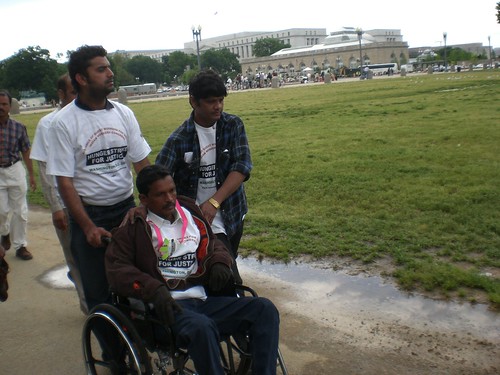
So since May 14, about 30 workers went back to D.C., escalating their campaign into a hunger strike, where 5 workers swore off of food until their pleas for intervention and justice were heard. It has been 9 days. While more workers have come from New Orleans to join in the hunger strike and/or to participate in actions this week, three of the original hunger-striking workers have been hospitalized, and it’s not really clear what the end point to this process will be. There are a number of supporters who have been around the workers in D.C. from the beginning, but they are tired, and morale seems low.
From a distance, and perhaps to the bookish/armchair revolutionary who longs to be part of an epic struggle against the oppressive state like third world uprisings around the world and even the attempts in the America of the 60s and 70s, the workers’ struggles and brave actions may seem heroic and completely worth supporting: this is the people uniting for a common cause against oppression after all. I know I felt that, even though I haven’t had any real connection to what’s been happening.
But I’m also beginning to wonder about some things, particularly with the organizing strategy. I’ve heard Saket Soni speak a couple of times in person about this campaign, and I’ve seen a bunch of videos through the campaign blog where you can hear his rhetoric and see the strong united front of the workers behind him. He hits all the right notes, connecting this terrible situation with the legacies of slavery and indentured servitude. He rallies the workers behind him and gives what seems to be adequate space to hear the workers’ voices and stories. It is hard not to admire an organizer who is fighting something that is this criminally unjust, and it is easy to hear the workers’ individual stories and think that while they are the brave people taking the risks, the organizers are critical to help them achieve justice.
But what’s really going on here? While the work of the New Orleans Workers’ Center for Racial Justice seems to be legitimate, and the workers seem to be participating, are people asking critical questions of this campaign? For example, the workers are seeking continued presence while their trafficking claims are investigated – at this point, their immigration status is not clear, and when pressed by media or others, the organizers, Soni in particular, state that “it is our belief that they are the victims of trafficking and should be granted continued presence in the United States.” That’s fine – but what is their actual status, and what risk are they running by being explicitly visible? I’m not saying they should hide and let the corporation get away with this – I’m asking if the workers realize that if they are found to have unlawful presence and are deported by ICE, they could be prevented from re-entering the U.S. for up to 10 years. This is a real impact that they should know: but does it run counter to the organizing strategy, and therefore, is it diminished in importance when the workers are briefed before making decisions?
As a second point, what is the narrative that they are crafting with this series of actions? Calling the bus journey from the South a satyagraha sounds great – invoking a particular (innocuous old man) image of Gandhi that may rally South Asians (or at least garden variety liberals) to the workers’ cause. It’s good media sense to tap into something familiar this way and invoke that the workers’ struggle for justice is neither isolated nor unfamiliar to South Asians. But then is the hunger strike a natural step in the actual organizing campaign, or is it the next step to get the press interested? Who are the targets that are supposed to be moved by this hunger strike?
1) The DOJ isn’t going to bend for this one case – no matter how egregious – because that sets it up to do the same for all of the other folks in similar or even more dire situations.
2) The Indian Embassy is too concerned about India’s endgame to wedge itself between the U.S. and Pakistan, get on the U.N. Security Council, and get recognized as a world nuclear and economic superpower with the help of the U.S. It’s not going to jeopardize those goals with the U.S. on account of these workers, no matter how terrible the situation. Let the U.S. courts sort it out: there’s big business to attend to.
3) The Congressional targets need to be made much more directly aware of the crisis and how they can intervene by pushing for an investigation and looking at the H2B program as a whole. But I can’t really see action alerts for allies to raise the pressure, and will the targets care if non-citizens are starving themselves for justice when they have constituents (and voters) who may be anywhere from ambivalent to wholly hostile towards migrant workers “taking their jobs”?
Basically, how is the hunger strike going to move hearts and minds, and if it’s not, why the hell are you endangering the workers’ health, safety, and ability to stay in the country for non-achievable goals (within the context of this particular timeframe).
On top of these strategy questions, which may be discussed internally and not disclosed to the rest of us, I also want to ask the question of how much power the workers actually have in making these decisions. It seems like they support Saket Soni and the Center, but what do we know? And what I’ve seen from desi and other left groups is fairly uncritical – just either staying away from the issue, or just forwarding along the information as an FYI. Has anyone actually directly asked Soni and the other organizers from the Center about this? My contacts who have visited the workers a few times have said that the workers have a lot of questions about the effectiveness of this campaign, the plan for the future, and legitimate concerns about how this whole thing has been managed, but that the questions are deflected internally, and things haven’t changed.
Are we giving Soni a free pass because he’s a man of color who is working with co-ethnics rather than a white wo/man in a community of color? Is he getting that free pass from white “progressives” who recognize their own privilege/are fearful of being called out and so they don’t criticize/come out publicly, and brown/black/yellow “progressives” because there is always a question of our own legitimacy in this kind of work, regardless of the racial/ethnic bonds we may have with the communities that we work with – and we don’t want the tables to be turned and the microscope to be on us and our work?
But what about the workers, then? Is the cult of personality enough to protect someone and his possibly flawed and dangerous strategy – or should we recognize that we too would be partially responsible if something terrible – that was avoidable – happens to the workers after they’ve taken the brave steps to leave the abusive work conditions and speak out? Why aren’t more people asking these questions instead of just “supporting” the struggle? Are we supporting the idea of the struggle – or the workers who are taking this effort on their backs: is it the same thing?
Aug 19, 2007
She Tends a Child Who Looks Like Her Employer
Picking up on a theme from last week...
They say that society is now equitable and that people of color have access to everything because overt racism is dead. But we live in a nation where generations of white kids see women of color as their caretakers, their companions, and ultimately, direct reports to their parents. Perhaps the key difference from slavery is that instead of just black slaves who primarily spoke english, the caretakers come from all over the world and speak many native languages.
You'd hope that this could open the minds of the children when they grow up, or even in their increasingly diverse school environments, to be more likely to embrace the polycultural spaces of urban america, but who knows. Lessons in power seem to come very early for kids - it seems like it takes a lot of work to deprogram them from assigning roles and value to their parents. I can't imagine that it's different for their caretakers, and I doubt many parents are saying "don't think of her status as below yours."
Modern day, yuppie aristocracy. Without many of the paternalistic tendencies of past generations, where hand-in-hand with slaves/servants not having the right to self-determination or freedom, some of their "masters" felt some responsibility for their well-being, in a weird, twisted way. I don't know if that's true now - labor has become even more disposable with the willing and desperate thousands needing to take jobs that take them away from their own kids, to tend to the privileged. Inequality can be measured in the benefits "professional" white women get from using the labor of women of color to facilitate their career advancement.
Clearly it's not just women, but if there is a sisterhood argument to be made over race, it still has to overcome the formidable barrier of class.
Feb 11, 2005
Living Wage, pt II and The Year of Change

i wanted to pick up on my previous post about working wages in movement orgs. There's also a sense that many folks with partners have some agreement where one of them makes mondo money while the other becomes a professional do-gooder. We know of so many examples of this - and it calls to question what happens when both folks want to do socially conscious work, and neither wants the other to give up their passion. Do we inadvertently have to struggle just to make ends meet? Or do we have to find some space between the two of us in which one has to give up the things that he/she believe in, to ensure that the institution that you share between you remains viable, rather than worrying about the same for an NGO or a cause?
We've found a good balance for us - more of a "we've both got to stay true to the work that we feel that we have to do." However, I feel that my pending decision to go to school for three years is going to test that balance in a significant way. There is much planning to do to make sure that we're not wiped out and burnt out at the end of that next phase.
But I'm getting more excited about change. I think that the trip to Washington made me more excited as well, even though I didn't get a chance to spend much time thinking about being local and what that would mean, I at least had the chance to be in the environment again. The prospect of working in communities that are wholly new to me is scary and invigorating - the prospect of working in communities and settings where things are just getting off the ground, where the deep-seated bitterness and antagonisms that gum up coalition-building in NYC are largely absent, is very appealing. Being a student in that environment may allow me to explore organizing and other skills in community-based work that I haven't been able to develop as a working staffer.
The prospect of leaving the comfort of a place that feels like home no matter how random or wonderful is frightening.
So emotional moderation is the key, at least until we make a decision.
Feb 3, 2005
Brother, can I get a living wage?
Sony NetMD Blastin':
Opeth: Deliverance
Iron Maiden: Live After Death
Testament: First Strike Still Deadly
Got into a conversation with Boogie, an old friend and ally, via AIM about the crappy wages and long thankless hours that movement organizations force their staff to endure. D had just gone through a workshop about taking what you need to make sure that you can do this work for the next 30 years, and I don't think that slave wages were part of the equation. But it seems that more groups than not don't take their workers welfare into account when doing their accounting. In a lot of ways, this is wholly hypocritical of organizations claiming to fight for social justice. Happiness starts at home. Or more appropriately, do unto your own as you'd have the world do unto its workers.
So why do so many of these organizations pay such low wages? Part of the equation is clearly that the work itself is not valued on the market, and thus organizations have a hard time rustling up the funds to pay a decent salary to their workers. But I sometimes think that a part of it is also a whole culture of struggle that's taken over the consciousness of the conscious. That you aren't completely legitimate if you aren't really suffering, like "the community." At times it feels like an over-idealization of the state of the have-nots, that status in the movement is inversely proportional to your comfort in your personal life. That "the struggle" has to be more than a metaphoric or representative condition, but instead must be a much more literal struggle in your own daily life. Hyper-reality, perhaps, especially as more and more privileged folks with professional credentials enter the field and displace some of the folks who actually hail from the communities that the movement hopes to organize and bring towards self-determination.
It's not that I fully agree with the notion that authenticity in the movement only comes from going through the physical struggle in your past. But I definitely don't agree that you have to struggle while doing the work to be considered authentic. And how are we supposed to sustain this movement and recruit and train new leaders if we burn through ourselves by pushing ourselves at the brink of tolerable working conditions? Is it a wonder that so many people burn-out and drop out of sight for stretches of time or even for good? We have to critically evaluate the way that we treat ourselves and those around us in this work. Or else we'll end up with a lot of bitter, disillusioned drones, and the wrong side will have won the larger battle.
You cannot win the larger struggle by having pissing contests with your allies about who's a more authentic advocate. Let's focus, people. And let's build a conscious movement that takes care of everyone who shares in its vision.
UPDATED:
I just remembered two other things that I wanted to include in this. First, I'm fortunate that I work somewhere that pays competitive wages in the nonprofit sector. I may bitch about leadership and mission drift and the detachment of the org from reality, but I definitely have to be thankful that I'm being paid for that privilege. Second, part of what fueled this strand of writing was a site visit that we conducted with a group that we work with last week. The executive director told us that the board voted to cut senior staff's salary by 1/3 so that the organization could move into a more accessible space for the community. That's honorable, but the salaries were low to begin with. He told us that he made $20K in 2004. That's just ridiculous. You can make more working in a bookstore.