

It's funny how we have to search for our collective histories in the dusty corners of second-hand bookstores (which is where some of the old-timer API* literature heads first found John Okada's classic novel "No-No Boy"), or in the fading stories of elders and first generations of immigrants (like the oral history projects that have documented in pieces what early life for Asian immigrants was like), on the falling walls of the first immigrant detention centers (poetry carved into the walls on Angel Island), or even by dumpster diving in Chinatowns to preserve original signs from the and artifacts from the roots of our communities here.
We're always forced to look to the margins, and nowadays, with the cannonization of "Asian American History" and "Asian American Experience" by the academic elite, we sometimes have to look to the margins of these margins to find real stories, real talk, real struggles. So much of what people do - everyday struggles, victories, cultural evolutions, micro-movements, are lost in history. The act of documenting is in itself an act of filtering and valuing different things, casting aside and away some things or keeping them in boxes because a linear narrative is easier than the complex and often contradictory one to write and to use for whatever purpose we have in mind.
But what's lost in that process? How many moments, connections, and transformations don't make it into the books? It's not simply about the need to see yourself or the things you know in these historical accounts of times we've been through, but because the personal stories, the small steps, are what future generations can latch onto: the big movements and red-letter-days are few and far between. As they've said over and over about the Civil Rights movement, for example, it took a lot more than the iconic, memorialized moments (what broke the camel's back: one straw or the thousand that came before it?) to create what happened.
In our inability to really take the time to capture these things, and because every day is potentially full of moments worth documenting, are we building the stories to carry the next generation forward, or just singular narratives that simplify what has really happened in our time? Living in the margins (of the margins) do we run the risk of losing the complexity and varied intersections of these times in API* communities and community building altogether?
May 14, 2009
API* Heritage Post #14: Preserving History

May 13, 2009
API* Heritage Post #13: The Next Generation
Just when you think you can lose hope for the new generation of students coming up through colleges and graduate schools, the summer interns begin at your organization, and you realize that there are still folks with that fire in their belly for community work.
Our first intern started this week at my workplace, and she fit right in. Her personal story is one thing, but to see that a young person has so much energy, enthusiasm, and even the sheer will to learn is a really encouraging thing. I know friends who have become embittered about the excesses of young people, or even their disinterest or entitlement (I'm sure I've written about this here too). But I definitely feel like that's only one piece of the puzzle: there's hope out there. And it may be all the hope our community really has, if most of my generation is bitter now.
May 11, 2009
API* Heritage Post #11 & 12: Jean Shin and Hope for Asian American Art
This year, in an actual attempt to really observe API* Heritage Month, I'm trying to put up a post a day about what that means to me. Click the tag for API* Heritage to get the whole series.
Saturday's post gave a tiny piece of context for a little review I wanted to share about artist Jean Shin's show at the Smithsonian American Art Museum, which I got to check out while in DC yesterday. First, Jean Shin came to the U.S. with her folks from Korea when she was 5. They settled in the suburban Washington area, and she eventually moved to NYC to pursue her career as an installation artist.
She has been featured in a number of different places in New York and around the nation, but this is (to my knowledge) her first significant show at a Smithsonian space. Smithsonian = free, so I made an effort to get to the city and check this one out.
Basically, this show is remarkable. I strongly recommend it to anyone who is in DC or planning on visiting there at some point before the show closes in late July. I'm hoping to go down to the show again before it closes, and definitely want to check out more of her work in the future - there are some permanent installations in NYC, actually.
Jean Shin takes ordinary items, amasses huge quantities of them, and does something quite interesting with them as part of an installation piece. Her thoughtfulness, her connection between the work, place, relationships is really fascinating, and while the work may seem initially abstract / "modern" (in the pejorative sense that people often use for art created principally for the sake of the artist), there's a lot more going on there.
Everyday Monuments is the piece that's new for the Washington show. She collected more than 2,000 athletic trophies from residents of Washington DC, which she and her staff painstakingly modified one at a time, removing signs and indications of the sport, and replacing the props held by the figure or the implied motion with something that represents an unheralded job or occupation. Where once there was a hockey stick, there is now a broom or a shovel. A football player's pigskin is replaced with a book. Trays of food and drinks, garbage cans, plungers, tires, paint brushes replace balls and other implements of sport, and fill empty hands that were supposed to represent the second after a free throw was made.
Taken one at a time, the pieces are interesting, funny, and innovative. Taken all at once in the context of Washington, a city filled with stoic monuments to people and times that sometimes mask the full scope of loss, complexity, and the many people who make any movement/moment in history, the work is revelatory. The title, "Everyday Monuments," and the deliberate placement of the work within a scale representation of the National Mall make the artist's intentions clear: she is highlighting the unsung heroes of our society, their labor building the foundation for all other great acts to follow. The fact that she and her staff had to physically alter the figures, sometimes removing limbs or torsos, is also quite symbolic of the transformation and losses that laborers often endure, which are often not fully evident when you just look at them (i.e. the very specific condition of immigrant laborers, who often perform their demanding jobs with torn and still raw familial and other connections that they have left behind to work, usually without much choice).
Why is the work so compelling? Because Jean Shin is a very thoughtful artist, and the scale and ambition of her work is extraordinary, even though multiple pieces fit into a relatively small gallery space. Another piece explores the interconnectedness of the Asian American arts community in 5 or 6 cities through a physical "mapping" of relationships by threads linking sweaters arranged on walls that have been donated by more than 200 other API* artists in the cities where the piece has been exhibited. The use of physical space and the direct engagement with the API* community immediately frames her sensibilities as directly linked to
the "community" even if all of her work does not derive solely or directly from those links.
It's probably this fact that leads me to believe that in many ways, this imagined, fractured community we still talk about is most evident, seems most real to me, in creative and arts spaces, where the communal is personal, and where both inform the political, but the discourse between the three and the outside worlds are seldom simple or just reduced to the uncritical space of "solidarity" amongst people. Even work that is not politically radical often explores boundaries, borders, definitions, and complex questions of belonging, heritage, and even worldview in ways that our political discourse and movement building have not been able to do since these conversations began more than 40 years ago.

May 10, 2009
API* Heritage Post #10: Thanks Mom
I wasn't able to spend this Mother's Day with my mom, and frankly, I've not been able to spend as much time with Mom as I should over the past couple of years. As I talk about "API* Heritage" this month, I realized that I should first think about my personal heritage, and what I've received from my Mom and family.
Rather than go on here, I'm just going to say "thanks, Mom." All that I am able to write or pontificate about, all the space that I have for myself to question and reevaluate where I am, and what this imagined, fractured community is, is because you've given me that space. You haven't pushed me to do more than be happy, and to do the best at what I can in whatever I care about. You stress trying to be a good and honest person over blind passion for some kind of cause, but you understand when I go a bit overboard. You've given me tools, but I'm still learning how to use them.
Regardless, thanks mom. Even if I can't talk about all these little things that take up space in my head with you, you forgive my many faults, you listen and even repeat some of the things that I tell you, and you don't ask much from me at all, though you really could. The heritage that I don't question, and that which I am proudest of, comes directly from what you've given and taught me over all these years.
May 9, 2009
API* Heritage Post #9: Asian American Arts and the Movement
This year, in an actual attempt to really observe API* Heritage Month, I'm trying to put up a post a day about what that means to me. Click the tag for API* Heritage to get the whole series.
My post about "The Snake Dance of Asian American Activism" a few days back didn't really get into the authors' discussion of Asian American arts in the movement. I thought some of their reflections on cultural work and the movement were quite good, actually.
One section in the book, labeled Art and Culture: The Making of Asian America discusses how cultural work gave a popular to some of the ideologies behind the early AA Movement mobilization such as self-determination, the "common person's role in making history," and other specific historic references. There was a point, which is also well-documented in Tad Nakamura's touching portrait of the life of Chris Iijima in A Song for Ourselves, when artists and cultural workers had to decide between representing and exploring collective personal histories of our people, and moving into work that looked inward (best captured in a quote in the book on page
I've had a long love affair with Asian American cultural work. Artists and cultural workers who are deliberate and thoughtful about their histories, our collective inheritances, and what world it is in which they live have been able to create powerful, lasting work that is not just propaganda on the stage, page, or track, but actually brings to light an experience, no matter how personal or individual it may seem, that comprises another patch in the quilt of Asian America.
Cultural workers can create spaces for community members to engage with questions of identity, belonging, community, and in/justice in ways that a speech, a manifesto, or a rally can never do. And by re/appropriating traditional cultural forms, from sampling filmi songs to using korean drumming at a rally for racial justice, Asian American cultural workers are able to bring together elements of the familiar and the new to many generations of community members at the same time. This is both a personal observation and something that the authors of Snake Dance brought up as well.
But it's when folks are lazy about "political work" that I get annoyed. While I like some overtly political/ideologically driven work, I think the worst example of rants masquerading as cultural work come in the spoken word arena - where there is often nothing artful about the framing of a piece that just seems hollow, angry, and gimmicky. Regular readers know how much I like some of the Fil-Am emcees who have been writing and living incredible work in the past 10 years - Geo, Bam, Kiwi, Koba, and the list goes on. I think the Two Tongues crew were really powerful because they were able to really write and not lose creativity while being clear about what they wanted to get across.
This post was actually the lead up to a show I just got to see at the Smithsonian American Art Museum, but I'll leave that for tomorrow's post at this point. Stay tuned!
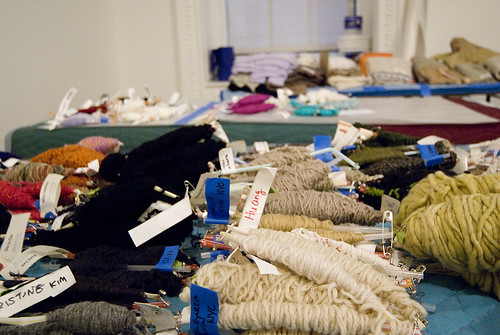
May 8, 2009
Post #8: Movement is in the Heart
Carrying over from yesterday's post, I had a piece of a conversation with a coworker about what some of the older movement folks did: living and working alongside the "community" they spoke about and advocated/organized with. She seemed skeptical of the whole thing: suggesting to me that there was still appropriation and//or crossing of lines in her mind: those with the privilege to decide where they want to live, and the ability to decide that they want to work as a laborer, even though they possibly had other options, was questionable to her.
I think part of it may be related to something I read in my poverty law class when I was in school: while other groups can coalesce around an identity, as a source of power and a foundation for organizing, the author argued that poor people are not proud to be poor, and poor people don't want to remain poor, particularly in the American system, but likely anywhere you go in the world. And for immigrants, the extrapolation goes, that should go double, because many were poor back home, and after years of backbreaking work in a hostile environment, the last thing they want is to remain in that same condition. I don't know either way.
But while I don't think that I idealize the harsh conditions that workers (or low-income renters) deal with every day, I do think that a part of me always feels disingenuous as I do the work that I've done and even as I do what I'm doing now. It's still a "career" to practice public interest law, and I'm still very much in a (c)(3) box. No matter what my message about peoples' power is while I'm at work, nor even if my personal vision for this work were crystal clear, it still feels like an act sometimes. Perhaps it's just because it's hard for me to reconcile "movement" with "career" - I think you could say this is a defining part of your life, but if you get paid for the work, and if you are not in control of how you spend all of your time, then there is a gap between that theory and practice.
I don't know if there's an ideal, but sometimes I wonder if people who volunteer are, in a way, more pure than those people who work on community-based projects as a paid job. I raise this only because it's so easy to be distracted by the day-to-day, or to get too comfortable (particularly as a lawyer, because you have that club card that non-lawyers do not have, even if firm big-shots don't acknowledge that you have the same training as they did.
For a long time, I've been saying that "policy" positions and jobs are bullshit: ultimately, you're just getting paid to spew your opinion in a more formalized, backed-by-quantitative-facts kind of way. But I'm seriously wondering if all community-based "jobs" are bullshit as well. As long as we make a career out of this work, there are potential conflicts between a more pure vision of what a movement or peoples' struggle should be, and what the constraints of your employer are and how they limit actions to support a radical social change agenda.
Perhaps movement is in the heart, to borrow from Carlos Bulosan, and not in the effort to get more funded positions to talk about it. And perhaps that movement is dying with those who are leaving us so quickly (Richard Aoki, now Manong Al Robles).
May 7, 2009
Post #7: The Snake Dance of Asian American Activism
 I mentioned earlier in this "series" that the SAALT Summit made me think about some things a little more than I have for a while. I won't be able to go in depth here, but I want to explore some of these points over the course of the next couple of weeks. Today, rather than get on my computer and muddle through even more work in the evening, I decided to just start reading, which I haven't done in a long time. I pulled out the relatively new book, "The Snake Dance of Asian American Activism," written by Michael Liu, Kim Geron, and Tracy Lai to add some context to the "Asian American Movement" that we keep hearing about.
The book was a surprisingly quick read - perhaps I was skimming some of the things I knew, but I felt like they did a good job of moving quickly through the material. As academics with pretty solid personal histories of organizing and activism, they seemed to know when to move on from a point or moment in history, citing to source material and not lingering too long. The interesting thing about this book is that rather than give me yet another academic tome to criticize for how it has completely left out South Asians from the framing of the "Asian American Movement", I had other things to ponder once I got through this book.
The authors' premise is that there are critical pieces of history and context for what is now referred to as the Asian American Movement that are often hidden beneath the more common accounts of identity formation and struggle for "equality" that take up much of the space in Asian American studies circles. I found the way that the framed when the Movement started interesting yet frustrating, because they actually went as far back as labor organizing on the West Coast in the '30s, but ignored the revolutionary Ghadar movement work that had happened in the early South Asian communities in the Pacific Northwest. Perhaps the idea was to trace the arch from labor organizers who were somehow connected to the Chinese and Japanese Americans who were involved in the '60s and early '70s (though the labor organizers were also Filipino and may not have been so connected).
My other issue was that while the authors mentioned South and Southeast Asians, there was little time spent investigating or thinking about the radical work that was happening in these communities as early as the 80s, and definitely further along into the 90s. Granted, a great deal of the professionalized organizational work (which the book does a good job of critiquing and discussing from the context of the earlier AAM organizations) in South Asian communities have not been driven by an ideology of broad systemic change, but there have been some interesting, and important developments over time that should have been explored.
In addition, some of the specific critiques of the hard-Marxist approaches that some organizations took on, with professionalized "organizers" trying to distance and legitimize themselves in contrast with less doctrinarian counterparts in service and advocacy organizations. This was particularly offputting in some of the organizations that the book's authors bring up, and the reason for some of the fissions that occurred in the 80s and 90s between groups, organizers, and different approaches to the work.
I think what I found the most interesting and thought-provoking, however, was that a lot of the activists in the 70s actually lived in the SROs and hotels with the low-income tenants. The organizations shared space in those buildings as well, sometimes run out of apartments. Activists took jobs in the labor industries to both make a living, and live the same life as the people whose voices they thought should lead or guide the movement. This is so different from what we all do now: we are professionalized, making a career out of talking about and minutely affecting the conditions that real working people deal with every day. The difference between this approach and that taken by some of the folks from the 70s is enormous, and something I plan to think and write a lot more about in this space.
For now - this is enough. Check out this book if you get a chance.
May 6, 2009
Post #6: McDonalds
Okay - my post about APA Heritage month? I remember when McD's had some weird Asian campaign a few years ago. I just looked for it again, and WTF is this? Okay, so this is like guide 101 for white guys trying to pick up Asian women. But it's like so bizarre. And I can't even begin to understand how they can break down Cantonese and Mandarin under Chinese, but can't even come up with a real language for the "Henna Mouse" or "Jeepney Mouse."
The reason I went to this site is actually because I got a targeted mailing from McDonalds that I could see was for coffee. When I turned it over, I saw that the main tag line was "Taste Ki Baat Hai!" WTF part 5000. Either some group that knew I was South Asian sold my name to McDonalds, which is so low down I wish I could figure out who did it, or somehow, they figured out a way to do name-based micro-marketing. I don't live in a desi neighborhood, so I have no idea of how they hit their mark.
I just feel kind of violated: anything McDonald's that comes at me conjures up 2 radically different feelings: 1) I remember the family going to McD's sometimes, just getting 3 or 4 large fries and a couple of sodas, and then one or more of us would get a sundae or something. That's about all we could eat, but it was happy times when we went (I'm talking once a month or something). But then 2) I found out that McDonald's coats its fries with beef extract or something. How fucked up is that? I can't even begin to tell you. Fried potatoes made with beef extract. Meat-eaters are so insane.
Yeah. That's some heritage for you.
May 5, 2009
Post #5: Talking Community
Sometimes I feel like I'm just starting on this journey of "community work" because of my "rebirth" as a working who actually has more direct contact with community members than I ever did in the past. But I realize when I think about the years and different hats I've worn, that rather than complain about "those old-timers" I'd better be careful that I don't become one of them.
It's weird to be in a setting where I'm both one of the oldest people at my office, and yet still one of the greenest in this line of work. There's the odd combination of respect for the barrel of years that I sometimes dip into to inform what I'm saying or where I'm coming from, and my personal acknowledgement that I don't really know much when it comes to actually practicing law.
But you know, actually working with community folks definitely humbles a guy like me. I'm realizing how little I know, and how much of what we do as "Asian Americanists" is still theoretical and privileged if it's not connected to regular folk, even if we're not on the ivory tower spouting theories. I realize that because the everyday stories and the ways that people connect to one another, and actually to us, is amazing.
Sometimes I forget that I speak a different language from my group client because we have a rhythm with the interpreter and we connect in some fundamental way. I mean, with that group, they refer to me as their lawyer and get really happy when they see me now. Then there's someone else who was at a general presentation I made to who referred to me as "the foreigner" in Chinese when speaking with a co-worker of mine. The difference is just context.
But it's humbling, and it's rewarding even on the tough days, because you feel that link both to the individuals and the many stories that paved the way for their own, and yours. But it's not a point to get on others' cases about if they aren't doing this - it's partially our role to find ways to make these stories get out there and are heard by more people. Maybe these stories of "community" can build community in their own right.
May 4, 2009
Post #4: Manong Al
 Al Robles, poet, activist, free spirit from the early days of Asian America passed away this weekend. I didn't know him. I didn't even know his work very well, save for a few poems that I've read in anthologies and the few times I read pages from his book, Rappin’ With Ten Thousand Carabao in the Dark, yet another on a long reading list that keeps getting longer.
But I know his name, and enough pieces of his story, and even a few of its intersections with stories with which I am familiar, such as that of the International Hotel. Manong Al, as he was known by the community, spent a lot of time with the older, single Filipino men, manongs themselves, who lived in the SRO units at the I-Hotel. He shared time, advocated for individuals to get social services, and just was around. His story, his life, and his light are interwoven with those stories from the early days of a conscious Asian American movement. As I think about ways to mark heritage month this year, I'm hoping to study his lessons and to celebrate his life.
May 3, 2009
Day #3: Margins and Margins
There is always an uncomfortable gap between the "professionalized" Asian Americans who make it their living to speak on behalf of the communities that live within our imperfect, big-tent nation, and the people who they speak of (or ignore altogether). But I think there are even further divisions that separate us than just the elite and the non-elite.
There is also an elitism within community-based work that has created schisms in most major cities between people with different approaches and frameworks about working with immigrants, with the poor, and with the historically and currently oppressed. My personal priorities often align me with people who believe in peoples' movements and a move away from the successful immigrant class taking up all bandwidth when talking about "community issues" to policy-makers.
However, I have issues with both "sides" and still think there is a holier-than-thou attitude from some people on the left about what it means to be "real" and conscious when thinking about and addressing the significant class/gender/orientation/age/language/immigration status differences that can separate our communities and splinter our voices.
I believe that it's possible to be righteous about these important differences without always being self-righteous. I think if we work from a position that there is something to be gained for everyone if we find cooperative or collaborative ways to address shared concerns and stay out of each others' ways for things that don't affect one another, we can move things further and faster. By fully dismissing the prospect of working together, or for some kind of transformative process that can move people who have privilege to use that privilege to support a humanist, fully progressive agenda, we will continue to work in small silos and actually force our privileged, (and white-washed) static understandings of class differences upon a situation where that may not be the right answer.
I'm so tired of South/Asian marxist-leninists regurgitating white formulations of class struggle. What does that say to co-ethnics who are both class oppressors and relatives of people who are poor? Or those who have gone from one end of the poverty/realized power spectrum to the other? Do we assume that we can't move (or force) some of them to see the light and support poor peoples' struggles as their own? Why can't they be allies like we are? Is this all about the ego and insecurity of the "organizers," lest they be identified with the privileged, who they most likely more closely resemble?
Whatever it is, I'm not afraid of conflict at all, but I don't think we always have to start there. And I think using old, rigid ideologies to understand the current situation and condition of our communities is intellectually lazy and consciously insincere.
May 2, 2009
Day #2: Our Heritage Spreads Across the Sky
Heritage Month feels kind of overwhelming on the East Coast. I think it's because we don't have a steady stream of things going on in the community or cultural arena at all times, particularly in parts of NYC and I'm sure in other seaboard cities. So to have a full calendar with multiple things going on every day makes me wish that 1) I had a lot more time to just go to events like I did when I was a pup; and/or 2) we need to get our act together and spread this shit out.
I remember really feeling community at some of the earliest events I went to. But it's far more than just the activities and social side of it, enit? We're not just creating new holidays to celebrate when most of our calendars already have many that we go through with family and community every year already. "Heritage month" isn't just to a time to see old friends, to gather and to celebrate. It's also a time to reflect, to say yo, "we're still here, we're growing strong, and we're getting tired of saying we belong" (Chris Iijima, "Asian Song").
In our celebrations this month, are we counting the histories of struggle, of resistance, of oppression, as part of this heritage? Or is this about just saying we're proud of Chinese food (again, hat tip to Chris Iijima) and Kal Penn? I'm asking that we remember that our "heritage" as Asians, Pacific Islanders, whomever, living within the boundaries and borders of the United States extends far beyond our ancestral links and traditions. Our heritage is far richer, the things we pass on to our children far more vibrant than just those things that we've left behind or that may be worth leaving behind. Our heritage includes what we are doing today, and what we'll do tomorrow.
I'm all for celebrating that.
May 1, 2009
Day #1: Love for the People
So why the hell do we still care about Asian America? (I'm leaving out the "Pacific" because of all the various issues I have with including it that I'm going to spare you from at this point.) I don't really know sometimes, even though I've been involved in this work and these conversations for a long time now.
Our differences are clear, our histories - at least those that we have uncovered - not so neatly intertwined or even inter-related. We have had moments when our people have actively stood in silence or distanced themselves from one another (WWII "I am not Japanese"; post sa-i-gu LA; the aftermath of Sept. 11). Even now, there is grudging respect between Indian and Chinese immigrants in the brain trust fields, but it's still all about the economic arms race - the new hot&cold war bubbling over from the messy Asian states to join us stateside.
But there's a spark still for some of us, at least the old-timers. I still think "maybe I'll get to have a conversation with an old-timer who remembers the I-Hotel" because those manongs speak to a history in the United States that I wish I could trace directly through my own family some times. Don't hate what you've got, right? And my own family history is important and special in what role it plays in the new immigrant stories of America. But hearing and knowing some of the other stories have kept me centered, and reminded me that things were not easy in the past, and they are not easy now for newcomers.
But community is about more than just struggle. It's about what people are building every day, in their homes, across their families, on blocks, streets, and through cities and vast expanses of territory all across the land. There are physical, real markers of what ordinary people make of that word "community", that we can easily forget in the midst of theory and discourse and academic wranglings about insiders and outsiders.
Heritage month is an opportunity for us to feel that love again: the love for the people that brought us into this work, or into this consciousness. A sense that we're not alone, that we have a cannon and a common framework simply in the conscious effort to create one. That the music I listen to now spans many genres and many years, but that there is some link between A Grain of Sand and Bambu or Himalayan Project or Vijay Iyer. A link, a thread, a song. These tapestries, which only some of us can really see, are sacred: they mark not only the passing of time, knowledge, and struggle, but the very spirit of those struggles are woven right into them.
This month, we study these stories, we honor them, and we write anew what community, and love, mean to each of us individually and together.
Apr 30, 2009
Attended the SAALT South Asian Summit in Washington D.C. last week, and I have much to share. Listening to folks who have worked in the community for a long time, as well as new folks from all over the nation either working or hoping to connect to community-based work was really helpful.
Inspired by Giles Li's "poem a day" postings for National Poetry Month, I am hoping to post at least once a day about community-based work, reflections, and thoughts for APA Heritage Month this year. So please tune in, chime in, and let's build again.
Apr 22, 2009
Post #667: Building a Rep
Yeah, so this is one after 666. For a lifelong (well, 20 years or so) Maiden fan, that's gotta have some significance. Anyway, today's quick funny/surreal moment: when a friend told his boss in government that I should be part of the "secret effort" to save her worthless job, he read her extremely negative reaction to be an "indictment" on my "radical reputation."
Ha. That made my day. Live what you feel, ya'll. And break those uncomfortable conversations out of the small circles where people nod their head in agreement with all that we say. These messages have to get out further.
Be well, enjoy the rain or moon or mud, because living this life is a blessing. And sticking your foot up the ass of anyone who gets in the way of your movement is a joy worth repeating.
Meanwhile, I'm gonna look into this co-op idea with my man KC.
Apr 13, 2009
More on Firm Associates Getting Paid Time Off
As a follow-up to my post, here's a piece in the NY Times about Skadden associates being offered $80K to "take a year off." And part of the "taking a year off" for the associate they interview entails "practicing non-profit law" where they can.
It's really hard for me not to say "fuck you, associates." Go coast on the capitalist system you help to prop up during your day jobs. Leave the breaking it down - or at least working with people that the same system is crushing - to those of us who make half of your time off, play money.
Apr 7, 2009
More on Binghamton
This article on CNN.com actually gives us more about the victims, and the secretary who played dead and then dialed 911. I haven't had a chance to process the new information, but 8/13 at my count were folks of Asian or Arab descent. That's crushing: I didn't expect the numbers to be that high.
I'm surprised that there is no Russian or Central Asian casualty on the list, just given how much play the Kazakh survivor was getting in the beginning. More later, I guess.
Apr 4, 2009
Burying the News
I woke up this morning to see what the updates were on Binghamton, only to spend about 5 minutes trying to find it on the CNN website. Nothing updated since last night at 10:42PM. The national venue had moved on: the senseless slaughter of "Kurds, Russians, Chinese, Arabs, Laotians, and others" (NY Times) was not of interest to the nation, I suppose.
The New York Post has a cover story that does some justice to the situation, at least giving us more information and refraining from the assault against immigrants that we expect in the days to come. Although again, I wonder if this had been a mall rather than a citizenship services organization, what the response would have been. Will we get the stories of all those lost and saved: whose people may not be here in the United States, whose English skills are not as polished, nor names as familiar to the general American public?
Or perhaps this will open up a dialogue of some kind, or the sense that there is a need to protect refugees and immigrants who come into our small cities, live on the periphery, make out their existence quietly and patiently, trying to build a life out of the fragments that many come from, or without the familiar elements of home that we are all bound to miss if we have to leave things behind. I feel for these families, I feel that their stories must be shared and their lives grieved and celebrated as our nation does with many different victims. This is a moment for people to show that they care about more than the familiar.
Apr 3, 2009
Binghamton.
Another shooting massacre, another brownyellow face that will make its way over every news channel. This time, the victims seem to all be immigrants, which makes this a different kind of tragedy from Virginia Tech, but quite related: there is an innocence with youth and an innocence that I connect with the long journey one must make to gain citizenship in this country.
Today is a chilling reminder that we're not safe, no matter where we are, and no matter who we think might be "one of us." But I'm wondering what the national mood will be: will people just move on from this, not taking the full tragedy to heart, or will they stand as firmly as everyone did with Virginia Tech? I was impressed by the Mayor of Binghamton, making it clear that these were residents and citizens of his city, and that together, they were a critical part of the fabric of that society.
While we don't know enough - or really anything - about the killer, I think that if the initial reports are true, and that this is a distraught or deranged man in his 40s, of Asian descent, there are a few things that I hope are talked about more. Mental health issues were paramount and discussed to some degree after Virginia Tech, but I haven't seen much movement. In addition, the cumulative effect of American wars in Asia: militarization, emasculation of males, and desensitization to violence of both the populations abroad and those here. It's not an excuse, of course, but a larger conversation that Asian Americans should be having within our communities, particularly those that have been war torn in past or present.
It's a sad day in upstate New York, and I feel an overwhelming heaviness about the whole thing. When they release the names and stories of the victims, suddenly the quick search through for immigrants / Asians that I inevitably do in any such tragedy will result in far more names than usual. It will become clear, as we can only imagine, that the victims' stories match those of people in our families, that we see every day, who have been making the time to learn what they needed to finally "become American" by naturalizing and looking back to the land of their birth no more as home. It is a sad day in America, where even a place where people go to become American is not safe.
I fear the wingnut commentators on this. If they even talk about it at all, or decide to just dismiss it all as third-world news from a small city no one will care about in a few weeks. I don't know what would be worse: their attention, or their disinterest.
Mar 31, 2009
Embracing a Radical New Future
I got a message from someone when I made a snide remark about lawyers that got me thinking: I was just suggesting that lawyers make lousy organizers, a premise that is not very controversial to most organizers and many community lawyers. The response did not take issue with this so much as it recast 2008 electoral canvassing and partisanship as some amazing feat.
I wanted to discuss my general lack of faith in the traditional American electoral system as a true mechanism for transformative change. Perhaps that's because I've been wondering if systematic exclusion from suffrage for such large segments of the population for so long turned it into one of the main "prizes" for a rights movement, whether or not that's what the people most valued. At the end of the day, though the right to vote is important, would people choose that over the right to housing, education, or peace? While we speak of the history of struggle to gain the right to vote in this country, there are so many who still lose their right to vote because of incarceration, REAL ID, etc. Or don't have the vote at all, as non-citizens even if they fight in a war for this country or live here for a lifetime.
Maybe if we get away from republicanism (little r) and around to something more representative and truly democratic (proportional voting is one avenue) I will come around to see it as more than an opiate to keep the general population disengaged after an election is over. The whole marketing of presidential campaigns decides for the people what they should consider important. I find that to be incredibly problematic: just tonight I saw on MSNBC that Cheney said to some constituency that 'Obama was pro-Palestine' as a way to make him lose the election or at least confidence from influential segments of the powerful. This framing just proves that regardless of our small, mostly symbolic victories, by setting the parameters for debate before we even get in the ring. This is a different kind of game, people.
Trust me: it's not something I share with many people, and my status messages end up being in code half the time because I'll get people close to me blacklisted if I share what I'm really thinking about "American democracy". And civic engagement is so much more than just voting, can include so much more of our population, and doesn't have to conform to the old rules.