

Years after Apu, there have been a string of desi guys who have shown up in supporting roles on sit-coms. Everyone remembers "Babu Bhatt" from Seinfeld (though I'm still trying to forget). I'm sure people can name their favorites (or crappiest), but I'll just do this quickly. After all, I'm sure some of the pop culture sites have probably covered this a million times:
1) Unhitched - Shaun Majumdar - I just watched a snip of this, and it was bad. The dude's accent sucked - I don't know if he was hamming it up to prove the point that he doesn't actually have an accent, but it was pretty bad. Though he was apparently a "pro" at getting the "O" when married, of course it was tied to "tantric" technique, which he then went on to teach another character. So he's a sex machine. That doesn't really inspire me to think his character is breaking any molds (reading that he's a doctor in the show doesn't help). I couldn't stand it anymore.
2) Aliens in America - Adhir Kalyan - when I first heard about this show's premise, foreign exchange student from Pakistan lives with a family in Wisconsin, I really expected the worst. I heard from somewhere that it wasn't that bad, and because "Unhitched" was so terrible (and I was coming off a really funny Simpsons), I decided to check this out a gain. I'm glad that I did. The show actually dealt with some issues of difference and understanding fairly well for a sit-com. I was pretty pleased - I thought it would be more of a gloss on Gene Yang's Chin-kee character (see the wonderful, American Born Chinese), but it was a little more layered than that. In a way that is simplistic (who's the target audience for this show, after all), it is still humanizing this kid and gives us something better than the b.s. thrown out every week in shows like 24 and the like. Hey, and there's a cover of "(What's So Funny About) Peace, Love, and Understanding" on the show that features Salman Ahmad of Junoon. That's pretty cool. I actually thought the episode I watched was better than most of the "Little Mosque on the Prairie" stuff I watched earlier.
3) Weeds/30Rock - Maulik Pancholy - The roles are not specifically desi, and that's kind of cool, actually. His politics are good, and he's a funny actor. I really enjoyed seeing him on Weeds, and haven't seen an episode of 30Rock with him, but he's just a character, not a desi character, and that's refreshing.
I'm pretty sure that show with geeks or super geniuses and the female neighbor (I think it's called Big Bang Theory?) has a desi guy in it, wielding the protractor or some other nonsense, but I haven't watched more than a snip of the pilot.
Beyond the quick run-through of characters, I think it's an interesting comment on how the desi guy has become the new accessory in these shows. Is it the accent? Is it some residual glow from the "Harold and Kumar" phenomenon? I'm really not sure, but it's definitely become more prominent. "Aliens..." actually focuses on the character, while the other shows have the characters in much more supporting roles, but it's an interesting time to watch what evolves out of this for desi male actors. Will they graduate from the boxes that they're placed in at this point (or do we say "not playing a terrorist" = the second wave of desi men on the little screen?).
Regardless, I still think Mindy Kailing, of the office, is the funniest South Asian on American television. And she's writing a lot of the stuff herself!
Mar 23, 2008
The Desi Guy in Sitcoms

Mar 20, 2008
Obama's Speech
Okay, I didn't hear Obama deliver the speech. I read it the morning before he delivered it, and I have to say a few things from the moment I read it:
1) Why did he make that comment about "staunch ally Israel"? Was that really necessary? He took the cheap shot, dismissed the real suffering of the Palestinian people, and kind of bent backwards when he really didn't need to go there. So that was annoying.
2) We've been saying for a long time that Obama had to talk about race in some real way. Running the campaign as a "post-race" candidate just appealed to the neo-cons who have hijacked the idea of a "color-blind society" from Dr. King and turned it into a crusade to ignore the devastating and real impact that race still has in the United States. It's not just about the past, either. It's about how things are right now and how they will be if we keep going the way we're going. Obama running for office was presented by some people - liberals who didn't seem to have a more critical analysis, especially - as a big step towards "healing" the country's wounds and divisions. A lot of people said to me, well of course he believes the same things we do about institutional racism and how far this nation still needs to go. He just can't talk about that right now, to get elected. Just get him in office, and you'll see.
Well that wasn't good enough for me. If other issues were handled that way - we would just work on faith that health care was a priority for Hilary but she wouldn't have to talk about it. Or national security for McCain. But that's not how it works, and just ignoring race, when it was clearly the subtext of the polling analysis and the undercurrent of "what will middle America, the white folk who don't live in cities do when it's time to vote?" didn't seem right. I felt like it was racist in itself to say that talking about race is too "controversial." Maybe Obama wouldn't have gotten this far if he'd had the dialog that his speech is said to have kicked up, a while ago. Maybe this is as soon as he could have had it. I don't know, but I think the way he approached these questions earlier (or didn't) really troubled (and puzzled) me.
3) I don't know, is it just me (I know it's not) - but I found Reverend Wright's sermons - at least the snippets we kept hearing - quite refreshing. It's funny that the media is calling the sermons so problematic. They should do the same about all the anti-gay sermons, literature, talk-show appearances that the mainstream evangelists do all the time. Or even just the simple "nonbelievers will go to hell" litany that immediately makes me feel pretty angry and powerless. But there have been some great pieces about how this may be the first time that white people in the mainstream are actually hearing the tone of what a lot of people feel. Maybe it's the first time that a lot of white folks are actually getting a glimmer of a sense of what it's like to feel powerless against someone speaking so patently against your closely held beliefs. Now imagine what it would be like if you really didn't have the political and race-based power that you have. I don't think you can.
4) Obama's speech surprised me. I didn't expect him to go as straight on with some of the points that he did. I was actually happy that he didn't make light of the anger, of the history that people all remember. That he didn't bring things up to say "all is fine now" but to reinforce his message of hope. I think he could have taken a safer road (though I don't know how revolutionary his speech was - he was towing some lines while saying "hold up, things aren't perfect"), and I'm happy that he didn't. I don't know if he's won away my vote in the general election from Nader/Gonzalez, but he finally showed me that he gets some of what we've been talking about in radical circles of color for a while.
5) That said, some of my friends have just trashed the speech. They hated it, they thought it didn't push the debate at all, they say that it was a purely political speech. I guess I'm not as cynical about it - though I can be pretty brutal in the post-mortem. I think that political operatives and the whole SAFO crowd are a little nutty, and not objective at all, but there's also such a thing as being over-critical without giving people the moment that they kind of deserve. I have to give Obama this moment - it was impressive, he's been getting and will continue to get a lot of slack for whatever he says, and really, the man said I'm not going to back down but I'm not going to yell in your face. I don't know if I'd be able to do that, myself. Because emotions are clearly running high, and he has been able to keep his poise and take the higher road through all of the b.s. It almost seems like he's too good at it - but that's not a fault. We may just be too cynical on the left to acknowledge and accept that.
Mar 17, 2008
Maiden: Somewhere In Your Wallet Album?
 Okay - so I'm clearly a Maiden fan, have been for a long time (again, not as long as some of the folks out there, but long enough), and was really happy with the last studio album. But how many greatest hits packages do you need? They are coming out with ANOTHER "greatest" hits, this time from "1980 - 1989" and the only reason to even look at it in the store is to see how the new Derek Riggs picture looks close-up (it's likely a digital piece, so it doesn't have the crispness of his original paintings, but it's still a Derek Riggs).
I'm sure we can all complain about what's included and what's not, but do we really need "Iron Maiden," "The Trooper," etc? I think I'm going to have to pull together my own dream set list for a show, and/or even for a "greatest hits" package. They don't throw in a new song (at least Best of the Beast had "Virus" on it), they don't give you alternate versions, and there's no best of the b-sides disk (for those of us who couldn't buy the outrageously expensive treasure trove, Eddie's Archive).
The other thing that's funny about this release is that they have a funky download first option that they are rolling out (and trumpeting) that just seems: 1) bizarre; 2) lame; and 3) like the idea really is "somewhere back in time" - like 10 years ago, in the context of what other groups are doing. If Maiden were really on top of this stuff, they'd take a number from Trent Reznor's book, pull together some deluxe packages for fans with Derek Riggs artwork, picks, whatever, and they'd be able to totally make the headlines and fuck up the major labels. Can you imagine if they gave the greatest hits away for free as a download, for real? And if you "buy" it - you'd get a special disk of b-sides and/or a small poster? Hell - Maiden is so rich that they could do a special printing of a 7" picture disk for a reasonably prized deluxe edition. How many fans would jump at that? I know I would. And it could go directly to them, or hell, to the Clive Burr Foundation that's been set up.
But they are conventional, and their management can't think that far ahead. And while I still love the music, I'm getting really sick of seeing the high prices and redundant releases. Do you really need that much more money?
Mar 16, 2008
Somewhere Back in Time Concert Review
I caught Maiden at the Meadowlands on Friday, and what can I say? First, it was the third time I've seen them, after the Brave New World tour, their stint on Ozzfest where they played the tightest 1.25 hour set I could imagine from their first four albums, and this one, where they stretched out a bit and celebrated the Live After Death DVD release (finally!) with a throwback to that period. This time out, they promised to play songs from the next few albums, and we were treated to the four songs from Powerslave that people knew, a couple of tracks from Somewhere in Time, and a golden 3 from Seventh Son (as well as a sing-along of "Fear of the Dark," the title track from the album that I've written about earlier).
What can I say? I got into Maiden after a good friend said "you found Guns 'n' Roses? You should listen to this" and handed me Somewhere in Time. So I don't go as far back as many of the other fans who can point to original pressings of Metal for Muthas and whatever, but I ate it up. Maiden was the first band I really obsessed over, and getting to know the back-catalog became a bit of an obsession. I settled on my favorite album (post-D'ianno, of course) to be Seventh Son for a long time, and it remains the one album I know I can put on at any time and just listen to straight through (though "Can I Play With Madness" grates on my nerves, to be honest). Anyway, as I've gone through many phases in music, and even in my interest in much heavier stuff now, Maiden remains for me, as I can imagine for a lot of other people, a touchstone, a reminder of a simpler time, and a consistent favorite.
Going to this show was particularly exciting because the only good live recordings of songs from Somewhere in Time and Seventh Son I had heard were from Maiden England, which I thought was phenomenal. I wished I had known about the band (and been able to get out of the house for concerts) during the Seventh Tour. But even just hearing a few of these songs live for my first time would be a real treat, so I was excited.
I'll just break down my realizations after the show briefly:
1) Large venue shows kind of suck. Too much money for tickets (and Ticketfucker is involved and sucking the marrow out of your bones as you pay), parking and getting out of the clusterfuck parking lot sucks, and you have to walk a long time to get back to your vehicle.
2) Concert shirts are damn expensive. I'm a bit old to still buy t-shirts and wear them (and my walls don't have space for this shit anymore), but come on: $45 for a t-shirt?! Now I see the "strategy" that Metallica is employing, since their shirts are now available at JC Penney (well, I saw a Ride the Lightning shirt there, next to something with Pac-Man on it, I think). My souvenirs from the show? A downgrade in my hearing ability and a postcard announcing new tour dates in June.
3) There are a lot of assholes who come to Maiden shows. They are too accessible, they have been around too long, and they are an easy name to drop to show your "creds." So there are a lot of dicks who comes to these shows. We almost torched some of them when they started tapping our vehicle to talk to us.
4) There aren't really surprises when you come to a Maiden show: the catalog is deep, the B-sides aren't as deep -- with all the coverst they do, you can enjoy the songs when you get them but who cares to hear that shit live -- but they don't really have the space for spontaneity, which is too bad, really. So while there are new songs on this set that we haven't heard live, it's not like they are suddenly pulling back and giving you "Flash of the Blade" or "Big 'Orra" or something. Or even a throwback to the old Smith/Murray dual guitar solo that they did during Somewhere in Time. After seeing some other acts a few times, like Springsteen, who has been around for longer than Maiden, and seeing how he pulls together set lists that are so different each night -- drawing from fan favorites that aren't singles to obscure b-sides, and not really catering to the lowest common denominator each time -- you feel like you can go to one Maiden show, and you know 75% of the songs you're going to get each time (give or take a few tracks from the new album, if there is one). So that was a bit of a downer, though I don't know what I was expecting. I guess I feel like if they have to go back to the first 4 albums for some of the standards, I'd rather hear "Flight of Icarus" or "Still Life" live, which I didn't catch when they did their first revival of the old stuff, than the 1 millionth replay of "Iron Maiden," "The Number of the Beast," or whatever else. Maybe it's just because I can tell that they are on the top of their game as musicians playing the material (they were amazing), and I want to see/hear more.
5) Adrian Smith could be in a harder band. He looks the part. Janick is ridiculous with his onstage presence, but it's endearing now. Dave Murray's leads were on fire. I would have killed for even a short detour on one of the songs though, to let the guitarists breath a little. A tight set is a wonderful thing, but it would have been so worth it to see them let loose a little bit more.
Anyway - I don't want to seem overly critical. It was a Maiden show, it was amazing, and I was so happy I went. I may not get to see them when they return to the area in June, because of the damn bar exam, but I'm glad I saw them here. Hearing "Wasted Years," "Moonchild," "The Clairvoyant," and a few other songs just made the night for me. I think I'll have to pull together my dream set-list for a 2 hour show, just to see how different it would be. Thankfully, they didn't play "Die With Your Boots On," or else those poseurs who got in our way when we were trying to leave might have ended up on the evening news.
UP THE IRONS!!!
Mar 12, 2008
Free Tibet!
The escalating tensions between China and the displaced Tibetan populations in India and the diaspora should hopefully raise people's consciousness about the egregious human rights violations that plague this relationship. I hope that more Asian Americans are very critical of what China has done to the Tibetan people - "saving" Tibet is not enough. Tibet must be free.
And people should disassociate their ethnic/racial pride as Asian Americans of Chinese descent from the nation/state of China - who you are is not defined by the political nation from whence your forebears came. South Asian Americans/Brits/Canadians are some of the fiercest critics of their countries of origin - because they have a legitimacy that may turn more heads than random white people. But for some reason, people don't always seem that comfortable with other Asian nations (show me that I'm wrong).
I've long considered Tibetans to be South Asian brothers and sisters, not that the boundaries matter that much, but they are a strong and proud people, and I don't really have a lot of faith that ever-more capitalist India will continue to be a safe-haven for Tibetans, even though so many of the young folks who are willing to march/fight for Tibetan freedom were actually born in India. How long before the Indian middle class says "let's cut this vestige of failed socialist Nehruvian policies - Tibetans are an internal matter for China to deal with, and we should stop letting them in."
Now is the time, I think, for some movement on this issue. But I want to learn more about it before I just shoot off from the heart without knowledge.
Mar 11, 2008
Arthur Who?: Confronting Anti-Islamic Opinion in Asian Week
In today's Asian Week Opinion, Arthur Hu posted a vitriolic response to Michelle Obama's statement (a lifetime ago, it seems) that a particular moment was the first time she'd been proud to be an American (taken out of context and clarified ad-naseum, so I'm not going to go there).
His text includes this nugget:
Nearly half of America is crazy about the man, but I haven’t seen a survey asking if America was ready to promote a son of Islam, Christian or not. Even McCain had to apologize for a host who emphasized Obama’s middle name.
You should get the idea from that. I'm getting fed up of the islamophobia or just flat out bigotry that's coming up in "Asian American" spaces. I want to think that it's just ignorance, but I suspect that it's worse: Asian Americans, even those who think that they are representing some kind of dissident or civil rights voice, have bought into the American bias hook, line, and sinker. It makes navigating Asian American spaces really difficult for Asian Americans who are either Muslim or work in Muslim communities (read: South Asian). I'm not taking this shit anymore. I'm calling these people out. Read More......
Mar 3, 2008
Asian American Activism: The Safe Work?
I've written here about working in the South/Asian American communities, and seeing that work as being where I've been and where I want to be after finishing with school. But regular interactions with family and desi family friends have made me think more about that choice: specifically because of how matter-of-course the older generation have adopted the racism of white America, fitting right into the racial hierarchy that puts them somewhere between blacks and whites, unless they get uppity.
Sure we get angry, upset, and try to educate within our communities, but how much is sinking in? How much just looks to people like we're idealistic? If we can't even move people on issues of faith (i.e. we are the same people, but choose to worship differently, so what's the big deal?), how are we going to combat all the racial programming that has convinced them that they want nothing to do with the black community (and increasingly, "those Mexicans"). I thought I had the patience, but I end up just ranting nowadays, not moving the dialog at all.
So I've started thinking that because there is still this perception that all South Asians or other Asian Americans in the United States are doing well, working in South/Asian American communities is a "safe" choice to explain/justify to the older generation. They think "job discrimination, yeah, I went through that in my effort to get my engineering job" so they think it's good that you're fighting for that particular right. They don't think you're talking about undocumented workers whose rights are being abused by other South Asians. Even domestic violence, which is so pervasive in our communities here, is connected as a middle class dilemma, and isn't questioned as much.
Never mind that we're thinking and talking about redistributive economics and hoping to work with people who will not be able to get that perfect job as a doctor, because they came here as laborers. The class distinctions are not quite as relevant to them - they can say "my daughter works for
I'm starting to think that this enables us to do this work without being questioned to the same degree, probably, as people working for social, economic, and racial justice in a space that works primarily with other people of color - with "immigrants' rights" being thought of as working with the Latin@ communities in the middle, and working with Black communities still at the bottom of the perception latter for the first generation. So I'm starting to wonder if I'm taking the safe road by trying to work in South Asian or even Asian immigrant communities. Is it easy to hide some of the significant differences between my life experiences and those of the communities I want to work with because we have "co-ethnicity" for me to hide behind? Seeing how many people that work in Asian or South Asian spaces are incredibly centrist, are we just enabling more of the same by working in these spaces that don't really shake up the status quo? Are we just doing "charity" rather than "movement" work?
Ahmedabad's Fancy Marketing
Check out the video below, sent to me by a family member who was born and raised in the city. It's amazing how you can just look at these things without a critical eye and think "wow - how great!" But then you start to think about how the city is incredibly segregated between the Muslim and Hindu/Jain sections, how Muslims live in abject poverty, and how there is such deep-seated hatred, racism, and bigotry fomenting in the middle-class Hindus/Jains there and abroad (which just makes no sense - you're doing okay, why are you hating on the people who are suffering?). And you remember that Ahmedabad has been the epicenter of Gujarat's politics of hate, culminating in the pograms in which thousands were killed and tens of thousands were displaced from their homes.
This is obviously to appeal to tourists and commerce interests abroad, saying "hey, remember us? forget about Banglalore and the other cities," but the omission of Muslims and/or the history of communal violence from the narrative about the city altogether (how many more pujas do you want to show, after all?) is very disturbing.
Mar 2, 2008
Misogyny and Election 2008
Sometime in January, Gloria Steinem sent up an op-ed in the Times that got a lot of play because she compared the misogyny and sexism that Hilary was facing in the race - and by extension, that women face in their everyday lives - with the limited outright racism that confronted Obama in the race to date. The piece drew a lot of ire from various camps, and I don't know if there was any real resolution or even a follow-up or clarification by Steinem. Obviously, you can't really get far by comparing oppressions, but she was trying to make a point about how even facially obvious sexism pervades American culture.
I was not as sympathetic to the point earlier, knowing that there are a lot of factors -- class and particular life history -- that have been greasing the wheels for Obama at that point, and he offers good proof to the proponents of color-blindness that the system works (similar to Clarence Thomas, Alberto Gonzalez (maybe not so much anymore) and other really successful people of color). Of course racism exists, and is still deeply embedded in the institutional oppression and generational disadvantages that have made it more difficult for people and communities of color to have a fair shake.
But I've been thinking more about Steinem's points, and after seeing the segment below on Meet the Press today, was just absolutely shocked in two ways. First, Tim Russert pointing to recent Pew Research Center poll results (with an N of an undisclosed number, but higher than 100 people), mentioned that when asked to sum up the leading candidates in one word, 11 people said a "word that rhymes with rich." I was shocked that that a significant a percentage of people actually felt comfortable enough to say something that offensive. That's a large segment, and it seems to be very telling that they can use a slur rather than even some indirect way of getting to the point. Obama's words were pretty vanilla, pun both intended and not.
But when I went to the actual Pew site for the poll, I started thinking more about what happened on Meet the Press, and realized my second moment of shock and disgust: the Pew website summary doesn't draw the list out as far as the list shown on MTP. They only go down the top five. In essence, MTP could have done the same thing and made the same point. And I just wonder - even on the full list there's nothing remotely similar in the columns for the other two men (though McCainites might beg to differ concerning the "liberal" on his list, but I guess he should rest assured that nearly as many people called Hilary "socialist").
Why did they include the really offensive comment? Why was that okay? Beyond a conspiracy theory, what does it say about how acceptable it is to put something like that on national television (I don't give a fuck about your disclaimer, Tim Russert, that this is a "family" program, you still had it out there). Sorry, that's fucked up. Here's the clip:
While I'm not a big fan of either candidate at this point, this really made me think more about what this race is bringing up, and the fact that while "women" (of all backgrounds) and men of color may have aligned interests against white male patriarchy, there are some other things going on here that make it easier for some men of color to rise in prominence and still preserve the underlying inequalities of power that keep this society so screwed up.
This moment serves as a reminder to me that sexism and patriarchy are important oppressions that I have to keep in mind at all points, not just as an item on a checklist to mention while flashing left credentials. This shit is real.
Feb 14, 2008
i've got love to share - i ain't all hard,
it's just sometimes, in this life
it's hard not to dwell
on the sheer weight of this movement
or at least, getting it started
in my head
but that's where i've been wrong, right?
that movement, someone said
has to begin inside love
and spread through the ideology
if we want real change
so to overcome the conceit
that my extra stress will carry this wave
i'll have to remember
1 isn't only a lonely number
it's not strong enough
until it's added to 1
and 1
and on
and on
with love for all the kindred spirits
who sustain me through the us we create
in each interaction
but for today
(and not because it is 2/14)
let me just begin
with that first 1
Feb 3, 2008
Retro-Thrash Makes Me Nostalgic
With the advent and current fad of retro-thrash that I've been reading/hearing about a lot on Invisible Oranges, Aversion Online, and other reputable spaces, I've been curious about the phenomenon, but not had the time or exposure to hear a lot of the new stuff. More than that, the phenomenon has made me think about why thrash has been a favorite of mine in the various (and ever-increasing) genres and subgenres of metal.
What is it about thrash? I'm not going to go down this path for too long, because "retro-thrash" has made me go down memory lane and revisit a period of the music past the 1991 release of Metallica's Black Album - which I used to hold was the turning point for thrash, and the point at which I stepped away from metal for a while.
Anyway, I like thrash because of the aggression in the riffs, the just over the top nature of it (just past pop-accessible/mainstream power metal and hard rock), the way that it's not really unified in any way (where black, power, and death metal seem to have some theme/technique that binds them), the showmanship is focused on guitar leads and some riffage - not so much on the rhythm section (I didn't really even pay attention to what drums and bass were doing), and the vocals are all over the map. The funny thing is, they want you to be able to discern the lyrics... there's perhaps a bit of naiveté that they will change the minds of people listening. But think about the singing - from the highly idiosyncratic vocals in Vio-Lence, to more power metal type stuff with Forbidden, to almost a hardcore approach with the thrash bands that adopted that style. And where else could a singer like Joey Belladonna seem to fit on top of a band like Anthrax?
I like thrash because it is pretty uncomplicated - the complexity of death metal (I've been learning) is hard to dig into (especially for someone whose metal journey started with Maiden). I like the social consciousness of some of the lyrics, though you can only imagine there's a "top ten" list out there somewhere from which the lyricists choose their themes (racism? check, environmental warning? check, war?...). I like singing along with people whose voices aren't so technical/skills-based (usually) as power/heavy metal, and yet actually have the pop-sensibilities of verse-chorus-verse structure. And I'll still hold that a strong/solid Slayer lyric is much more aggressive and "dangerous" when you can blast it and the average Joe in the street knows that Araya is screaming "before you see the light, you must die!!!"
As an outsider embracing a music of outsiders and for outsiders (hipsters weren't around when I was coming up), being "close" enough to understanding for mainstream listeners to more clearly demarcate my difference, actually made a difference. I think death and black metal were just so out there at that time that they weren't considered sufficiently dangerous enough for me to let go of thrash. Really, it was the sing-alongs while barreling down small town roads in my buddy's car.
So I've been revisiting older, but not first generation, thrash lately. I got into the genre after the standard-bearing albums had been out for a while - it was catch up for me until Metallica's Black Album came out. The album's "accessibility" blew them up, screwed them up, yadda yadda yadda. The story is documented in their own, tragically funny Some Kind of Monster (a real treat for the Mustaine fans/haters out there, by the way). I'm not going to waste space on the album here - it was baaaaad - it just wasn't thrash (or, really, very revolutionary or new in any way. If I wanted to hear watered down Soundgarden, I'd just as well have waited for Audioslave). More than just the album itself, what I think it did was sound the death knell for American thrash. Albums by other groups after Metallica did so well tried to emulate the accessibility of their effort, or reacted to it. Many groups broke up soon afterwards, and grunge took off in the mainstream.
I have a personal story connected to (and that prompted) this little walk down thrash memory lane. I was turned off by Metallica but I distinctly remember going out during May of 1992, in the midst of my finals in college, to one of my favorite record stores downtown to pick up the day's new Maiden release: Fear of the Dark. I can't remember if I knew or just found out then that Testament's The Ritual came out at the same time, but I picked that up too.
Fear of the Dark struck me immediately because the cover (which I had on one of those large cardboard boxes they dispensed with soon after) featured the first non-Derek Riggs sleeve I'd seen for Maiden. I was shocked, and not happy. The music impressed me even less. But Maiden had lost their way with the preceding album, in 1990, which felt like a step backwards, a quick release, and a major disappointment after the masterful Seventh Son.... Because I was trying so hard to like Fear, I only gave Testament's The Ritual (blessed with a more interesting cover), a few cursory listens. I seemed to have some positive memory of Souls of Black - the 1990 release which is now my least favorite Testament album, going further to suggest that the decline of the metal I listened to actually pre-dated the Black Album because 1990 was a pretty bad year.
Anyway, because of my Souls of Black memory, I thought The Ritual was just not hard enough. It showed a stronger departure from Testament's trademark thrash sound - the highlights on this disk were Chuck Billy's ability to stretch out his voice and sing a bit more, and Alex Skolnick's lead breaks. Even Peterson's trademark outstanding riffage was not particularly interesting or memorable. This seemed like more of a hard rock/crossover kind of album. Now that I know Chuck Billy's roots as more of a rock singer, I can see where this gave him some space to spread out, and he does just that. It's hard to fault his vocal delivery - he really is one of the best. Listening to the album now, it's actually grown on me a little more, though I can't help but notice how boring the drumming is - something I only noticed after listening to more death metal.
Once I heard The Ritual and found out that Skolnick was leaving, I tuned out for about 10 years. I missed their resurgence with Low, the new direction of Demonic, and the full return to form in The Gathering. I only got a sense of how great they'd become when I listened to the outstanding Live at the Fillmore disk - where I heard Murphy shred, and the wonderful 3-song acoustic set at the American Indian Community House in NYC (if only I'd known!).
That I missed the original releases of the key thrash albums back in the mid eighties is one thing: I was pretty young. But missing new classics as they were released because of the Black Album fallout (and how too many groups thought it was a ticket to get away from struggling on the fringe), really sucks. Metallica killed a lot, and the new resurgence of metal (thrash, particularly, because death, which was just a footnote when I was coming up is the real veteran now) is at a good time, and I'm glad to actually be a part of it as it is going on.
Bud SUCKS
*sigh* This may go all over the damn blogosphere soon after the game, if it isn't already, so I'm just going to put it out there right now: that Bud Light ad was whack. It came on around 7:25EST. It featured white men in a bar teaching immigrants how to pick up women, giving them lines that the immigrants, of course, botch. There's an Indian guy, an East Asian guy, and an African immigrant. And at the end, the fourth guy, who ends up with a "date" due to his Bud Light, is another kind of Asian.
I'm sure there will be a link soon enough on YouTube, and a lot of guys will get their tighty whities in a bunch about it, especially Asian men feeling like it's attacking their manhood, etc (in the theme of my last post).
But of course, this is part of a different narrative: the "foreign Asian/immigrant" narrative. What's interesting is that they had three Asians and an African immigrant: no Latinos at all. What does that say about white male (I'm assuming they are behind the ad, but I could be wrong) paranoia about men of color and white women? Does it mean that Latino men are taking the place of African Americans as the biggest "threat" to "preserving the race"?
Reading a sexual subtext into the rabid anti-immigrant rhetoric by white male Amerika raises the stakes a bit. But I don't know if this is anything new, but the emphasis on violent crimes and criminals that "open borders" may let in far exceeds the reality. So there must be something else here.
Anyway, Bud sucks.
Jan 30, 2008
A (New?) Different Asian Male Stereotype
People have been writing and talking about the asexual, effeminate, emotionless Asian male stereotype in the United States for a long, long time. People are still writing and talking about it. There's another type that pops up here and there, especially when something awful like Virginia Tech happens, that suggests the boiling over of a repressed, frustrated, unpredictable Asian male (the ticking time bomb of the quiet kid in the corner who draws/writes/thinks violent things for himself, and for good measure, mutters a lot too). Though people may connect the two (repressed sexually, or overcompensating), they are different.
But that "angry asian male" (not speaking of one in particular, hat tip) exists in another space. That's domestic violence. As you likely know, it runs pretty deep in our communities, both here and abroad. While some part of it, I'm sure, is that we're in a patriarchal society and the way that man mis/treat and abuse women is not checked enough by social norms, there is still too much violence happening in South/Asian communities for us not to look at this more directly and closely. And while I know this isn't something new - I just wanted to ask the question, why are Asian men taking out anger, in whatever way and from whatever root cause, on our Asian sisters?
On the broader subject of domestic violence, what does it mean for a community or communities (specifically desi groups in the U.S.) to have so many domestic violence organizations around the nation? Does it mean both that it is a serious issue, and it's one that's easy to rally around and create organizations that focus upon the issue than things like workers' groups? Why aren't these issues becoming less prevalent in our communities - I don't think it's because the steady stream of immigration brings more "traditional" men with fucked up values/performances of gender through violence against their partners. Without empirical data, I wouldn't be surprised if the numbers also come from native born or long-time U.S. residents who are South Asian as well.
So what is it about our men? Why are these issues still prevalent? And how do we move away from the angry (violent) Asian men in relationships? Do we need more affirmative, critical, and safe spaces for Asian men to work through these and other issues? Do any still exist?
Jan 28, 2008
A Matter of Faith: Non-Christians and Asian America
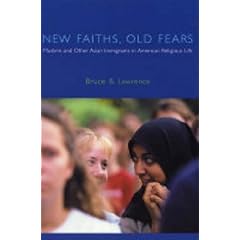
After writing that piece yesterday on a faith-divide that is causing political dissonance in the states of Asian America, serendipity put me in a used bookstore today where I came upon this book:
New Faiths, Old Fears: Muslims and Other Asian Immigrants in American Religious Life,
by Bruce B. Lawrence.
Lawrence focuses a lot of his discussion on Iranian Americans and their particular orientation to both faith and racial/ethnic groups in the United States, but he actually talks about the "new faiths" in the United States, and the uneasy way in which American communities as a whole, and Asian American spaces in particular, are dealing with the rising tide of Muslims, Buddhists, Hindus, Sikhs, Jains, Zororastrians, and other peoples within the coalition. Fascinating stuff, and I'm glad to see I'm not crazy. I was really interested and picked up the book because he talks about South Asians for a while in the book, which was unexpected when I first reading through it.
It's interesting how the issue of faith identity is dealt with in progressive/left spaces. I haven't had a lot of experience, but while I can understand if someone dismisses faith because organized religion is just another system of oppression, that perspective ultimately disregards that faith (and discrimination/exclusion based on it) is a real phenomena in coalition communities. So the left ideologues who don't want to think about faith are doing what color-blindness advocates do with race: assume that if we don't talk about it, there's no real-world impact on people's lives.
But alternatively, you have people who harbor their own biases, whether knowingly or not, against particular faith communities. American popular culture has turned Islam into the communism of the 50s (call it a green scare if you want). I wouldn't be surprised if mainstream Asian Americans who don't have exposure to Muslims (or other faith "minorities" within Asian America) are working off of a lot of assumptions and misinformation in their orientation to these communities.
It doesn't help that evangelical Christianity has caught on like wildfire in several Asian ethnic communities, and some churches have adopted the American angle of "building community" by highlighting and reviling something different. Hinduism has been targeted in some churches, but it's not really seen as a threat in the same way as the master American narrative has made out Islam. Islamophobia may be another way to make yourself seem like a real American - kind of like wrapping your community up in American flags the way Chinatown and other NY immigrant neighborhoods did immediately after Sept. 11th.
As an aside, that toss-off comment above, "Green Scare", is kind of apropos, actually, with the new unholy trinity that keeps the reactionary right (and those like them) up at night: environmentalism/conservation, Islam, and the Redistribution of Wealth.
Jan 26, 2008
Asian Americans and Palestine
Does Asian America care about what's happening in Palestine? Sometimes I wonder if folks even see how connected it is to this nation we strive to imagine (or thrive by collecting a paycheck on). More on that in a minute. But seeing the thousands of people streaming across the border from the besieged Gaza territories into Egypt really shook me - I wasn't paying attention to the sealing of the border and embargo that Israel had placed on the territory over the past weeks. People needed food and goods to survive: they were buying what they needed from across the border, not stealing.
I live in relative comfort, and am afforded the luxury to complain on these pages. But real people are struggling with real crisis, and sometimes it gets me how people are so selective about what they care about. A touchstone moment for me was a conversation I had with an activist and lawyer friend years ago who I respect for his commitment to civil political rights of Asian/immigrant communities here, in NYC. We were having some kind of conversation about recent events and I mentioned some things I'd heard about overseas in an Asian nation that doesn't get much play in the media (or didn't at that time). He said, both with some level of chagrin, but mainly with a "don't have the time" response that he really has no idea of what's happening around the world - he's too focused on the fight in front of him.
This isn't uncommon, but the moment is frozen in my memory because the date was Sept. 10, 2001, and the nation I was talking about was Afghanistan. It wasn't that I knew something was up - it was actually a conversation about the Taliban's destruction of the Buddhas of Bamyan earlier that year - but even at that time, his relatively sharp rebuke about not knowing/caring about world affairs struck me. Of course, it was only days later that the Taliban became a known and familiar group on the American landscape, but only after something happened here.
Of course, Americans of all kinds just tuning out of world dynamics isn't a new observation, and bringing it up here isn't a revelation. But I feel like folks should wake up and think about the interconnections, especially if they profess some kind of community kinship across the fragile coalition of Asian America and/or they say that they believe in justice. One of the biggest gaps in Asian American spaces and dynamics, aside from the very familiar "East/South/Southeast/Pacific Islander" tensions, is around questions of solidarity, especially related to the faith-based concerns for Asian Muslims and other non-Christians. I haven't read/seen much on this, and I don't have empirical data, but I want to put some things out there that I hope to get back to at some point.
I've mentioned before (I think, and if not, it's a pending post that I will definitely get to soon), that while the narrative of Asian American (and broader) cultural studies sometimes suggests that traditions and sharing around food are one of the ways that different communities build solidarity, there's often a gap for people who observe dietary restrictions. So where the whole "we all eat with chopsticks" or "rice is central" themes are nice, it makes it hard to break bread with APA compatriots when the bread has lard and there's pork or meat in every other dish.
Not understanding how a simple issue like poor menu planning can immediately alienate and make folks less open to collaboration when it excludes consideration of vegetarian and halal diets is a fundamental failing of a lot of pan-Asian American efforts. You want to think that the community and political stuff should take precedence, but I've heard time and again that when something so simple is completely not considered, people lose faith that there's any point in trying for the bigger issues. I've seen this change gradually in cities on the East Coast, perhaps because South Asians and others are still more active in pan-Asian spaces, but it's pretty terrible on the West coast and other places. If I'm going to end up at a "community" dinner where I can't order something, I might as well be part of the NRA.
The bigger picture here, though, is that there are feelings of solidarity and empathy that a lot of people within "Asian America" feel for people suffering under systems of oppression around the world, aside from their so-called homelands. I can't think of a situation more relevant to more people I know than Palestine. The extreme injustices perpetrated as part of the Israeli oppression and occupation, and the world community's acceptance of state actions that are wholly unacceptable in almost any other part of the world, angers many people. No one is condoning outright acts of violence by either side, but state actors have to be held in check by the world community. And beyond an observation of world politics, this really affects the local.
The human rights violations perpetrated by the Israeli government are well-documented and hard to contest. And many see the struggle of the Palestinian people (not the military or insurgency leaders - just the ordinary people) as emblematic of how the rights of certain people -- Arabs, Muslims, whomever else -- are disposable on the global stage. And that's one of the reasons that a lot of people who are not personally tied to Palestine feel so strongly about the plight of the Palestinian people: that so many people who claim to care about rights don't care about Palestinians means that there are some rights that the world community just doesn't care about. And for the last sixty years in Palestine, that's Arabs and/or Muslims. In Kashmir, that's Muslims and Hindus. In tribal lands around the world, that's indigenous peoples. In China, that's Tibetans, Buddhists, Christians. In Burma, it's ethnic minorities and freedom fighters. In Sudan, it's the African Muslims and Christians. And the list is ever long.
Though the conditions aren't as bad in the United States for many of us, seeing that people aren't incensed (or often, are clueless) about the direct ramifications and echoes of these world phenomena upon our states of Asian America reminds people of how a lot of AA leaders played a game of "not our problem' for state actions against Muslims and South Asians in the wake of 9/11.
On that tip, there are some Asian American leaders out there who either don't see why the Israel/Palestine question is relevant, or have actually bought into the idea that the Israeli state is justified in anything/everything that it does. I understand that it is scary for many mainstreamers to voice an open anti-Zionist position because the fringe have convinced the world that speaking out against anything to do with Zionism is anti-Jewish (is speaking out against "Manifest Destiny" in the U.S. anti-European/white, or anti-oppression?). I guess the intersections of faith and politics are hard to navigate, but the perpetrator and originator of the most egregious violence is a state actor preserving power by stoking flames of intolerance and hatred between people with so much in common. Our understanding of Theo-Political fascist states should not be shaped by Dubya's rants. Just look at Modi's Gujarat.
So I'm very unhappy with the way that a lot of people, especially those in positions where they purport to represent Asian America, don't ask critical questions and come up with a reasoned orientation to the situation. By being so out of touch, they continue to show us how they will not be able to hold together an effective, progressive Asian American coalition that recognizes and stands against oppression, regardless of whether it directly (or at least, obviously) affects their interests. It's time to hold them accountable.
Jan 18, 2008
Is It Worth It?
Sometimes, it's hard not to lose hope in processes and in people - it's hard not to feel that it's impossible to find some kind of truth in this system that's twirling around us (or spinning with malevolent intent, depending on your particular point of view at the time).
It's also hard not to feel like people have become so shut off from whatever impact their actions and (in)actions have upon the world. Learning about injustice is only one step, but putting some of the things we've learned into practice, well that's not so easy. I suppose even taking small steps like becoming a vegetarian is not an easy thing, but people who aren't born into that system take the steps to make that happen. It's just that I can do whatever I want to reduce my energy consumption, carbon footprint, and waste, but the next person is going to do double and wipe out my effort.
In a bit of a leap from there, I guess that while anarchists and rigid marxists are often labeled as nihilistic (and maybe that's true for anyone who questions the status quo), I think that capitalism and mass consumption is far more nihilistic. In focusing only inward, in thinking only about how something will affect yourself, you've taken the rest of the world out of the picture - it's as if it doesn't exist, or it doesn't matter that it does. That's scary stuff. Billions of individuals, all acting under the false premise that they are alone, or that the physical ramifications of their choices, decisions, and actions don't really make a difference of any kind, freeing them up to do whatever they want.
It's funny - on one hand, the universal conceit of humans is that we believe that we are the pinnacle of what natural processes (or intelligent design if that's your cup of tea) have created and therefore, the earth and everything on it is ours for the taking/breaking/making. Because we think, and we rationalize our place in this world, we are above the "beasts." On the other hand, though we are more conscious of the impact of our actions upon the world, when it's convenient, the majority wants to believe that the best and most efficient system is the "free market" system -- the economic and social equivalent of an empirical natural formula: let things take care of themselves without regulation, and there will be an equilibrium in which we can all exist. Feels like of like sticking your head in the sand after you create the desert. Knawimean?
It's not like I'm immune from this or that I'm speaking from up on high. But people get so entrenched in their thinking and are better at rationalizing why they should continue to live their lives as they do than use this miracle of thought and reason to make something of their small place on the planet. But if this were to become a lament of the futility and idleness of human beings, well, this would be a very long, sad rant. And this whole frustrating thing makes me sad enough. People wake up!
I may have to watch an inspirational video or something to get me out of it.
Jan 15, 2008
Iron Maiden on NPR?!
Woah. What a trip this is. A story in Global Hit, which is a daily part of "The World." Basically a piece about a fan in Bolivia who has been hoping to bring Maiden to his home country. Pretty freakin' awesome that they had this on NPR of all places.
Read More......Jan 9, 2008
New Year: Presidential Race/Gender/Religion Questions
New year, new vows? Forget that - no justice, no peace. "There's war on the streets, there's war in the middle east." (can't remember where that line is from, but feels like I can't even place the decade because of the damn perpetual interventionist military-industrial complex of a government that we pay our taxes to).
On that tip, and this initial tangent, why is it that the American people don't give a shit about learning about the rest of the world and the world's history (broadly) while our "leaders" can't wait to dig their greedy hands and pour the blood of our young soldiers into yet another land abroad? Is the miseducation of the masses a way for the powerful to keep American people insensitive to the plight of the world's people? Damn right it is - and the profits for mass media, quasi-military/quasi-development multi-billion $$ behemoths like Haliburton, and everyone else with a fist up in the Treasury depend on it. " We don't want the damn immigrants here, and bomb their lands as much as you want to keep us safe."
Anyway, that's not my point right here. Election season is at full blast, I guess. The talking heads at the podium give way every night to the multitudes of talking heads from the corporate media, and the message of who we should elect, why we should elect them, and what the basis of that decision should be has been compromised fully at this early point. The battle royale between Hillary and Barrack are less about gender and/or race and more about dynasty, "electability," and "safety" to the so-called undecided masses. While I'm pissed as hell that Kucinich has been edged out of the debates altogether, I'm also pissed that even Edwards is getting the short shrift from the media.
I'll get into the whole race/gender/supporting the white men running for office thing soon enough, I'm sure. But at this moment, I'm kind of over the analyses that I've seen. Some of the discussions that I have been having with folks are also around why it is that white voters seem to be embracing Obama's campaign, and whether that will last. The common thought is "America isn't ready to elect a Black President" - which is a very polarizing statement in its own right. But then there's the question of someone being "palatable" or "safe" in a way that has been repeatedly contrasted with Jesse Jackson and Al Sharpton's previous campaigns for the presidency.
I guess I'm annoyed at all of this on a lot of levels, but I want to think about it a little more. With race and gender thrown kind of in our faces, the question of faith/religion is getting lost in the mix. There's a viral campaign going on, just under the mainstream, about Obama being secretly Muslim and a part of a plot to take over the nation by radical fundamentalists. Whatever his personal faith, this thing is going to get really ugly really fast. If it ends up that he was raised Muslim, the know-nothings everywhere will have a field-day, and while the influential radical Zionists will want blood, even the majority of cultural Jews who are currently supporting him may have new reservations. And let's not forget the average "I don't know a Muslim but they're all going to hell" American. Fear (mongering) is a dangerous thing.
Forget that - even if the international conspiracy theories don't do him in - do you really think that we're going to get through this campaign and this attempt to pin a faith on the man without discussions of the Nation of Islam, Minister Farakhan, and the rest of it? Of course, no one wants to mention Muhammad Ali in this mix instead of the most incendiary folks from the large American black muslim community. So I'm putting out there that if the "Obama is Muslim" thing grows larger, we're going to see multiple threads that he'll have to deal with that will focus on the "unsafe" elements of black nationalism (via black muslims), and the "foreignness" of the man with the funny name that people like Andy Rooney can't deal with.
But this is far from over, and I'm far from finished with my anger about all of this. Let's hope I can write more regularly this year. Thanks for coming back.
Jan 6, 2008
M.I.A. down with M.E.T.A.L.?
In my ongoing quest to understand the metal/hard rock influence in M.I.A.'s music, I fell onto her "officially" released version of the Paper Planes video. Aside for the sound being intact from the recording (the censorship issues that she faced came, ironically, from gunshot sound effects rather than actual words), she sported a Metallica/Ride the Lightning shirt in one of the scenes that comes up a few times. What that's all about, I have no idea.
Dec 28, 2007
We Eat Our Own.
"When a leader speaks,
that leader dies." - Living Color, Cult of Personality
I don't know a lot about South Asia, even if I write about things related to the diaspora regularly on here. I know less about Pakistan than I do India, and realize that as the news of Benazir Bhutto's death washes over the world, people with no business commenting on it will do so anyway. Still, I feel like her killing raised two quick thoughts for me:
1) It reminded me, again, of how complex global politics are, and how people can be easily mislead to think that one person, or one family, can serve either as the savior for the nation or the key architect(s) of its damning. The Bhutto family's destiny is linked with Pakistan's, in some way, but it just seems crazy the way that the Western media is playing her role and her importance out.
2) It also made me think more about how hard it is for leaders in South Asian nations to really push for change (whatever kind) without risking their lives. The history over the past 60 years has not been a pretty one, particularly in India, Pakistan, and Sri Lanka. It's no wonder that people: a) are less willing to step forward and challenge business as usual, and b) have a hard time remaining hopeful and not cynical about change and leadership. While there's still fervent support of political parties (at least in India), the view from afar may be askew. I used to think that the BJP had massive support from the people - and Modi's reelection may testify to that - but it may be just the idea of belonging to something rather than real faith in actual change.
Maybe people aren't really that supportive of any particular candidate or perspective. And maybe it's that cynicism that we confront with people in the diaspora, here in the U.S. and elsewhere, who don't have the faith in change that some of us still offer as an alternative to going along with the same old ways - whether that's regarding civil rights or anything else.