


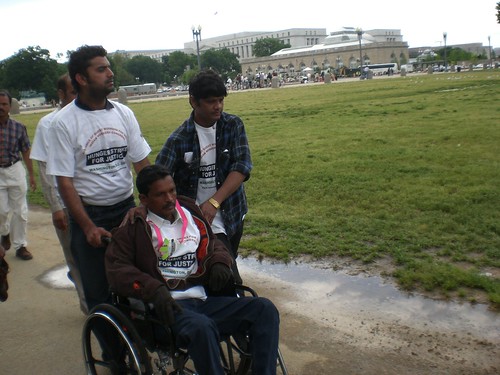
The basics details: some 100+ workers (of the total 550 at Signal International) walked off the job at the beginning of this year, risking so much but stepping up because they couldn’t take it anymore. They had connected with the New Orleans Worker Center, headed by (young) South Asian leftist Saket Soni from Chicago. The workers have since engaged in a number of actions, including a satyagraha “march” from the deep South to Washington, D.C., where they stopped to meet and build solidarity with civil rights leaders and African American communities on the way. They rallied in D.C. and presented their requests and demands to the Indian Embassy (for the Indian government to intervene on their behalf as it has with nations in the Middle East), DOJ (for the granting of continued presence status), and members of Congress. That was at the end of March. And nothing moved between that time and May.
So since May 14, about 30 workers went back to D.C., escalating their campaign into a hunger strike, where 5 workers swore off of food until their pleas for intervention and justice were heard. It has been 9 days. While more workers have come from New Orleans to join in the hunger strike and/or to participate in actions this week, three of the original hunger-striking workers have been hospitalized, and it’s not really clear what the end point to this process will be. There are a number of supporters who have been around the workers in D.C. from the beginning, but they are tired, and morale seems low.
From a distance, and perhaps to the bookish/armchair revolutionary who longs to be part of an epic struggle against the oppressive state like third world uprisings around the world and even the attempts in the America of the 60s and 70s, the workers’ struggles and brave actions may seem heroic and completely worth supporting: this is the people uniting for a common cause against oppression after all. I know I felt that, even though I haven’t had any real connection to what’s been happening.
But I’m also beginning to wonder about some things, particularly with the organizing strategy. I’ve heard Saket Soni speak a couple of times in person about this campaign, and I’ve seen a bunch of videos through the campaign blog where you can hear his rhetoric and see the strong united front of the workers behind him. He hits all the right notes, connecting this terrible situation with the legacies of slavery and indentured servitude. He rallies the workers behind him and gives what seems to be adequate space to hear the workers’ voices and stories. It is hard not to admire an organizer who is fighting something that is this criminally unjust, and it is easy to hear the workers’ individual stories and think that while they are the brave people taking the risks, the organizers are critical to help them achieve justice.
But what’s really going on here? While the work of the New Orleans Workers’ Center for Racial Justice seems to be legitimate, and the workers seem to be participating, are people asking critical questions of this campaign? For example, the workers are seeking continued presence while their trafficking claims are investigated – at this point, their immigration status is not clear, and when pressed by media or others, the organizers, Soni in particular, state that “it is our belief that they are the victims of trafficking and should be granted continued presence in the United States.” That’s fine – but what is their actual status, and what risk are they running by being explicitly visible? I’m not saying they should hide and let the corporation get away with this – I’m asking if the workers realize that if they are found to have unlawful presence and are deported by ICE, they could be prevented from re-entering the U.S. for up to 10 years. This is a real impact that they should know: but does it run counter to the organizing strategy, and therefore, is it diminished in importance when the workers are briefed before making decisions?
As a second point, what is the narrative that they are crafting with this series of actions? Calling the bus journey from the South a satyagraha sounds great – invoking a particular (innocuous old man) image of Gandhi that may rally South Asians (or at least garden variety liberals) to the workers’ cause. It’s good media sense to tap into something familiar this way and invoke that the workers’ struggle for justice is neither isolated nor unfamiliar to South Asians. But then is the hunger strike a natural step in the actual organizing campaign, or is it the next step to get the press interested? Who are the targets that are supposed to be moved by this hunger strike?
1) The DOJ isn’t going to bend for this one case – no matter how egregious – because that sets it up to do the same for all of the other folks in similar or even more dire situations.
2) The Indian Embassy is too concerned about India’s endgame to wedge itself between the U.S. and Pakistan, get on the U.N. Security Council, and get recognized as a world nuclear and economic superpower with the help of the U.S. It’s not going to jeopardize those goals with the U.S. on account of these workers, no matter how terrible the situation. Let the U.S. courts sort it out: there’s big business to attend to.
3) The Congressional targets need to be made much more directly aware of the crisis and how they can intervene by pushing for an investigation and looking at the H2B program as a whole. But I can’t really see action alerts for allies to raise the pressure, and will the targets care if non-citizens are starving themselves for justice when they have constituents (and voters) who may be anywhere from ambivalent to wholly hostile towards migrant workers “taking their jobs”?
Basically, how is the hunger strike going to move hearts and minds, and if it’s not, why the hell are you endangering the workers’ health, safety, and ability to stay in the country for non-achievable goals (within the context of this particular timeframe).
On top of these strategy questions, which may be discussed internally and not disclosed to the rest of us, I also want to ask the question of how much power the workers actually have in making these decisions. It seems like they support Saket Soni and the Center, but what do we know? And what I’ve seen from desi and other left groups is fairly uncritical – just either staying away from the issue, or just forwarding along the information as an FYI. Has anyone actually directly asked Soni and the other organizers from the Center about this? My contacts who have visited the workers a few times have said that the workers have a lot of questions about the effectiveness of this campaign, the plan for the future, and legitimate concerns about how this whole thing has been managed, but that the questions are deflected internally, and things haven’t changed.
Are we giving Soni a free pass because he’s a man of color who is working with co-ethnics rather than a white wo/man in a community of color? Is he getting that free pass from white “progressives” who recognize their own privilege/are fearful of being called out and so they don’t criticize/come out publicly, and brown/black/yellow “progressives” because there is always a question of our own legitimacy in this kind of work, regardless of the racial/ethnic bonds we may have with the communities that we work with – and we don’t want the tables to be turned and the microscope to be on us and our work?
But what about the workers, then? Is the cult of personality enough to protect someone and his possibly flawed and dangerous strategy – or should we recognize that we too would be partially responsible if something terrible – that was avoidable – happens to the workers after they’ve taken the brave steps to leave the abusive work conditions and speak out? Why aren’t more people asking these questions instead of just “supporting” the struggle? Are we supporting the idea of the struggle – or the workers who are taking this effort on their backs: is it the same thing?
May 23, 2008
Mississippi Workers Hunger Strike: Day 10... to what end?

May 13, 2008
Indian Fraternities and Sororities
This past academic year, I spent more time at a large public undergraduate college, where there is a pretty significant Asian American community. I got to interact with some of the college-aged South Asians - though they were primarily Indian American, of course. Although the school has multiple South Asian organizations, based on religion, ethno-national identity, and even cultural groups (singing troupe, dancing group) a lot of the folks were part of the ever-growing South Asian (really, Indian) "greek" life that seems to have blown up over the last 5 years.
I know that the first Indian fraternity started in 1994. It was called Iota Nu Delta (IND) and started at SUNY Binghamton. Their website is quite a trip. I particularly enjoy this call-out quote on the sidebar: “February 7th, 1994 would be the birth of an organization where eight great men laid the foundation for the entire South Asian Greek cpmmunity (sic)...”
Okay - where to start with these groups? I guess the first thing is that the groups were marginal at best when I was an undergrad, and even in the years following. We laughed at their initial steps, not realizing that they would grow and multiply. I think there are about 10 Indian/South Asian fraternities and sororities now, and the students I spoke with were very energized about their organizations - far more, in fact, than they were about being part of any traditional college organization organized around ethnic or ethno-national origin. Far more, in fact, than they were about attending workshops or taking classes that explored South Asian American history, organizing, and struggles in the U.S.
So what is it with these organizations? Speaking as an outsider, I guess I thought they were fairly harmless when I was first exposed to them. Just replications of the mainstream white "greek" groups, not really following in the footsteps of the Alphas or the other strong Black and Latino/a fraternities and sororities that really focused on service and building a different kind of community. Those groups really focused on academic excellence, built around a fundamental understanding that shit is fucked up and that the man is trying to push us down, so this is another site for political and personal growth, solidarity, and identity. Again, as an outsider, that's just what I saw, in comparison to the watered down animal house hijinks of the white frats and the vacuous self-absorption of the white sororities. I remember the Black and Latino/a organizations worked hand in hand with the political organizations - there were differences, but they were connected as well.
But it doesn't seem to be the case with the new Indian greek life. The organizations seem separate, the students seem like they are in their own worlds, and just when I thought the Long Island cluelessness that had seeped into the consciousness of so many suburban desi kids was the outer limit of their uselessness, these folks often push the envelope further. And I haven't seen an outpouring of critical thinking or even serious community service come out of these groups - it's just more of the same from the mainstream frats. With more of these organizations coming up, I wouldn't be surprised if they just get stuck in their own turf competitions, and fully check out of any other campus engagement.
I know, I'm old and I'm out of it. But these groups are no longer on the fringe where they exist, and honestly, political campus organizations have not caught up and created something that matches the powerful effect of the pledging process: particularly how the rites of passage make folks feel connected (artificial community development). Once they get the incoming students to pledge/join up, they don't need to explore different identities and ideas - they can stay in the comfort zone of these uber-cliques.
I'm genuinely fearful for the future: I wonder if even the Indian Student Associations of the American college scene (never mind the pan-South Asian groups) have the same pull they once did. Not to mention that these groups actually re-emphasize the "Indianness" of the whole thing - as campus South Asian spaces become more heterogeneous, the frats and sororities may reflect the circling of the wagons for the privileged middle class Indian kids from suburbia, whose picture of what brown people in college should be is being rattled by urban, working class, non-Indian, non-Hindu, non-conformists. Rather than find common ground, the mainstream folks have moved into different configurations and "safe spaces" where they can continue to push the falsely monolithic "Indianness" of their parents that's not as threatening.
And what will that mean for social justice organizations in the future? Does it limit their pool for recruiting and/or building consciousness, or were these folks the already/traditionally uninterested, so there isn't much loss related to this development? Are there other effects when the active South Asian population is so fragmented on campuses - so that you have the "cultural" groups that attract foreign students and folks who grew up around all or no South Asians, the growing greek groups, the religious groups (I have to post on this separately, because this is also a newer development that is interesting/troubling), and the (quasi-)political groups (do they even exist anymore?). How can these folks advocate together around common concerns for South Asian American communities (on campus and off)?
On a different angle, if pan-South Asian work looks like it's failing, will that move more of the progressive South Asians on campus to the pan-Asian and pan-POC spaces out of frustration and their own search for community? Maybe that's a good thing... I have no idea if this is also happening in non-South Asian, APA spaces in colleges: and I really don't think this is likely on the West coast, where the history of student activism is so rooted. But I could be wrong, of course...
May 10, 2008
Is There Anybody Online Out There?!
I'm back, kind of. Finals, closing out my school gig, and trying to figure out what's next have kept me off the internets, at least as a poster, for a while. I don't think I'll be writing that much until August, actually, just given that the monopoly that makes us test and take exorbitantly expensive prep classes will own my ass until about 6 PM on July 31. I found out that Blue Scholars are actually playing NYC on 7/31, but we already got tickets to the Bruce show in NJ, so I'm not going to make it. First time I could catch them on a tour of the East coast, and the bullshit exam is in the way.
But forget all that. I've been thinking about what to do with this site. I've had it up for a few years now, and I enjoy writing here and trying to build community with the good folks who stop by once in a while, but the format (and the lack of design!) are limiting at best. I'm also feeling like I want to consolidate my attempts at writing and reflection under one banner, instead of the different sites and handles I'm using at this point.
This site has allowed me to feel more comfortable putting some basic criticism and thoughts out there, especially about the incredibly small APA community, but it's not quite how I'd want to do it - it's easy to hide behind a blog/pseudonym and just write stuff without taking heat for your opinions/observations. Usually, no one cares, and I've been pretty careful, but it's also not really moving a dialog with anyone. Blogs are fun ways to stay in touch with people, but the format I've been using with this isn't really going to move anyone or push for change because I've been conscious that it's cowardly to take what look like potshots at groups and individuals from behind something like this. And honestly, I want to build community with people - not be stuck in my own little silo.
So I'm thinking about that with this transition. I'll likely keep writing here for a while, as an outlet, but I'll figure out how/what comes next as soon as I have a moment to plan it out. Till then - keep on keeping on, ya'll. And enjoy the weather - rain washes it all away, and the sun keep us growing.
Apr 23, 2008
The Formation of Damnation: Testament
 The new Testament drops next week, but they have (graciously, awesomely) put up the whole album for free streaming on MySpace this week. They totally convinced me through this awesomeness to buy the CD on the spot directly from them. And you know, I'm through about half of the songs and this album RIPS. I am really excited to get my copy and play this thing to death. It sounds like a very good mix of their old style and the newer, more aggressive stuff they'd been playing since.
Testament are the best of the best. No one else has this much talent and ability to change tempo so effectively. I think having a real singer on the mic, instead of just a screamer/Danzig wanna-be, makes all the difference. And Alex Skolnick writes leads that fit. I really hope I can catch them after the bar this summer, if I don't go away. They're on tour with Priest, Motorhead, and Dio-Sabbath.
If you listen to metal, buy this album.
5/02/08 Update: So I put in my order the day that I put up this post, and I actually got my CD in the mail on 4/30, which was a day after it was available in stores. That means the Testament crew popped it in the mail on 4/28. On top of that, they gave me the original CD in full shrink wrap plus an extra copy of the booklet that was signed by the band (the signatures were the pre-sale promotion through the website, but I didn't expect the extra booklet). Damn cool. Wish I could say that the album was my favorite, but it just isn't. I'll do more of a breakdown once I'm through finals, but I realized a few things about the band through looking at the booklet (I think I haven't owned a real Testament CD in a long time, so I haven't really looked at the lyrics). It isn't the slam dunk I was hoping for, but you should still buy it.
Apr 22, 2008
Choose One? False Choice.
This post will not be news to the few and faithful readers, but I'm going to post again to pile on about how annoying it is to be around otherwise fairly smart people who have been wholly co-opted by this false set of "choices" presented to us in the corporate duopoly (hat tip, Chedda) in which we reside.
Basically (stop me if you've heard this one before) I was at a nice dinner with some folks, as a bit of a send-off before we graduate. Somehow, the Pennsylvania results came up, and someone asked me who I was supporting. When I said "still deciding between Nader and Mckinney," I got dumped on. "ohhh - you're voting for McCain" and "We saw this with Bush in 2000." I wanted to be quiet, I didn't want to engage. But it's just not easy.
"My people come from a country with 500 political parties, so I'm okay with breaking out of the so-called two-party system we have here." End good night out with decent people. This is why it's getting harder and harder to mix "progressives" with "radicals."
Apr 11, 2008
Where Are the South Asians: "Vincent Who?" Preview and Critique
I just caught wind of this new documentary, directed by Tony Lam and produced by Curtis Chin/Asians Pacific Americans for Progress, called "Vincent Who?" which looks at the legacy of the murder of Vincent Chin and the activism that galvanized some Asian American communities afterwards (it was 25 years in 2007). Here's the preview:
Okay - so I have some issues with this, and I'm hoping that they won't play out the same way once I see the full film, but I'm not hopeful. First, for Asian American activists of any color/ethnic configuration, Vincent Chin's story represented a senseless murder that underscored the sometimes severe anti-Asian sentiment that remained in the United States (i.e. passing new laws to get rid of racist old laws didn't get rid of Asian as foreign and other sentiments). The film "Who Killed Vincent Chin?" really captured the spirit of the time; the pain on his mother's face still haunts me, and the images of Asian activism around this particular hate crime were very important for me to feel connected and understand the injustice involved.
But the raising of Vincent Chin's story to this level of importance also does the same thing as focusing heavily on the 1960s and 1970s APA activism (I Wor Kuen, I-Hotel, Third World Student Strike, Basement Workshop, the Internment reparations movement and various other things): they shut out the importance, activism, and organizing in newer immigrant communities. Vincent Chin's story is the touchstone, but Navroze Modi, Balbir Singh Sodhi, Rishi Maharaj, and the many Southeast Asians who have been senselessly murdered are forgotten.
This film's preview tells me two things: first, the question is posed to a lot of South Asian students as well as other Asian students. They're as ignorant of Vincent Chin as anyone else, it seems, and I think the point should be that they should know. But second and more importantly, the people who are interviewed about the impact of the case and the resulting activism only includes (in my quick review of the preview and the written materials) one South Asian, who's on the WEST COAST (and who I've never heard of). Anti-Asian violence has been a huge deal in South Asian communities, and organizers and activists continue to use the lessons of the Vincent Chin advocacy to guide their ongoing work. But they are ignored in this new documentary. People who have no direct connection with the case are asked about how it affected them. I know a lot of people that it affected who committed their time and work to fighting anti-Asian/anti-immigrant/anti-gay/anti-black hate crimes. But they aren't included here (or at least, don't have any marquee presence, and I would think some of them would).
This just makes no sense to me at all - it seems like a glaring mistake that could have easily been rectified. I will wait to pass final judgment, but it was a great opportunity, I can come up with a long list of names of people who could have been interviewed, and I can't understand why, if the purpose was to show ways that APAs now are affected and could still be connected to this story, that step wasn't taken. Shut out again, even when hate crimes against South Asians have risen tremendously in the years after 9/11. I'm not whining here, just asking what gives, and wondering why there aren't more truly representative efforts out there by non-South Asians in things that are very obviously relevant.
Maybe I'm wrong. I'm not saying it's deliberate, but is that an excuse?
Apr 7, 2008
Taiyo Na: Love is Growth

Taiyo Na has finally finished his debut album, which started out as a wholly hip-hop joint, but now fluidly integrates soul and a range of other kinds of music into the vibe. I heard him in an interview on Asia Pacific Forum (where, incidentally, I first learned about Blue Scholars, who I can't even imagine my life without at this point). The album was put out/produced by Issilah Productions, one of the many projects of former Queens laureate (and damn good singer/scribe herself), Ishle Park. Man - there's talent oozing out over all the boroughs!
So check out some of the tunes, and show the brother some love - I've ordered up my copy, and have been listening to the tracks on his MySpace patiently until the disk arrives. You should too. I mean, the man wrote a love song to his immigrant moms. That's keeping it real.
Hipsters and Metal, Again?

Okay - so it seems like Metal Inquisition has found a hipster (or it may be streetware of some other kind) clothing line that has co-opted a classic death metal band's logo. See the post here for details (and the picture for the visual evidence).
A few things about this post, briefly.
1) I thought it was hilarious (again). But it also combines that whole "hipsters suck" thread with something I'd been thinking earlier: metal isn't supposed to be cool. It's supposed to be a close-knit, kind of brooding space (though some people are very giving if you're in it).
2) I thought the pictures and commentary were golden.
3) I actually really liked the race analysis that they had at the end of the piece (36 Mafia sporting Maiden shirts still has some redeeming and understandable side to it - given all the appropriation that happens the other way around with black culture). I'm telling you - these folks have more smarts to them than they let on.
4) Chuck Billy got cornrows?! WTF?!?!
Apr 6, 2008
Support the Fight for Asian American Studies at Hunter College
 I'm writing this in response and in support of the righteous students and organizers at Hunter College, part of the City University of New York, who are organizing and pushing to protect and expand Asian American studies at their school. I stand with these students and urge any reader here to check out their information (here's an article to start) and see how you can be supportive of their cause. I'll post more information up as I get it about how allies and supporters around the nation can show them love and let them know that we stand with them in this struggle. Though some of the private schools in NYC such as NYU and Columbia have been able to maintain and expand Asian American studies program and initiatives, the City University sites at Hunter and Queens College have not had the resources or the support from Administration to do as well. They are struggling, and with them, students from families throughout NYC, many of whom grew up in the city and know the communities well, have fewer opportunities to connect those communities to larger struggles in the way that only solid and resourced Asian American studies courses and programs can do.
I came up through public schools, up until this stint in graduate school. The fight for Third World Studies and curriculum came out of righteous struggle in public schools, with the partnership of the broader community, recognizing that we needed our peoples' struggles to be represented in the classroom for a lot of reasons. It is really serious if history is taught devoid of the specific activist and organizing legacies that have been at the root of social change, from the hard-fought labor victories that gave us the 40 hour work week, benefits, minimum wage and the right to organize to the civil and immigrant rights gains that the conservative movement is trying to roll back.
Ordinary and extraordinary people, far beyond the few known individuals like Dr. King and the others chosen by the mainstream to represent these mass movements, committed their lives and risked everything to move things forward. By ignoring or simplifying this context, the people - specifically the oppressed and powerless - are expected to stay in their place and play by the rules in place. They do this without knowledge that there has always been a strong and present resistance in the United States, and one that has made progress, even if it hasn't reached the revolution.
The prominent narrative in America is that the founding documents were all we needed to get the "freedom" and "liberty" we live with: the importance of peoples' power, and movements, are frequently undercut or actively contradicted. Why else would labor unions, which were so critical in so many ways, suffer from mediocre celebration and membership (though I'm not saying internal corruption is not also a factor).
This is even more pressing for communities of color and immigrant communities. Feeling powerless, they often don't know that there have been generations of struggle led by immigrants -- in the fields, in the factories, and on the streets -- that have changed this country. Asian American community contributions are one such place for these histories, which still remain hidden within the canon of American civil rights and resistance thought, literature, and studies.
While I think that Asian American studies can be a space that is self-indulgent, detached from the real community connections that it should have, and far too theoretical when there's a world outside for it to engage, it is also a space for reflection, revelation, and resistance. Asian American studies that engage the local communities, and that open up a dialog with those communities -- literally, and through the texts and pedagogy -- are our only hope to moving beyond simple identity politics to something more transformative.
I applaud the students at Hunter for saying "hell no!" and for holding on and fighting for Asian American studies. Hunter has had a long and difficult tradition with its Asian American studies programs, and I know there are some alumni out there who were part of earlier struggles, and should plug back into what's happening on campus.
To the students, your struggle is our struggle. Your struggle is a struggle that many of us forget is still going on at campuses where it matters. Your organizing is not in vain, nor is it lost on those of us who believe in the struggle and in the cause. It's not just about finding ourselves in the curriculum - it's asserting that we belong there, that our stories and community members should be in these institutions, and we should have the ability to learn from the past so that we can be connected to those struggles as we move forward.
Keep ya head up, and let us know how we can help.
Apr 5, 2008
Territories and Taboos: Tibet in Asian America
I've recently gotten a fresh taste of the minefield that is Asian American homeland politics, at least how they play out on the seemingly innocuous setting (yeah right) of a law school campus. Basically, I visited a school where they decided to have a discussion about what has been going on with the uprisings in Tibet/China over the last month. If you haven't been following, Tibetans have been rising up with a lot more fervor recently, in the months leading up to the Summer Games in Beijing.
The school didn't even have a group representing the growing independence/freedom movement, which is at odds with the Dalai Lama's message of a middle pathway towards nonviolent conflict resolution with China. I have a particular, inexplicable draw to thinking about the Tibetan people. I almost always feel a sense of kinship with the Tibetans I meet, even though I can't speak Hindi, and most of the ones I meet come from India and know the language (among others) very well.
That Tibet remains an occupied land, that China will not hear of the independence or even the true autonomy of the region, and that there will only likely be more violence and bloodshed, even with the world community paying more attention aren't even my key points here. I think Tibet is quickly becoming the premiere fiery issue for the neo-nationalists from China in the United States. It's a funny thing to see people who may have been oppressed by the state in the past, singing its praises and confronting pro-Tibet sympathizers.
That's what happened at this event - there was an organized group of Chinese students (couldn't tell if they were foreign students, long-time residents, or folks who have adopted (or countered) the politics of their parents) who dogged the speakers, made long speeches about the brutal, archaic feudal system in pre-occupation Tibet, and challenged the accounts of people from groups like Amnesty International. It was incredible, actually. I was pretty surprised - these are students who generally sit just at the periphery of noticeable student activity or speech. Something's riled up this feeling, and I wonder what it is.
Well, actually, the "what" is easy: it's a reactive nationalism, either one that's been there all along, or one that is awakening in light of what they may perceive is "China-bashing" by the world community. It's the "why" that's puzzling. The people have little/nothing to gain from taking such an adversarial position - people are saying that the government is to blame, not the 1+ billion Chinese people. But the feelings seem to run quite deep, and the resistance to hearing anything to the contrary seems to run even deeper.
China benefits from this nationalism, of course. As the governments of nations like China and Indian recognized long ago, their expatriates are the P.R. foot soldiers for nations that are slowly rising up. Make good impressions. Don't rock the boat. Decrease the level of mistrust/unfamiliarity that has kept us foreign and dangerous. We want a piece of the action, and it's up to you to bring it. This "duty" to serve as ambassadors of the sending nation is more than just suggested, sometimes. But I won't go there right now either.
I just wonder what this sharp reaction from Chinese Americans to the Tibet issue means for folks who want to work in the community. Is Tibet quickly becoming the new Kashmir (which you can't really talk about with people in South Asian communities whose politics you don't explicitly know)? Or even the new Taiwan? It feels like the relationship of occupation, cultural oppression, and interference make it closer to Kashmir, or even, as a speaker mentioned, the West Bank. And so we're back to Palestine/Israel, again.
But in a community that spends a tremendous amount of time caring about things overseas, are Asian American community workers being forced not to talk about foreign affairs in order to focus on domestic social and economic justice issues? And if this is so, isn't this denying a piece of our consciousness, and the opportunity to change hearts and minds with each conversation, that we should be taking? How can we stay silent about Tibet when we're talking to well-off Chinese Americans about human rights violations against Asian Americans in the United States, when we know that they have a set of misconceptions about the situation overseas that run so counter to the life ideology that brought you to this work to begin with?
Or is this the place where it helps to have people in the coalition that is Asian America who aren't speaking from within a specific group (i.e. having a South Asian talk to Chinese Americans community members so we don't immediately turn them off somehow). I know there's a way to play the differences - will have to think/write about that more later.
I'm just saying: Asian countries need to get their acts together. It's becoming more and more difficult to navigate the delicate sensitivities people have about these issues without just saying "Yo, this is where things are at. Deal with it!"
Apr 4, 2008
Sites I've Been Reading
Finally got my act together and updated some of the links I have to the left over there. I'll do better when I have more time (and maybe even update this site that looks like it's fresh from the late 90s). Here are some sites I've been checking out regularly that you should too:
1) The Cheddar Box: My man has been coming over and sharing the love on my infrequent posts - but you should see what the strong and conscious brother is writing, thinking, working, and living in ATL. And his site is definitely better looking than this one.
2) Boston Progress Arts Collective and Boston Progress Radio: I don't know where I've been, but Boston is where it's at. With the Asian American Resource Workshop, Asian American Movement 'ezine, CAPAY's youth organizing, really deep community development work in Chinatown, and Boston Progress Arts Collective (BPAC) - a fierce Asian American collective of artists and activists who run a community bookstore, have a 3 years and running monthly spoken word/poetry event, and now this nifty radio station and blog that features Asian American artists (it's the best thing to write to, let me tell you).
I don't know - the combination of real creative work, community, and DIY spirit warms my heart, hearkens back to the days I read about with storefront operations and community service activities by folks on the West Coast in the '70s, and certainly with the Basement Workshop in NYC. And this is BOSTON, people - never will I disrespect the city again, scout's honor. If there's a way, way East Bay... it may be Boston. Much love to the people out there. I know there probably aren't a lot of South Asian cats that pass through and call it home - but it feels like home to me, and like a place that would embrace me as a brother. Anyplace that values the power of words, beats, life (rice?)... without taking it so seriously that they can't laugh a little... well, bruh, that's community.
3) Metal Inquisition. This site is one of the funniest I read - if you're not a metalhead, it may not make much sense, but they're pretty funny even still. If you listen, or used to listen, to any metal, you'll appreciate it even that much more. Check it out. But don't stay too long, you may tear out your eyes (or at least become unable to tear them away).
Mar 23, 2008
The Desi Guy in Sitcoms
Years after Apu, there have been a string of desi guys who have shown up in supporting roles on sit-coms. Everyone remembers "Babu Bhatt" from Seinfeld (though I'm still trying to forget). I'm sure people can name their favorites (or crappiest), but I'll just do this quickly. After all, I'm sure some of the pop culture sites have probably covered this a million times:
1) Unhitched - Shaun Majumdar - I just watched a snip of this, and it was bad. The dude's accent sucked - I don't know if he was hamming it up to prove the point that he doesn't actually have an accent, but it was pretty bad. Though he was apparently a "pro" at getting the "O" when married, of course it was tied to "tantric" technique, which he then went on to teach another character. So he's a sex machine. That doesn't really inspire me to think his character is breaking any molds (reading that he's a doctor in the show doesn't help). I couldn't stand it anymore.
2) Aliens in America - Adhir Kalyan - when I first heard about this show's premise, foreign exchange student from Pakistan lives with a family in Wisconsin, I really expected the worst. I heard from somewhere that it wasn't that bad, and because "Unhitched" was so terrible (and I was coming off a really funny Simpsons), I decided to check this out a gain. I'm glad that I did. The show actually dealt with some issues of difference and understanding fairly well for a sit-com. I was pretty pleased - I thought it would be more of a gloss on Gene Yang's Chin-kee character (see the wonderful, American Born Chinese), but it was a little more layered than that. In a way that is simplistic (who's the target audience for this show, after all), it is still humanizing this kid and gives us something better than the b.s. thrown out every week in shows like 24 and the like. Hey, and there's a cover of "(What's So Funny About) Peace, Love, and Understanding" on the show that features Salman Ahmad of Junoon. That's pretty cool. I actually thought the episode I watched was better than most of the "Little Mosque on the Prairie" stuff I watched earlier.
3) Weeds/30Rock - Maulik Pancholy - The roles are not specifically desi, and that's kind of cool, actually. His politics are good, and he's a funny actor. I really enjoyed seeing him on Weeds, and haven't seen an episode of 30Rock with him, but he's just a character, not a desi character, and that's refreshing.
I'm pretty sure that show with geeks or super geniuses and the female neighbor (I think it's called Big Bang Theory?) has a desi guy in it, wielding the protractor or some other nonsense, but I haven't watched more than a snip of the pilot.
Beyond the quick run-through of characters, I think it's an interesting comment on how the desi guy has become the new accessory in these shows. Is it the accent? Is it some residual glow from the "Harold and Kumar" phenomenon? I'm really not sure, but it's definitely become more prominent. "Aliens..." actually focuses on the character, while the other shows have the characters in much more supporting roles, but it's an interesting time to watch what evolves out of this for desi male actors. Will they graduate from the boxes that they're placed in at this point (or do we say "not playing a terrorist" = the second wave of desi men on the little screen?).
Regardless, I still think Mindy Kailing, of the office, is the funniest South Asian on American television. And she's writing a lot of the stuff herself!
Mar 20, 2008
Obama's Speech
Okay, I didn't hear Obama deliver the speech. I read it the morning before he delivered it, and I have to say a few things from the moment I read it:
1) Why did he make that comment about "staunch ally Israel"? Was that really necessary? He took the cheap shot, dismissed the real suffering of the Palestinian people, and kind of bent backwards when he really didn't need to go there. So that was annoying.
2) We've been saying for a long time that Obama had to talk about race in some real way. Running the campaign as a "post-race" candidate just appealed to the neo-cons who have hijacked the idea of a "color-blind society" from Dr. King and turned it into a crusade to ignore the devastating and real impact that race still has in the United States. It's not just about the past, either. It's about how things are right now and how they will be if we keep going the way we're going. Obama running for office was presented by some people - liberals who didn't seem to have a more critical analysis, especially - as a big step towards "healing" the country's wounds and divisions. A lot of people said to me, well of course he believes the same things we do about institutional racism and how far this nation still needs to go. He just can't talk about that right now, to get elected. Just get him in office, and you'll see.
Well that wasn't good enough for me. If other issues were handled that way - we would just work on faith that health care was a priority for Hilary but she wouldn't have to talk about it. Or national security for McCain. But that's not how it works, and just ignoring race, when it was clearly the subtext of the polling analysis and the undercurrent of "what will middle America, the white folk who don't live in cities do when it's time to vote?" didn't seem right. I felt like it was racist in itself to say that talking about race is too "controversial." Maybe Obama wouldn't have gotten this far if he'd had the dialog that his speech is said to have kicked up, a while ago. Maybe this is as soon as he could have had it. I don't know, but I think the way he approached these questions earlier (or didn't) really troubled (and puzzled) me.
3) I don't know, is it just me (I know it's not) - but I found Reverend Wright's sermons - at least the snippets we kept hearing - quite refreshing. It's funny that the media is calling the sermons so problematic. They should do the same about all the anti-gay sermons, literature, talk-show appearances that the mainstream evangelists do all the time. Or even just the simple "nonbelievers will go to hell" litany that immediately makes me feel pretty angry and powerless. But there have been some great pieces about how this may be the first time that white people in the mainstream are actually hearing the tone of what a lot of people feel. Maybe it's the first time that a lot of white folks are actually getting a glimmer of a sense of what it's like to feel powerless against someone speaking so patently against your closely held beliefs. Now imagine what it would be like if you really didn't have the political and race-based power that you have. I don't think you can.
4) Obama's speech surprised me. I didn't expect him to go as straight on with some of the points that he did. I was actually happy that he didn't make light of the anger, of the history that people all remember. That he didn't bring things up to say "all is fine now" but to reinforce his message of hope. I think he could have taken a safer road (though I don't know how revolutionary his speech was - he was towing some lines while saying "hold up, things aren't perfect"), and I'm happy that he didn't. I don't know if he's won away my vote in the general election from Nader/Gonzalez, but he finally showed me that he gets some of what we've been talking about in radical circles of color for a while.
5) That said, some of my friends have just trashed the speech. They hated it, they thought it didn't push the debate at all, they say that it was a purely political speech. I guess I'm not as cynical about it - though I can be pretty brutal in the post-mortem. I think that political operatives and the whole SAFO crowd are a little nutty, and not objective at all, but there's also such a thing as being over-critical without giving people the moment that they kind of deserve. I have to give Obama this moment - it was impressive, he's been getting and will continue to get a lot of slack for whatever he says, and really, the man said I'm not going to back down but I'm not going to yell in your face. I don't know if I'd be able to do that, myself. Because emotions are clearly running high, and he has been able to keep his poise and take the higher road through all of the b.s. It almost seems like he's too good at it - but that's not a fault. We may just be too cynical on the left to acknowledge and accept that.
Mar 17, 2008
Maiden: Somewhere In Your Wallet Album?
 Okay - so I'm clearly a Maiden fan, have been for a long time (again, not as long as some of the folks out there, but long enough), and was really happy with the last studio album. But how many greatest hits packages do you need? They are coming out with ANOTHER "greatest" hits, this time from "1980 - 1989" and the only reason to even look at it in the store is to see how the new Derek Riggs picture looks close-up (it's likely a digital piece, so it doesn't have the crispness of his original paintings, but it's still a Derek Riggs).
I'm sure we can all complain about what's included and what's not, but do we really need "Iron Maiden," "The Trooper," etc? I think I'm going to have to pull together my own dream set list for a show, and/or even for a "greatest hits" package. They don't throw in a new song (at least Best of the Beast had "Virus" on it), they don't give you alternate versions, and there's no best of the b-sides disk (for those of us who couldn't buy the outrageously expensive treasure trove, Eddie's Archive).
The other thing that's funny about this release is that they have a funky download first option that they are rolling out (and trumpeting) that just seems: 1) bizarre; 2) lame; and 3) like the idea really is "somewhere back in time" - like 10 years ago, in the context of what other groups are doing. If Maiden were really on top of this stuff, they'd take a number from Trent Reznor's book, pull together some deluxe packages for fans with Derek Riggs artwork, picks, whatever, and they'd be able to totally make the headlines and fuck up the major labels. Can you imagine if they gave the greatest hits away for free as a download, for real? And if you "buy" it - you'd get a special disk of b-sides and/or a small poster? Hell - Maiden is so rich that they could do a special printing of a 7" picture disk for a reasonably prized deluxe edition. How many fans would jump at that? I know I would. And it could go directly to them, or hell, to the Clive Burr Foundation that's been set up.
But they are conventional, and their management can't think that far ahead. And while I still love the music, I'm getting really sick of seeing the high prices and redundant releases. Do you really need that much more money?
Mar 16, 2008
Somewhere Back in Time Concert Review
I caught Maiden at the Meadowlands on Friday, and what can I say? First, it was the third time I've seen them, after the Brave New World tour, their stint on Ozzfest where they played the tightest 1.25 hour set I could imagine from their first four albums, and this one, where they stretched out a bit and celebrated the Live After Death DVD release (finally!) with a throwback to that period. This time out, they promised to play songs from the next few albums, and we were treated to the four songs from Powerslave that people knew, a couple of tracks from Somewhere in Time, and a golden 3 from Seventh Son (as well as a sing-along of "Fear of the Dark," the title track from the album that I've written about earlier).
What can I say? I got into Maiden after a good friend said "you found Guns 'n' Roses? You should listen to this" and handed me Somewhere in Time. So I don't go as far back as many of the other fans who can point to original pressings of Metal for Muthas and whatever, but I ate it up. Maiden was the first band I really obsessed over, and getting to know the back-catalog became a bit of an obsession. I settled on my favorite album (post-D'ianno, of course) to be Seventh Son for a long time, and it remains the one album I know I can put on at any time and just listen to straight through (though "Can I Play With Madness" grates on my nerves, to be honest). Anyway, as I've gone through many phases in music, and even in my interest in much heavier stuff now, Maiden remains for me, as I can imagine for a lot of other people, a touchstone, a reminder of a simpler time, and a consistent favorite.
Going to this show was particularly exciting because the only good live recordings of songs from Somewhere in Time and Seventh Son I had heard were from Maiden England, which I thought was phenomenal. I wished I had known about the band (and been able to get out of the house for concerts) during the Seventh Tour. But even just hearing a few of these songs live for my first time would be a real treat, so I was excited.
I'll just break down my realizations after the show briefly:
1) Large venue shows kind of suck. Too much money for tickets (and Ticketfucker is involved and sucking the marrow out of your bones as you pay), parking and getting out of the clusterfuck parking lot sucks, and you have to walk a long time to get back to your vehicle.
2) Concert shirts are damn expensive. I'm a bit old to still buy t-shirts and wear them (and my walls don't have space for this shit anymore), but come on: $45 for a t-shirt?! Now I see the "strategy" that Metallica is employing, since their shirts are now available at JC Penney (well, I saw a Ride the Lightning shirt there, next to something with Pac-Man on it, I think). My souvenirs from the show? A downgrade in my hearing ability and a postcard announcing new tour dates in June.
3) There are a lot of assholes who come to Maiden shows. They are too accessible, they have been around too long, and they are an easy name to drop to show your "creds." So there are a lot of dicks who comes to these shows. We almost torched some of them when they started tapping our vehicle to talk to us.
4) There aren't really surprises when you come to a Maiden show: the catalog is deep, the B-sides aren't as deep -- with all the coverst they do, you can enjoy the songs when you get them but who cares to hear that shit live -- but they don't really have the space for spontaneity, which is too bad, really. So while there are new songs on this set that we haven't heard live, it's not like they are suddenly pulling back and giving you "Flash of the Blade" or "Big 'Orra" or something. Or even a throwback to the old Smith/Murray dual guitar solo that they did during Somewhere in Time. After seeing some other acts a few times, like Springsteen, who has been around for longer than Maiden, and seeing how he pulls together set lists that are so different each night -- drawing from fan favorites that aren't singles to obscure b-sides, and not really catering to the lowest common denominator each time -- you feel like you can go to one Maiden show, and you know 75% of the songs you're going to get each time (give or take a few tracks from the new album, if there is one). So that was a bit of a downer, though I don't know what I was expecting. I guess I feel like if they have to go back to the first 4 albums for some of the standards, I'd rather hear "Flight of Icarus" or "Still Life" live, which I didn't catch when they did their first revival of the old stuff, than the 1 millionth replay of "Iron Maiden," "The Number of the Beast," or whatever else. Maybe it's just because I can tell that they are on the top of their game as musicians playing the material (they were amazing), and I want to see/hear more.
5) Adrian Smith could be in a harder band. He looks the part. Janick is ridiculous with his onstage presence, but it's endearing now. Dave Murray's leads were on fire. I would have killed for even a short detour on one of the songs though, to let the guitarists breath a little. A tight set is a wonderful thing, but it would have been so worth it to see them let loose a little bit more.
Anyway - I don't want to seem overly critical. It was a Maiden show, it was amazing, and I was so happy I went. I may not get to see them when they return to the area in June, because of the damn bar exam, but I'm glad I saw them here. Hearing "Wasted Years," "Moonchild," "The Clairvoyant," and a few other songs just made the night for me. I think I'll have to pull together my dream set-list for a 2 hour show, just to see how different it would be. Thankfully, they didn't play "Die With Your Boots On," or else those poseurs who got in our way when we were trying to leave might have ended up on the evening news.
UP THE IRONS!!!
Mar 12, 2008
Free Tibet!
The escalating tensions between China and the displaced Tibetan populations in India and the diaspora should hopefully raise people's consciousness about the egregious human rights violations that plague this relationship. I hope that more Asian Americans are very critical of what China has done to the Tibetan people - "saving" Tibet is not enough. Tibet must be free.
And people should disassociate their ethnic/racial pride as Asian Americans of Chinese descent from the nation/state of China - who you are is not defined by the political nation from whence your forebears came. South Asian Americans/Brits/Canadians are some of the fiercest critics of their countries of origin - because they have a legitimacy that may turn more heads than random white people. But for some reason, people don't always seem that comfortable with other Asian nations (show me that I'm wrong).
I've long considered Tibetans to be South Asian brothers and sisters, not that the boundaries matter that much, but they are a strong and proud people, and I don't really have a lot of faith that ever-more capitalist India will continue to be a safe-haven for Tibetans, even though so many of the young folks who are willing to march/fight for Tibetan freedom were actually born in India. How long before the Indian middle class says "let's cut this vestige of failed socialist Nehruvian policies - Tibetans are an internal matter for China to deal with, and we should stop letting them in."
Now is the time, I think, for some movement on this issue. But I want to learn more about it before I just shoot off from the heart without knowledge.
Mar 11, 2008
Arthur Who?: Confronting Anti-Islamic Opinion in Asian Week
In today's Asian Week Opinion, Arthur Hu posted a vitriolic response to Michelle Obama's statement (a lifetime ago, it seems) that a particular moment was the first time she'd been proud to be an American (taken out of context and clarified ad-naseum, so I'm not going to go there).
His text includes this nugget:
Nearly half of America is crazy about the man, but I haven’t seen a survey asking if America was ready to promote a son of Islam, Christian or not. Even McCain had to apologize for a host who emphasized Obama’s middle name.
You should get the idea from that. I'm getting fed up of the islamophobia or just flat out bigotry that's coming up in "Asian American" spaces. I want to think that it's just ignorance, but I suspect that it's worse: Asian Americans, even those who think that they are representing some kind of dissident or civil rights voice, have bought into the American bias hook, line, and sinker. It makes navigating Asian American spaces really difficult for Asian Americans who are either Muslim or work in Muslim communities (read: South Asian). I'm not taking this shit anymore. I'm calling these people out. Read More......
Mar 3, 2008
Asian American Activism: The Safe Work?
I've written here about working in the South/Asian American communities, and seeing that work as being where I've been and where I want to be after finishing with school. But regular interactions with family and desi family friends have made me think more about that choice: specifically because of how matter-of-course the older generation have adopted the racism of white America, fitting right into the racial hierarchy that puts them somewhere between blacks and whites, unless they get uppity.
Sure we get angry, upset, and try to educate within our communities, but how much is sinking in? How much just looks to people like we're idealistic? If we can't even move people on issues of faith (i.e. we are the same people, but choose to worship differently, so what's the big deal?), how are we going to combat all the racial programming that has convinced them that they want nothing to do with the black community (and increasingly, "those Mexicans"). I thought I had the patience, but I end up just ranting nowadays, not moving the dialog at all.
So I've started thinking that because there is still this perception that all South Asians or other Asian Americans in the United States are doing well, working in South/Asian American communities is a "safe" choice to explain/justify to the older generation. They think "job discrimination, yeah, I went through that in my effort to get my engineering job" so they think it's good that you're fighting for that particular right. They don't think you're talking about undocumented workers whose rights are being abused by other South Asians. Even domestic violence, which is so pervasive in our communities here, is connected as a middle class dilemma, and isn't questioned as much.
Never mind that we're thinking and talking about redistributive economics and hoping to work with people who will not be able to get that perfect job as a doctor, because they came here as laborers. The class distinctions are not quite as relevant to them - they can say "my daughter works for
I'm starting to think that this enables us to do this work without being questioned to the same degree, probably, as people working for social, economic, and racial justice in a space that works primarily with other people of color - with "immigrants' rights" being thought of as working with the Latin@ communities in the middle, and working with Black communities still at the bottom of the perception latter for the first generation. So I'm starting to wonder if I'm taking the safe road by trying to work in South Asian or even Asian immigrant communities. Is it easy to hide some of the significant differences between my life experiences and those of the communities I want to work with because we have "co-ethnicity" for me to hide behind? Seeing how many people that work in Asian or South Asian spaces are incredibly centrist, are we just enabling more of the same by working in these spaces that don't really shake up the status quo? Are we just doing "charity" rather than "movement" work?
Ahmedabad's Fancy Marketing
Check out the video below, sent to me by a family member who was born and raised in the city. It's amazing how you can just look at these things without a critical eye and think "wow - how great!" But then you start to think about how the city is incredibly segregated between the Muslim and Hindu/Jain sections, how Muslims live in abject poverty, and how there is such deep-seated hatred, racism, and bigotry fomenting in the middle-class Hindus/Jains there and abroad (which just makes no sense - you're doing okay, why are you hating on the people who are suffering?). And you remember that Ahmedabad has been the epicenter of Gujarat's politics of hate, culminating in the pograms in which thousands were killed and tens of thousands were displaced from their homes.
This is obviously to appeal to tourists and commerce interests abroad, saying "hey, remember us? forget about Banglalore and the other cities," but the omission of Muslims and/or the history of communal violence from the narrative about the city altogether (how many more pujas do you want to show, after all?) is very disturbing.
Mar 2, 2008
Misogyny and Election 2008
Sometime in January, Gloria Steinem sent up an op-ed in the Times that got a lot of play because she compared the misogyny and sexism that Hilary was facing in the race - and by extension, that women face in their everyday lives - with the limited outright racism that confronted Obama in the race to date. The piece drew a lot of ire from various camps, and I don't know if there was any real resolution or even a follow-up or clarification by Steinem. Obviously, you can't really get far by comparing oppressions, but she was trying to make a point about how even facially obvious sexism pervades American culture.
I was not as sympathetic to the point earlier, knowing that there are a lot of factors -- class and particular life history -- that have been greasing the wheels for Obama at that point, and he offers good proof to the proponents of color-blindness that the system works (similar to Clarence Thomas, Alberto Gonzalez (maybe not so much anymore) and other really successful people of color). Of course racism exists, and is still deeply embedded in the institutional oppression and generational disadvantages that have made it more difficult for people and communities of color to have a fair shake.
But I've been thinking more about Steinem's points, and after seeing the segment below on Meet the Press today, was just absolutely shocked in two ways. First, Tim Russert pointing to recent Pew Research Center poll results (with an N of an undisclosed number, but higher than 100 people), mentioned that when asked to sum up the leading candidates in one word, 11 people said a "word that rhymes with rich." I was shocked that that a significant a percentage of people actually felt comfortable enough to say something that offensive. That's a large segment, and it seems to be very telling that they can use a slur rather than even some indirect way of getting to the point. Obama's words were pretty vanilla, pun both intended and not.
But when I went to the actual Pew site for the poll, I started thinking more about what happened on Meet the Press, and realized my second moment of shock and disgust: the Pew website summary doesn't draw the list out as far as the list shown on MTP. They only go down the top five. In essence, MTP could have done the same thing and made the same point. And I just wonder - even on the full list there's nothing remotely similar in the columns for the other two men (though McCainites might beg to differ concerning the "liberal" on his list, but I guess he should rest assured that nearly as many people called Hilary "socialist").
Why did they include the really offensive comment? Why was that okay? Beyond a conspiracy theory, what does it say about how acceptable it is to put something like that on national television (I don't give a fuck about your disclaimer, Tim Russert, that this is a "family" program, you still had it out there). Sorry, that's fucked up. Here's the clip:
While I'm not a big fan of either candidate at this point, this really made me think more about what this race is bringing up, and the fact that while "women" (of all backgrounds) and men of color may have aligned interests against white male patriarchy, there are some other things going on here that make it easier for some men of color to rise in prominence and still preserve the underlying inequalities of power that keep this society so screwed up.
This moment serves as a reminder to me that sexism and patriarchy are important oppressions that I have to keep in mind at all points, not just as an item on a checklist to mention while flashing left credentials. This shit is real.