

Check out the video below, sent to me by a family member who was born and raised in the city. It's amazing how you can just look at these things without a critical eye and think "wow - how great!" But then you start to think about how the city is incredibly segregated between the Muslim and Hindu/Jain sections, how Muslims live in abject poverty, and how there is such deep-seated hatred, racism, and bigotry fomenting in the middle-class Hindus/Jains there and abroad (which just makes no sense - you're doing okay, why are you hating on the people who are suffering?). And you remember that Ahmedabad has been the epicenter of Gujarat's politics of hate, culminating in the pograms in which thousands were killed and tens of thousands were displaced from their homes.
This is obviously to appeal to tourists and commerce interests abroad, saying "hey, remember us? forget about Banglalore and the other cities," but the omission of Muslims and/or the history of communal violence from the narrative about the city altogether (how many more pujas do you want to show, after all?) is very disturbing.
Mar 3, 2008
Ahmedabad's Fancy Marketing

Mar 2, 2008
Misogyny and Election 2008
Sometime in January, Gloria Steinem sent up an op-ed in the Times that got a lot of play because she compared the misogyny and sexism that Hilary was facing in the race - and by extension, that women face in their everyday lives - with the limited outright racism that confronted Obama in the race to date. The piece drew a lot of ire from various camps, and I don't know if there was any real resolution or even a follow-up or clarification by Steinem. Obviously, you can't really get far by comparing oppressions, but she was trying to make a point about how even facially obvious sexism pervades American culture.
I was not as sympathetic to the point earlier, knowing that there are a lot of factors -- class and particular life history -- that have been greasing the wheels for Obama at that point, and he offers good proof to the proponents of color-blindness that the system works (similar to Clarence Thomas, Alberto Gonzalez (maybe not so much anymore) and other really successful people of color). Of course racism exists, and is still deeply embedded in the institutional oppression and generational disadvantages that have made it more difficult for people and communities of color to have a fair shake.
But I've been thinking more about Steinem's points, and after seeing the segment below on Meet the Press today, was just absolutely shocked in two ways. First, Tim Russert pointing to recent Pew Research Center poll results (with an N of an undisclosed number, but higher than 100 people), mentioned that when asked to sum up the leading candidates in one word, 11 people said a "word that rhymes with rich." I was shocked that that a significant a percentage of people actually felt comfortable enough to say something that offensive. That's a large segment, and it seems to be very telling that they can use a slur rather than even some indirect way of getting to the point. Obama's words were pretty vanilla, pun both intended and not.
But when I went to the actual Pew site for the poll, I started thinking more about what happened on Meet the Press, and realized my second moment of shock and disgust: the Pew website summary doesn't draw the list out as far as the list shown on MTP. They only go down the top five. In essence, MTP could have done the same thing and made the same point. And I just wonder - even on the full list there's nothing remotely similar in the columns for the other two men (though McCainites might beg to differ concerning the "liberal" on his list, but I guess he should rest assured that nearly as many people called Hilary "socialist").
Why did they include the really offensive comment? Why was that okay? Beyond a conspiracy theory, what does it say about how acceptable it is to put something like that on national television (I don't give a fuck about your disclaimer, Tim Russert, that this is a "family" program, you still had it out there). Sorry, that's fucked up. Here's the clip:
While I'm not a big fan of either candidate at this point, this really made me think more about what this race is bringing up, and the fact that while "women" (of all backgrounds) and men of color may have aligned interests against white male patriarchy, there are some other things going on here that make it easier for some men of color to rise in prominence and still preserve the underlying inequalities of power that keep this society so screwed up.
This moment serves as a reminder to me that sexism and patriarchy are important oppressions that I have to keep in mind at all points, not just as an item on a checklist to mention while flashing left credentials. This shit is real.
Feb 14, 2008
i've got love to share - i ain't all hard,
it's just sometimes, in this life
it's hard not to dwell
on the sheer weight of this movement
or at least, getting it started
in my head
but that's where i've been wrong, right?
that movement, someone said
has to begin inside love
and spread through the ideology
if we want real change
so to overcome the conceit
that my extra stress will carry this wave
i'll have to remember
1 isn't only a lonely number
it's not strong enough
until it's added to 1
and 1
and on
and on
with love for all the kindred spirits
who sustain me through the us we create
in each interaction
but for today
(and not because it is 2/14)
let me just begin
with that first 1
Feb 3, 2008
Retro-Thrash Makes Me Nostalgic
With the advent and current fad of retro-thrash that I've been reading/hearing about a lot on Invisible Oranges, Aversion Online, and other reputable spaces, I've been curious about the phenomenon, but not had the time or exposure to hear a lot of the new stuff. More than that, the phenomenon has made me think about why thrash has been a favorite of mine in the various (and ever-increasing) genres and subgenres of metal.
What is it about thrash? I'm not going to go down this path for too long, because "retro-thrash" has made me go down memory lane and revisit a period of the music past the 1991 release of Metallica's Black Album - which I used to hold was the turning point for thrash, and the point at which I stepped away from metal for a while.
Anyway, I like thrash because of the aggression in the riffs, the just over the top nature of it (just past pop-accessible/mainstream power metal and hard rock), the way that it's not really unified in any way (where black, power, and death metal seem to have some theme/technique that binds them), the showmanship is focused on guitar leads and some riffage - not so much on the rhythm section (I didn't really even pay attention to what drums and bass were doing), and the vocals are all over the map. The funny thing is, they want you to be able to discern the lyrics... there's perhaps a bit of naiveté that they will change the minds of people listening. But think about the singing - from the highly idiosyncratic vocals in Vio-Lence, to more power metal type stuff with Forbidden, to almost a hardcore approach with the thrash bands that adopted that style. And where else could a singer like Joey Belladonna seem to fit on top of a band like Anthrax?
I like thrash because it is pretty uncomplicated - the complexity of death metal (I've been learning) is hard to dig into (especially for someone whose metal journey started with Maiden). I like the social consciousness of some of the lyrics, though you can only imagine there's a "top ten" list out there somewhere from which the lyricists choose their themes (racism? check, environmental warning? check, war?...). I like singing along with people whose voices aren't so technical/skills-based (usually) as power/heavy metal, and yet actually have the pop-sensibilities of verse-chorus-verse structure. And I'll still hold that a strong/solid Slayer lyric is much more aggressive and "dangerous" when you can blast it and the average Joe in the street knows that Araya is screaming "before you see the light, you must die!!!"
As an outsider embracing a music of outsiders and for outsiders (hipsters weren't around when I was coming up), being "close" enough to understanding for mainstream listeners to more clearly demarcate my difference, actually made a difference. I think death and black metal were just so out there at that time that they weren't considered sufficiently dangerous enough for me to let go of thrash. Really, it was the sing-alongs while barreling down small town roads in my buddy's car.
So I've been revisiting older, but not first generation, thrash lately. I got into the genre after the standard-bearing albums had been out for a while - it was catch up for me until Metallica's Black Album came out. The album's "accessibility" blew them up, screwed them up, yadda yadda yadda. The story is documented in their own, tragically funny Some Kind of Monster (a real treat for the Mustaine fans/haters out there, by the way). I'm not going to waste space on the album here - it was baaaaad - it just wasn't thrash (or, really, very revolutionary or new in any way. If I wanted to hear watered down Soundgarden, I'd just as well have waited for Audioslave). More than just the album itself, what I think it did was sound the death knell for American thrash. Albums by other groups after Metallica did so well tried to emulate the accessibility of their effort, or reacted to it. Many groups broke up soon afterwards, and grunge took off in the mainstream.
I have a personal story connected to (and that prompted) this little walk down thrash memory lane. I was turned off by Metallica but I distinctly remember going out during May of 1992, in the midst of my finals in college, to one of my favorite record stores downtown to pick up the day's new Maiden release: Fear of the Dark. I can't remember if I knew or just found out then that Testament's The Ritual came out at the same time, but I picked that up too.
Fear of the Dark struck me immediately because the cover (which I had on one of those large cardboard boxes they dispensed with soon after) featured the first non-Derek Riggs sleeve I'd seen for Maiden. I was shocked, and not happy. The music impressed me even less. But Maiden had lost their way with the preceding album, in 1990, which felt like a step backwards, a quick release, and a major disappointment after the masterful Seventh Son.... Because I was trying so hard to like Fear, I only gave Testament's The Ritual (blessed with a more interesting cover), a few cursory listens. I seemed to have some positive memory of Souls of Black - the 1990 release which is now my least favorite Testament album, going further to suggest that the decline of the metal I listened to actually pre-dated the Black Album because 1990 was a pretty bad year.
Anyway, because of my Souls of Black memory, I thought The Ritual was just not hard enough. It showed a stronger departure from Testament's trademark thrash sound - the highlights on this disk were Chuck Billy's ability to stretch out his voice and sing a bit more, and Alex Skolnick's lead breaks. Even Peterson's trademark outstanding riffage was not particularly interesting or memorable. This seemed like more of a hard rock/crossover kind of album. Now that I know Chuck Billy's roots as more of a rock singer, I can see where this gave him some space to spread out, and he does just that. It's hard to fault his vocal delivery - he really is one of the best. Listening to the album now, it's actually grown on me a little more, though I can't help but notice how boring the drumming is - something I only noticed after listening to more death metal.
Once I heard The Ritual and found out that Skolnick was leaving, I tuned out for about 10 years. I missed their resurgence with Low, the new direction of Demonic, and the full return to form in The Gathering. I only got a sense of how great they'd become when I listened to the outstanding Live at the Fillmore disk - where I heard Murphy shred, and the wonderful 3-song acoustic set at the American Indian Community House in NYC (if only I'd known!).
That I missed the original releases of the key thrash albums back in the mid eighties is one thing: I was pretty young. But missing new classics as they were released because of the Black Album fallout (and how too many groups thought it was a ticket to get away from struggling on the fringe), really sucks. Metallica killed a lot, and the new resurgence of metal (thrash, particularly, because death, which was just a footnote when I was coming up is the real veteran now) is at a good time, and I'm glad to actually be a part of it as it is going on.
Bud SUCKS
*sigh* This may go all over the damn blogosphere soon after the game, if it isn't already, so I'm just going to put it out there right now: that Bud Light ad was whack. It came on around 7:25EST. It featured white men in a bar teaching immigrants how to pick up women, giving them lines that the immigrants, of course, botch. There's an Indian guy, an East Asian guy, and an African immigrant. And at the end, the fourth guy, who ends up with a "date" due to his Bud Light, is another kind of Asian.
I'm sure there will be a link soon enough on YouTube, and a lot of guys will get their tighty whities in a bunch about it, especially Asian men feeling like it's attacking their manhood, etc (in the theme of my last post).
But of course, this is part of a different narrative: the "foreign Asian/immigrant" narrative. What's interesting is that they had three Asians and an African immigrant: no Latinos at all. What does that say about white male (I'm assuming they are behind the ad, but I could be wrong) paranoia about men of color and white women? Does it mean that Latino men are taking the place of African Americans as the biggest "threat" to "preserving the race"?
Reading a sexual subtext into the rabid anti-immigrant rhetoric by white male Amerika raises the stakes a bit. But I don't know if this is anything new, but the emphasis on violent crimes and criminals that "open borders" may let in far exceeds the reality. So there must be something else here.
Anyway, Bud sucks.
Jan 30, 2008
A (New?) Different Asian Male Stereotype
People have been writing and talking about the asexual, effeminate, emotionless Asian male stereotype in the United States for a long, long time. People are still writing and talking about it. There's another type that pops up here and there, especially when something awful like Virginia Tech happens, that suggests the boiling over of a repressed, frustrated, unpredictable Asian male (the ticking time bomb of the quiet kid in the corner who draws/writes/thinks violent things for himself, and for good measure, mutters a lot too). Though people may connect the two (repressed sexually, or overcompensating), they are different.
But that "angry asian male" (not speaking of one in particular, hat tip) exists in another space. That's domestic violence. As you likely know, it runs pretty deep in our communities, both here and abroad. While some part of it, I'm sure, is that we're in a patriarchal society and the way that man mis/treat and abuse women is not checked enough by social norms, there is still too much violence happening in South/Asian communities for us not to look at this more directly and closely. And while I know this isn't something new - I just wanted to ask the question, why are Asian men taking out anger, in whatever way and from whatever root cause, on our Asian sisters?
On the broader subject of domestic violence, what does it mean for a community or communities (specifically desi groups in the U.S.) to have so many domestic violence organizations around the nation? Does it mean both that it is a serious issue, and it's one that's easy to rally around and create organizations that focus upon the issue than things like workers' groups? Why aren't these issues becoming less prevalent in our communities - I don't think it's because the steady stream of immigration brings more "traditional" men with fucked up values/performances of gender through violence against their partners. Without empirical data, I wouldn't be surprised if the numbers also come from native born or long-time U.S. residents who are South Asian as well.
So what is it about our men? Why are these issues still prevalent? And how do we move away from the angry (violent) Asian men in relationships? Do we need more affirmative, critical, and safe spaces for Asian men to work through these and other issues? Do any still exist?
Jan 28, 2008
A Matter of Faith: Non-Christians and Asian America
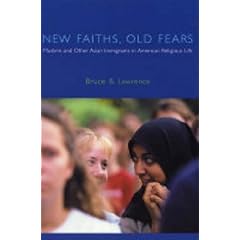
After writing that piece yesterday on a faith-divide that is causing political dissonance in the states of Asian America, serendipity put me in a used bookstore today where I came upon this book:
New Faiths, Old Fears: Muslims and Other Asian Immigrants in American Religious Life,
by Bruce B. Lawrence.
Lawrence focuses a lot of his discussion on Iranian Americans and their particular orientation to both faith and racial/ethnic groups in the United States, but he actually talks about the "new faiths" in the United States, and the uneasy way in which American communities as a whole, and Asian American spaces in particular, are dealing with the rising tide of Muslims, Buddhists, Hindus, Sikhs, Jains, Zororastrians, and other peoples within the coalition. Fascinating stuff, and I'm glad to see I'm not crazy. I was really interested and picked up the book because he talks about South Asians for a while in the book, which was unexpected when I first reading through it.
It's interesting how the issue of faith identity is dealt with in progressive/left spaces. I haven't had a lot of experience, but while I can understand if someone dismisses faith because organized religion is just another system of oppression, that perspective ultimately disregards that faith (and discrimination/exclusion based on it) is a real phenomena in coalition communities. So the left ideologues who don't want to think about faith are doing what color-blindness advocates do with race: assume that if we don't talk about it, there's no real-world impact on people's lives.
But alternatively, you have people who harbor their own biases, whether knowingly or not, against particular faith communities. American popular culture has turned Islam into the communism of the 50s (call it a green scare if you want). I wouldn't be surprised if mainstream Asian Americans who don't have exposure to Muslims (or other faith "minorities" within Asian America) are working off of a lot of assumptions and misinformation in their orientation to these communities.
It doesn't help that evangelical Christianity has caught on like wildfire in several Asian ethnic communities, and some churches have adopted the American angle of "building community" by highlighting and reviling something different. Hinduism has been targeted in some churches, but it's not really seen as a threat in the same way as the master American narrative has made out Islam. Islamophobia may be another way to make yourself seem like a real American - kind of like wrapping your community up in American flags the way Chinatown and other NY immigrant neighborhoods did immediately after Sept. 11th.
As an aside, that toss-off comment above, "Green Scare", is kind of apropos, actually, with the new unholy trinity that keeps the reactionary right (and those like them) up at night: environmentalism/conservation, Islam, and the Redistribution of Wealth.
Jan 26, 2008
Asian Americans and Palestine
Does Asian America care about what's happening in Palestine? Sometimes I wonder if folks even see how connected it is to this nation we strive to imagine (or thrive by collecting a paycheck on). More on that in a minute. But seeing the thousands of people streaming across the border from the besieged Gaza territories into Egypt really shook me - I wasn't paying attention to the sealing of the border and embargo that Israel had placed on the territory over the past weeks. People needed food and goods to survive: they were buying what they needed from across the border, not stealing.
I live in relative comfort, and am afforded the luxury to complain on these pages. But real people are struggling with real crisis, and sometimes it gets me how people are so selective about what they care about. A touchstone moment for me was a conversation I had with an activist and lawyer friend years ago who I respect for his commitment to civil political rights of Asian/immigrant communities here, in NYC. We were having some kind of conversation about recent events and I mentioned some things I'd heard about overseas in an Asian nation that doesn't get much play in the media (or didn't at that time). He said, both with some level of chagrin, but mainly with a "don't have the time" response that he really has no idea of what's happening around the world - he's too focused on the fight in front of him.
This isn't uncommon, but the moment is frozen in my memory because the date was Sept. 10, 2001, and the nation I was talking about was Afghanistan. It wasn't that I knew something was up - it was actually a conversation about the Taliban's destruction of the Buddhas of Bamyan earlier that year - but even at that time, his relatively sharp rebuke about not knowing/caring about world affairs struck me. Of course, it was only days later that the Taliban became a known and familiar group on the American landscape, but only after something happened here.
Of course, Americans of all kinds just tuning out of world dynamics isn't a new observation, and bringing it up here isn't a revelation. But I feel like folks should wake up and think about the interconnections, especially if they profess some kind of community kinship across the fragile coalition of Asian America and/or they say that they believe in justice. One of the biggest gaps in Asian American spaces and dynamics, aside from the very familiar "East/South/Southeast/Pacific Islander" tensions, is around questions of solidarity, especially related to the faith-based concerns for Asian Muslims and other non-Christians. I haven't read/seen much on this, and I don't have empirical data, but I want to put some things out there that I hope to get back to at some point.
I've mentioned before (I think, and if not, it's a pending post that I will definitely get to soon), that while the narrative of Asian American (and broader) cultural studies sometimes suggests that traditions and sharing around food are one of the ways that different communities build solidarity, there's often a gap for people who observe dietary restrictions. So where the whole "we all eat with chopsticks" or "rice is central" themes are nice, it makes it hard to break bread with APA compatriots when the bread has lard and there's pork or meat in every other dish.
Not understanding how a simple issue like poor menu planning can immediately alienate and make folks less open to collaboration when it excludes consideration of vegetarian and halal diets is a fundamental failing of a lot of pan-Asian American efforts. You want to think that the community and political stuff should take precedence, but I've heard time and again that when something so simple is completely not considered, people lose faith that there's any point in trying for the bigger issues. I've seen this change gradually in cities on the East Coast, perhaps because South Asians and others are still more active in pan-Asian spaces, but it's pretty terrible on the West coast and other places. If I'm going to end up at a "community" dinner where I can't order something, I might as well be part of the NRA.
The bigger picture here, though, is that there are feelings of solidarity and empathy that a lot of people within "Asian America" feel for people suffering under systems of oppression around the world, aside from their so-called homelands. I can't think of a situation more relevant to more people I know than Palestine. The extreme injustices perpetrated as part of the Israeli oppression and occupation, and the world community's acceptance of state actions that are wholly unacceptable in almost any other part of the world, angers many people. No one is condoning outright acts of violence by either side, but state actors have to be held in check by the world community. And beyond an observation of world politics, this really affects the local.
The human rights violations perpetrated by the Israeli government are well-documented and hard to contest. And many see the struggle of the Palestinian people (not the military or insurgency leaders - just the ordinary people) as emblematic of how the rights of certain people -- Arabs, Muslims, whomever else -- are disposable on the global stage. And that's one of the reasons that a lot of people who are not personally tied to Palestine feel so strongly about the plight of the Palestinian people: that so many people who claim to care about rights don't care about Palestinians means that there are some rights that the world community just doesn't care about. And for the last sixty years in Palestine, that's Arabs and/or Muslims. In Kashmir, that's Muslims and Hindus. In tribal lands around the world, that's indigenous peoples. In China, that's Tibetans, Buddhists, Christians. In Burma, it's ethnic minorities and freedom fighters. In Sudan, it's the African Muslims and Christians. And the list is ever long.
Though the conditions aren't as bad in the United States for many of us, seeing that people aren't incensed (or often, are clueless) about the direct ramifications and echoes of these world phenomena upon our states of Asian America reminds people of how a lot of AA leaders played a game of "not our problem' for state actions against Muslims and South Asians in the wake of 9/11.
On that tip, there are some Asian American leaders out there who either don't see why the Israel/Palestine question is relevant, or have actually bought into the idea that the Israeli state is justified in anything/everything that it does. I understand that it is scary for many mainstreamers to voice an open anti-Zionist position because the fringe have convinced the world that speaking out against anything to do with Zionism is anti-Jewish (is speaking out against "Manifest Destiny" in the U.S. anti-European/white, or anti-oppression?). I guess the intersections of faith and politics are hard to navigate, but the perpetrator and originator of the most egregious violence is a state actor preserving power by stoking flames of intolerance and hatred between people with so much in common. Our understanding of Theo-Political fascist states should not be shaped by Dubya's rants. Just look at Modi's Gujarat.
So I'm very unhappy with the way that a lot of people, especially those in positions where they purport to represent Asian America, don't ask critical questions and come up with a reasoned orientation to the situation. By being so out of touch, they continue to show us how they will not be able to hold together an effective, progressive Asian American coalition that recognizes and stands against oppression, regardless of whether it directly (or at least, obviously) affects their interests. It's time to hold them accountable.
Jan 18, 2008
Is It Worth It?
Sometimes, it's hard not to lose hope in processes and in people - it's hard not to feel that it's impossible to find some kind of truth in this system that's twirling around us (or spinning with malevolent intent, depending on your particular point of view at the time).
It's also hard not to feel like people have become so shut off from whatever impact their actions and (in)actions have upon the world. Learning about injustice is only one step, but putting some of the things we've learned into practice, well that's not so easy. I suppose even taking small steps like becoming a vegetarian is not an easy thing, but people who aren't born into that system take the steps to make that happen. It's just that I can do whatever I want to reduce my energy consumption, carbon footprint, and waste, but the next person is going to do double and wipe out my effort.
In a bit of a leap from there, I guess that while anarchists and rigid marxists are often labeled as nihilistic (and maybe that's true for anyone who questions the status quo), I think that capitalism and mass consumption is far more nihilistic. In focusing only inward, in thinking only about how something will affect yourself, you've taken the rest of the world out of the picture - it's as if it doesn't exist, or it doesn't matter that it does. That's scary stuff. Billions of individuals, all acting under the false premise that they are alone, or that the physical ramifications of their choices, decisions, and actions don't really make a difference of any kind, freeing them up to do whatever they want.
It's funny - on one hand, the universal conceit of humans is that we believe that we are the pinnacle of what natural processes (or intelligent design if that's your cup of tea) have created and therefore, the earth and everything on it is ours for the taking/breaking/making. Because we think, and we rationalize our place in this world, we are above the "beasts." On the other hand, though we are more conscious of the impact of our actions upon the world, when it's convenient, the majority wants to believe that the best and most efficient system is the "free market" system -- the economic and social equivalent of an empirical natural formula: let things take care of themselves without regulation, and there will be an equilibrium in which we can all exist. Feels like of like sticking your head in the sand after you create the desert. Knawimean?
It's not like I'm immune from this or that I'm speaking from up on high. But people get so entrenched in their thinking and are better at rationalizing why they should continue to live their lives as they do than use this miracle of thought and reason to make something of their small place on the planet. But if this were to become a lament of the futility and idleness of human beings, well, this would be a very long, sad rant. And this whole frustrating thing makes me sad enough. People wake up!
I may have to watch an inspirational video or something to get me out of it.
Jan 15, 2008
Iron Maiden on NPR?!
Woah. What a trip this is. A story in Global Hit, which is a daily part of "The World." Basically a piece about a fan in Bolivia who has been hoping to bring Maiden to his home country. Pretty freakin' awesome that they had this on NPR of all places.
Read More......Jan 9, 2008
New Year: Presidential Race/Gender/Religion Questions
New year, new vows? Forget that - no justice, no peace. "There's war on the streets, there's war in the middle east." (can't remember where that line is from, but feels like I can't even place the decade because of the damn perpetual interventionist military-industrial complex of a government that we pay our taxes to).
On that tip, and this initial tangent, why is it that the American people don't give a shit about learning about the rest of the world and the world's history (broadly) while our "leaders" can't wait to dig their greedy hands and pour the blood of our young soldiers into yet another land abroad? Is the miseducation of the masses a way for the powerful to keep American people insensitive to the plight of the world's people? Damn right it is - and the profits for mass media, quasi-military/quasi-development multi-billion $$ behemoths like Haliburton, and everyone else with a fist up in the Treasury depend on it. " We don't want the damn immigrants here, and bomb their lands as much as you want to keep us safe."
Anyway, that's not my point right here. Election season is at full blast, I guess. The talking heads at the podium give way every night to the multitudes of talking heads from the corporate media, and the message of who we should elect, why we should elect them, and what the basis of that decision should be has been compromised fully at this early point. The battle royale between Hillary and Barrack are less about gender and/or race and more about dynasty, "electability," and "safety" to the so-called undecided masses. While I'm pissed as hell that Kucinich has been edged out of the debates altogether, I'm also pissed that even Edwards is getting the short shrift from the media.
I'll get into the whole race/gender/supporting the white men running for office thing soon enough, I'm sure. But at this moment, I'm kind of over the analyses that I've seen. Some of the discussions that I have been having with folks are also around why it is that white voters seem to be embracing Obama's campaign, and whether that will last. The common thought is "America isn't ready to elect a Black President" - which is a very polarizing statement in its own right. But then there's the question of someone being "palatable" or "safe" in a way that has been repeatedly contrasted with Jesse Jackson and Al Sharpton's previous campaigns for the presidency.
I guess I'm annoyed at all of this on a lot of levels, but I want to think about it a little more. With race and gender thrown kind of in our faces, the question of faith/religion is getting lost in the mix. There's a viral campaign going on, just under the mainstream, about Obama being secretly Muslim and a part of a plot to take over the nation by radical fundamentalists. Whatever his personal faith, this thing is going to get really ugly really fast. If it ends up that he was raised Muslim, the know-nothings everywhere will have a field-day, and while the influential radical Zionists will want blood, even the majority of cultural Jews who are currently supporting him may have new reservations. And let's not forget the average "I don't know a Muslim but they're all going to hell" American. Fear (mongering) is a dangerous thing.
Forget that - even if the international conspiracy theories don't do him in - do you really think that we're going to get through this campaign and this attempt to pin a faith on the man without discussions of the Nation of Islam, Minister Farakhan, and the rest of it? Of course, no one wants to mention Muhammad Ali in this mix instead of the most incendiary folks from the large American black muslim community. So I'm putting out there that if the "Obama is Muslim" thing grows larger, we're going to see multiple threads that he'll have to deal with that will focus on the "unsafe" elements of black nationalism (via black muslims), and the "foreignness" of the man with the funny name that people like Andy Rooney can't deal with.
But this is far from over, and I'm far from finished with my anger about all of this. Let's hope I can write more regularly this year. Thanks for coming back.
Jan 6, 2008
M.I.A. down with M.E.T.A.L.?
In my ongoing quest to understand the metal/hard rock influence in M.I.A.'s music, I fell onto her "officially" released version of the Paper Planes video. Aside for the sound being intact from the recording (the censorship issues that she faced came, ironically, from gunshot sound effects rather than actual words), she sported a Metallica/Ride the Lightning shirt in one of the scenes that comes up a few times. What that's all about, I have no idea.
Dec 28, 2007
We Eat Our Own.
"When a leader speaks,
that leader dies." - Living Color, Cult of Personality
I don't know a lot about South Asia, even if I write about things related to the diaspora regularly on here. I know less about Pakistan than I do India, and realize that as the news of Benazir Bhutto's death washes over the world, people with no business commenting on it will do so anyway. Still, I feel like her killing raised two quick thoughts for me:
1) It reminded me, again, of how complex global politics are, and how people can be easily mislead to think that one person, or one family, can serve either as the savior for the nation or the key architect(s) of its damning. The Bhutto family's destiny is linked with Pakistan's, in some way, but it just seems crazy the way that the Western media is playing her role and her importance out.
2) It also made me think more about how hard it is for leaders in South Asian nations to really push for change (whatever kind) without risking their lives. The history over the past 60 years has not been a pretty one, particularly in India, Pakistan, and Sri Lanka. It's no wonder that people: a) are less willing to step forward and challenge business as usual, and b) have a hard time remaining hopeful and not cynical about change and leadership. While there's still fervent support of political parties (at least in India), the view from afar may be askew. I used to think that the BJP had massive support from the people - and Modi's reelection may testify to that - but it may be just the idea of belonging to something rather than real faith in actual change.
Maybe people aren't really that supportive of any particular candidate or perspective. And maybe it's that cynicism that we confront with people in the diaspora, here in the U.S. and elsewhere, who don't have the faith in change that some of us still offer as an alternative to going along with the same old ways - whether that's regarding civil rights or anything else.
Dec 21, 2007
A World Without Art.
I have spent the last two and a half years stuck in the timesuck that is law school, and while I see the tunnel's end, it isn't really lit up yet. I'm thankful to be back in school, but a quick accounting of what I've lost along the way makes it a less than fully rosy picture.
But what affects me more, and in a far deeper way, is how I have lost my connection to the arts. This has happened over a longer period time, maybe about 4-5 years, spanning from the dog days of the last full-time gig that I held down. In my first life after school, I spent a lot of time checking out performances, readings, and even some visual stuff. It's easy to overlook things in NY, even though it's all over the place, but I was fortunate enough to be in a setting where I had access and I was around artists.
Cut to more social service and policy work, and I didn't have as much exposure, but still took advantage when I could. There's something rejuvenating and pure about art, and engaging with people who want to talk about the (per)mutations of human experience, thought, culture, and political galaxies that intertwine with good work. To feel inspired, to feel challenged, to experience something that is, in most cases, ephemeral... momentary... unique in that moment. That's probably why I love performance. Though live music can fill that gap, but it's still a different experience than other performance, especially good theater and performance art.
I've dug deep into music as a refuge, but it is not a satisfactory replacement, no matter how much I love it. At least not recorded music. I've not been able to read much fiction for a long time, and I still feel that reading is too isolating - it doesn't feel like I'm experiencing something with people the same you feel with performance. The journey is generally inward, and I don't feel satiated or inspired by inwardness.
So I feel empty, in some critical, crucial way. There is a vibrant, creative, urgent world right outside of my viewpoint, and I have not dipped into it for any sustained time in years. And honestly, lawyers, law students, policy wonks - they are too literal, too limited, too linear. Their language is tightly wound around single meanings and objectives - their time too guarded by objectives (worthwhile or otherwise). Spontaneity is a "waste of time" rather than a tapping of the real lifestream that is meant to replenish our weariness with passion for the struggles and stories that make liberation more than just an academic exercise.
No press release nor policy brief ever moved me. No legal argument ever fundamentally changed my view of the world and my place in it. No conversation with a lawyer has ever really kept me guessing about which turn or angle it will take next, careening from random association to crystal clarity and connecting dots I didn't even know existed. I don't begrudge any lawyers this, because it's not their role, but I miss what I have lost.
Dec 19, 2007
Proud to be from New Jersey
Though I moved to NY in my early adolescence, I'm still NJ-born. And while it's always hip to say you're from NY (though much of the state is not NYC - it's more like a weird cross of the midWest and the South), people remain down on NJ. Well, without the long thought process on my own reevaluation of the way I've approached it myself.
I'm just writing to say that today, in light of the Governor's ending capital punishment in the state, I am proud to be of New Jerseyian descent, as it were.
Dec 16, 2007
Sikh Org Battle Royale: Pt II
I knew I shouldn't give up on superlatives from another Sikh group. Just when I was looking at handing the prize for most "accomplishments" (or at least the most times I've seen "only Sikh organization" on one page) to the Sikh Coalition, watch out! Here comes SALDEF. My inbox was graced with a press release/solicitation:
SALDEF: The Sikh American Voice in Congress
(wait, they have a seat now? or is that an advisory position?)
1) SALDEF is the only Sikh American organization working with Congress to protect Sikh American families from hate crimes.
2) SALDEF is the only Sikh American organization working with Congress to ensure that Sikhs are not forced to check their religion at the door of their workplace.
3) SALDEF is the only Sikh American organization working with Congress to ensure our children attend school free from harassment and bullying.
4) SALDEF is the only Sikh American organization working with Congress on the End Racial Profiling Act (ERPA).
Okay - so I don't know a lot about Washington, but how, exactly, does one "work with Congress," and how does one claim to be the only group to do so? Does that mean that all the other groups never call the Representatives or Senators of states that house their office, initiatives, or constituencies? This series of claims seems pretty hard to understand - and it's basically all about the same work. I mean, all you have to do is be a part of a task force called together by some staffers on the Hill, and then you're working with Congress! Well, I mean, that's what I would think.
Boy, I can't wait to see what United Sikhs and SCORE come up with.
Dec 15, 2007
The Inevitable Rise and Liberation of NiggyTardust!
 You know, it's amazing how even the underground has its levels of hype and overhype. Not to say that Radiohead is "underground" by any means, but their decision to put up the new album, "in Rainbows," as a digital download for which listeners could pay what they want has been heralded as a move that will change the face of the music industry. Meanwhile, a remarkable collaboration that went further than radiohead (with big names of its own, but maybe not names that stack up against the unlikely combination of stadium-filling grandeur and art rock that is the radiohead phenomenon) hasn't gotten much play. Well, maybe real music heads know about it, but I sure didn't.
It's a collaboration by Saul Williams, poet, MC, and voice, and trent reznor. Yeah, that trent reznor. Called "The Inevitable Rise and Liberation of NiggyTardust!", an obvious tip of the hat to Bowie's Stardust album, it was made available in two formats online in November 2007: a $5 version that comes in either 192Kbps DRM-free MP3 or FLAC (lossless), or, completely free, which comes in the 192Kbps DRM-free version. Both come with a beautiful, 33 page PDF of lyrics and intricate artwork that's worth the $5 alone. I still have to listen to most of it, but it's an edgy piece of work - Reznor's production shines, unhampered by his usual attempts to rewrite his angst from his first 2 albums in new and interesting ways. Williams is a powerful MC, and he even pulls in a cover of U2's Sunday Bloody Sunday for good measure.
I strongly recommend this album to anyone looking for something new and interesting, and in the interest of supporting artists who aren't afraid to take on the record companies and distribute their own music at a far more reasonable price than what you get for packaging at a big box store. And this album, unlike the Radiohead album, will not be available on CD after the fact (which folks didn't know when the rh album hit the net).
Dec 3, 2007
Queensryche Cover Album: Two Devils Horns Waaaaay Down

Anyway, after all that, I found out about this covers album Queensryche released last month and thought "wow - I'd be interested in hearing how they approach some of these tracks." "Synchronicity II," "Red Rain," and a cover from Jesus Christ Superstar? Bring it on. Well, even if the album was not particularly ill-conceived, the execution is excruciating. I'm not sure if it was the streaming quality on Free Napster, though I haven't had this complaint with them before, but the mix sounded god awful. And Tate's lackluster delivery was painful - he's lost his voice completely. It's shameful that he's still trying to sing, actually. He should hang up the mic and get a desk job. Seriously, it was *awful* - his moaning at the beginning of "Synchronicity II" sounds like he has no monitors to guide him -- he's off time, off tune, and shouldn't sing this way in his shower. What happened to his voice?
It was a terrible waste, and honestly, the worst disappointment was Queensryche's attempt at "Heaven on Their Minds." Andrew Lloyd Webber generally annoys me, but his work on Superstar was pretty rocking. And you can almost feel that if Queensryche were in top form, from their "golden" period, they would have made this one shine. But it's just terrible and I couldn't listen through it. I almost put on that Def Leppard cover album of 70s glam (from Napster, okay - I don't own that crap) just to cleanse my listening palate after subjecting it to pieces of this record. I don't know what the reviewers were listening to, but it sure couldn't be what I heard.
And what is it with bad covers from the soundtrack of JC Superstar, anyway? Sinead turned in a very poor performance of "I Don't Know How to Love Him" on her latest, Theology. And now this awful recording. Webber would be rolling over in his grave, if he were dead. Yeah, so just don't bother with this one. It's not that it's mellow -- it just sucks.

Nov 29, 2007
How to Bury a Racist (Dinosaur?)
If you're like me, you probably thought that the grand funeral procession by the NAACP this summer to finally bury the "N Word" (and perhaps any shred of relevance that the organization had left), didn't do much to remove the word and its impact on race consciousness in the U.S.
Well, not too long after, those pesky diggers, the paleontologists, had more new about the remains of a previously unknown species of dinosaur that had been unearthed about 5 years earlier, and inadvertently also dug up centuries of shame and hatred, all in one fell swoop. What am I talking about? Well - check it out yourself: people, we give you the grand re-introduction of the Nigersaurus, so named because of where it was found.
*sigh*
I'll be damned if this doesn't feel like a pre-packaged Chris Rock bit naughtily tucked away in the science news. Are scientists really that clueless? Even without beating up on the scientists, it's interesting how the racists seem to take every opportunity they can to share their views through the internet. There has definitely been an upswing in the blatant racist acts on campuses and communities throughout the U.S., and it's hard not to think that the isolated crazies are feeling more and more emboldened by the actions and statements of elected officials, the white supremacy groups, and even the nutty religious institutions that are buying up air time and spewing out invectives.
Nov 28, 2007
Supporting Sikh Civil Rights Groups: The New Faith-Based Giving?
Between the Sikh Coalition, the Sikh American Legal Defense and Education Fund (SALDEF), UNITED SIKHS, and I'm sure other, local groups who are planning to hire lawyers too, I think the Sikh community may have more staffed groups that claim to represent their civil rights than any other American community of similar size. I don't begrudge the community that it needs this support, especially given what's gone down since Sept. 11, but the one-up-manship of the groups is bordering on ridiculous when you get emails from them all in succession, proclaiming that they are the "first", the "largest" or the most important and urging us all to pay attention. Let's look at mission statements first:
1) SALDEF. Founded in 1996, SALDEF is the largest and oldest Sikh American civil rights and educational organization dedicated to protecting and promoting the civil rights of Sikh Americans through legal aid, advocacy and educational outreach. SALDEF's mission is to create a fostering environment in the United States for future generations of Sikh Americans.
2) The Sikh Coalition. The Sikh Coalition is a community-based organization that works towards the realization of civil and human rights for all people. The Coalition serves as a resource on Sikhs and Sikh concerns for governments, organizations and individuals.
3) United Sikhs. UNITED SIKHS is an international non-profit, non-governmental, humanitarian relief, human development and advocacy organization, aimed at empowering those in need, especially disadvantaged and minority communities across the world.
Then, some choice statements that they've made about themselves in recent press releases, which almost speak for themselves:
1) "With a full-time staff of five, the Sikh Coalition is now the most staffed Sikh organization in the history of the United States." Sikh Coalition press release, November 20, 2007.
2) "The Sikh Coalition is the only Sikh organization that employs attorneys full-time. The Coalition currently has three attorneys on staff." [website]
3)"The Sikh Coalition is the first Sikh organization to qualify for and receive an Americorps VISTA volunteer from the federal government." [website]
4) "The Sikh Coalition successfully encouraged the first Sikhs to successfully run for political office in New York City on a non-partisan basis." (hmmm -- this is kind of a risky statement to put out there) [website]
Wow - can't actually find equivalent proclamations from the other groups on their websites, though I know I've seen stuff. As a passing thought, I wonder how much of this is a gendered thing - given that all of the groups are led and predominantly directed by men, unlike most other South Asian groups. Then again, there's similar tension between other groups, so I may just be reaching.
Anyway, beyond the way that there seems to be at least a little shoving going on between these groups, it's interesting to see how many resources are going into this work. More than most ethnic or racial minority-based organizations, there seems to be support from the community for civil rights advocacy for Sikhs. A lot of the funding for these groups comes from donors - which is pretty impressive. But I know I would get confused to see that there are a bunch of groups claiming the same kind of work.
I often speak about how our communities actually have a deep history of philanthropic giving (unlike what the mainstream conventional wisdom about tight-fisted Asians may say), but it's usually within the family or to faith-based organizations. Are all of these groups still enjoying donations from the community because -- at least in this community -- civil rights groups are the new temples/faith-based institutions for specific groups who feel beleaguered by hate/bias/misunderstanding? It's hard to tell from the outside - because I can't think if there any other examples of faith-based identities that give in this way, save for Jewish communities with the ADL and other civil rights orgs that recognized the need for Jewish communities to defend themselves.
While the Indian/Jewish analogies have been getting a lot of play in the media (and this is problematic for a lot of reasons - from the model immigrant stories in the U.S. to the meta narrative about the nuclear power leanings of India and the BJP's desire to create an axis against Islamic States between the U.S., Israel, and India (they want the military aid and to finally be recognized as a world power -- i.e. take us seriously, damn it) -- it's interesting to look at the civil rights/community institutions model of the first successful Jewish communities in the U.S. and whether any of our communities here are modeling that now.
I think an argument can be made that Sikhs are sorta there or getting there. And it's really interesting to see that some of the mission statements claim an interest to represent/help many different groups, beyond just Sikhs. Again, I don't think it's necessarily bad to have "competition" between non-profits, in the interest that the best model eventually wins out, but it can be duplicative, confusing, and unproductive if there is a bigger strategy in mind for any of these groups.