

Though Cali has been questionable in some of the crazy things (read: Ward Connerly ballot initiatives) that have gotten through in the past 10 years, but I have to say - the Saturday protest that broke the 500,000 mark, and the numerous other accounts of resistance (from LA high school students to the santuary city initiative below) have definitely been very impressive.
Some folks have been wondering what's up with NYC. Chicago, Denver, LA, and other places have hosted large-scale actions. What about NYC, haven for immigrants the world over? It's coming, albeit late. April 10. I'll post more when I find it.
COACHELLA: Another Alta California city votes to become an "Immigrant Sanctuary"
by
Hector Carreon
La Voz de Aztlan
Los Angeles, Alta California - March 24, 2006 - (ACN) Yet another city council in Alta California has voted to become an "Immigrant Sanctuary". Coachella, a city 125 miles east of Los Angeles and with 30,957 residents, passed a resolution that states "the city will provide a safe, healthy and dignified place to live for its immigrant communities, regardless of immigration status."
Coachella Mayor Jesse Villarreal said that the undocumented immigrants living in the city can rest easy knowing that the local police won’t act as border patrol and turn them in. The resolution will also protect US citizens of Mexican descent from being harassed by the police who could mistake them of being undocumented. . The city populations is 97% Latino.
The "Immigrant Sanctuary Movement" is rapidly expanding in Alta California with the cities of Maywood, Los Angeles, Huntington Park, Pomona and San Francisco having already passed similar measures. The city council resolutions are attempts to prevent local police from arresting the undocumented if the anti-immigrant legislation presently before the US Senate passes.
Mar 29, 2006
Sanctuary Cities: It's a Movement

Mar 27, 2006
Guthrie's "Deportee" and the Immigration Debate
Thought this was a bit of a positive note, in spite of the grim immigration deform legislation that's being discussed in Senate this week.
Heard Billy Bragg on the radio a couple of days ago, and learned both about his work (which I didn't know before this program) and about a really interesting bit of information about Woody Guthrie, the man who inspired Dylan to reach deep into the heart of American music to draw upon the raw truth that he eventually found.
Apparently, Guthrie read a story about a plane of Mexican immigrants that crashed, killing all 28, as well as the pilot and copilot, who were the only 2 to be named. The New York Times only mentioned the others as "deportees," neglecting even to give them some kind of final rites afforded by printing their names in the paper.
Guthrie, drawn by this insensitivity, wrote a poem called Deportee (Plane Wreck at Los Gatos) that dealt with the story. I'm surprised, and quite touched by this - it's heartening that there were people involved in folk music who would step forward and highlight injustices of this kind even before Dylan and Cash. His poem is below:
Chorus:
Goodbye to my Juan, goodbye Rosalita
Adios mis amigos, Jesus y Maria
You won't have your names when you ride the big aeroplane
All they will call you is, deportees
The crops are all in and the peaches are rottin''
The oranges are piled in their creosote dumps
They're flying them back to the Mexican border
To pay all their money to wade back again
Some of us are illegal, and some are not wanted
Our work contract's out and we've got to move on
It's six hundred miles to the Mexican border
They chase us like outlaws, like rascals, like thieves
The sky plane caught fire over Los Gatos canyon
A fireball of lightning, it shook all our hills
Who are these good people all scattered like dry leaves
The radio said they were just deportees
Is this the best way we can harvest our orchards
Is this the best way we can harvest our crops
To die like dry leaves and to rot on the topsoil
And be called by no name except, deportees
This broader consciousness is what we need today - though Springsteen is out there consistently (check out tracks on the haunting Ghost of Tom Joad and the more recent Devils and Dust, and there are others who speak up both in song and off the stage, we need more folks in mainstream music to take up these issues and broaden the debate. They need to help take it out of the hands of the right-wing talk show hosts.
But beyond celebrating the anti-jingoism that constitutes Guthrie's patriotism and particular American spirit, the lyrics underline the some of the more troubling aspects of life for undocumented immigrants in the United States. Already severely marginalized and shut out of many normal aspects of American life, they are being pushed further into the shadows (and if some would have their way, right out of the country). There are obvious overtones of racism and xenophobia afoot, but there is also a visible mean and retributive streak permeating this conversation. The pundits and idealogues are a super-minority in the United States, and as most tests and polls indicate, even basic understanding of macro-economic principles that govern "free trade" and open markets eludes the majority of the public. Hell - kids can't even find the United States on the globe, so forget a more nuanced understanding of how global market pressures and the allure of the bottomless line for greedy multinationals have precipitated the tremendous influx of immigrants, both through closely regulated channels and alternative paths, to the US.
The irony of the American backlash against immigrants is manyfold. First, the average white American doesn't know much about the rest of the world, but assumes that people come to the United States because it's the best place in the world to live. "They love us cuz of our freedoms." More like freedumb. Joe Average needs to think that the United States remains a peerless, fearless leader at the top of the world, and that other nations aspire for its greatness and yearn for its protection. The steady diet of jingo-nationalist drivel that has flooded the airwaves from the Reagan years onward has eroded the sense of independent thinking, the feeling that a truly free press would be free to openly question and criticize without being labeled liberal or biased, and that the public at large would demand truth instead of the opaque filters, smoke and mirrors, and appeals to the lowest common denominator. It is absolutely astounding that people really think that all people who come to the United States would rather be here "taking their jobs" than working in a good job in their homes, where their civil, social, and cultural networks are intact. Americans are some of the least traveled, least knowledgeable people about the rest of the world - they have a vague sense that their country is the best off and most desirable, but they have no idea nor perhaps any inclination to wonder why, or wish for a more equitable distribution of opportunity and prosperity around the world.
Second, mainstream Americans who aren't thinking very hard and are being stirred up against immigrant rights in this country aren't seeing the big picture at all. They are afraid of change, of course, and they are being pushed towards a false belief that their jobs are at risk because of immigration, when the truth is, their jobs are at risk because America hasn't kept up and figured out new ways to remain a global economic leader. The short-term strategies that fund farmer subsidies, allow for multinational corporations based in the United States to seek and exploit workers around the world, and employ temporary work programs for specialized technicians and engineers from China and India without making it easy for them to settle in the United States are all contributing to the bleeding away of competitive advantage for American workers. The corporations are going to do just fine - or as WalMart shows us, better than fine - because they are getting around unionized labor and minimum wage standards by going overseas, and the United States government is turning a blind eye to their practices. Americas failed their responsibility as world citizens because they can't see beyond their own priorities to understand how worker abuses like extreme oversea sweatshop labor make everyone a loser. Human rights are more than just feel-good ideas, and should be enforced even when it means that the American consumer won't get the lowest price on their goods. And it's too late to cry over that spilt milk now. But that's not what American conservatives think, and cry (wolf) they will, right until the bill passes.
But meanwhile, China and India are keeping more of their engineers and scientists, and even attracting some back from the US, where glass ceilings and visa headaches have made it more difficult for the best and the brightest to be all that they can be. So now, instead of "celebrating" that the low-level tech jobs that the H1-Bs were taking are not being filled as readily and as quickly (and perhaps now more Americans can take those jobs), all you see is the programming and print news that are focusing on the growing strength of the two Asian nations. Suddenly, the fear isn't only that "they" are coming here to take our jobs, but it's going to be that they are going everywhere else to take over the lead for innovation, productivity, and supply of bright labor and products. So now, instead of a fear for individual jobs (which is also somewhat baseless, considering the severe restrictions on H1-b hiring, and the fact that only some employers were hiring undocumented workers, with tremendous abuse and substandard wages), there's a vague, bordering on xenophobic reaction to the growth in other countries.
So which one is it, uninformed and emotional American public? Do you want the US to be the economic leader at the expense of the rest of the world, and keep this place the beacon for those trying to make a better life for themselves and their families in light of the impact on nations with citizens who aren't as lucky - simply by birth, not by any inherent entitlement - as you? Or would you rather that the playing field around the world were a tiny bit more level, but your labor is still not worth much because you haven't been educated in a way befitting a global marketplace. American education, as a largely mono-lingual endeavor, is not preparing the next generation for interaction with the world. The hubris that English will and should be the only lingua franca of commerce and opportunity is ludicrous. It is only the latest of the colonialist languages to have their time in the sun, but the age of colonialism may be ending, though imperialism and other strands of North/West-centric policy and dominance will remain for a long time.
I don't envy common Americans (myself somewhat included). They've been duped, bamboozled, and played for stupid for so long that their leaders, corporate bosses, and the rest of the world either regard them with a mix of pity and disdain, or they don't regard them at all.
It's sad to think that a nation founded in good principles has evolved into a place where ideal citizens are no longer breathing, hard-working persons, but rather corporations, which are considered citizens through the conventions of legal fiction, and have twisted this place beyond recognition. Read More......
Mar 24, 2006
Subservient Chicken
Not that it's my specialty (nor desire) to highlight all things even remotely interesting to the desi-pop-culture-ADD crowd, but this was pretty cool...
That subservient chicken thing on the Burger King website a while back that was a really popular forwarded link for a while was actually designed by a Desi American dude, Jeff Benjamin, as part of a re-brand for the company to make them seem more relevant and known to the modern (internet savvy?) generation. I found this out, as I do many things nowadays, from the snippet of a news video blog, Rocketboom. Click to see the clip of Jeff talk about the thinkin' behind the chicken.
I like telling the chicken to "freak out."
Sounds right.
Thank you.
Feeling particularly grateful for life and the people in it, including those who are in my life directly, and you who read here but may not comment. Your eyes, your time, your hearts: no words.
Been trying to stay afloat otherwise, and working towards freedom in the middle of May. Perhaps more content at that point, too. Meanwhile, remember the following tech PSAs:
1) Del.icio.us is a great way to keep track of your bookmarks and keep them accessible online, as well as create a virtual corkboard for a group of friends or allies. At least until All Peers goes live (see #2).
2) Firefox still rules. And it's about to get better.
3) Pandora makes mandatory work fun.
Have a great weekend.
Mar 23, 2006
3 Christian Peacemakers Released in Iraq
 The news about the three Christian peacemakers was noteworthy today, not only because it was a shard of happy news in this otherwise bleak cycle (of at least the past 6 years). Of course, it's happiness in the face of what created the situation to begin with, but that's not news.
What I got out of the coverage that I've heard:
1) The news that I've heard has continuously mentioned "3 Western Christian Peacemakers" and "2 Canadians and a Brit." It's notable that at least in this instance, a desi man (Harmeet Singh Sooden) who I think is a converted Sikh, is included as a Westerner, and as a Canadian. Is it because of his religion? Or is it because desis are becoming more recognized as members of these communities? Regardless, that was noteworthy.
2) As I feared, the reports are that information leading to the rescue came from 2 detained Iraqis (in Iraq). I heard the message loud and clear: Folks are critical of these detentions, but the information we got came directly from this technique.
3) Ironically, the Christian peacemakers are in Iraq in part to protest the detention of thousands of Iraqis. I didn't expect a strong condemnation of the same after this result this week, but in their celebratory statement, they write:
"Throughout these difficult months, we have been heartened by messages of concern for our four colleagues from all over the world. We have been especially moved by the gracious outpouring of support from Muslim brothers and sisters in the Middle East, Europe, and North America. That support continues to come to us day after day. We pray that Christians throughout the world will, in the same spirit, call for justice and for respect for the human rights of the thousands of Iraqis who are being detained illegally by the U.S. and British forces occupying Iraq.Read More......
During these past months, we have tasted of the pain that has been the daily bread of hundreds of thousands of Iraqis. Why have our loved ones been taken? Where are they being held? Under what conditions? How are they? Will they be released? When?" [link]
Mar 19, 2006
why.
Sometimes, we're out of touch with important people in our lives for a long time. Sometimes it's only a little while, but in that span, galaxies can spin out of control, empires crumble, lives change forever.
I got some news today that doesn't deal with me directly, but it's close enough, and bad enough of a prognosis, to really make my head and heart reel. I'm okay, we're okay, but someone and his family are not, and the suddenness of this change, of any change that becomes the focus point for a "before" and "after" re-envisioning of personal history, is quite jarring.
I feel like writing about other things is meaningless right now. Cancer is so frighteningly random.
Mar 15, 2006
Large Oil Spill in Alaska
 As Earth's condition moves to critical and Americans remain with their heads planted firmly up their asses about the irreversible damage that threatens not only fragile ecosystems but the future of us all, I open up the daily science news feed, and the following article greets me.
267,000 gallons of crude oil? I guess you could argue that the oil is natural, and that at least it isn't asbestos or something manufactured. But the natural world wouldn't have that much oil come up on its own in most circumstances. And we wouldn't end up with it strewn out and destroying what it touches. Man may not have created oil, but he craves it and that desire has created disasters in its wake - environmental, social, and political.
NY Times
March 15, 2006
Large Oil Spill in Alaska Went Undetected for Days
By FELICITY BARRINGER
WASHINGTON, March 14 — The largest oil spill to occur on the tundra of Alaska's North Slope has deposited up to 267,000 gallons of thick crude oil over two acres in the sprawling Prudhoe Bay production facilities, forcing cleanup crews to work in temperatures far below zero to vacuum and dig up the thick mixture of snow and oil.
The spill went undetected for as long as five days before an oilfield worker detected the acrid scent of hydrocarbons while driving through the area on March 2, Maureen Johnson, the senior vice president and manager of the Prudhoe Bay unit for BP, said at a news conference in Anchorage on Tuesday.
At the conference, officials from BP, the company pumping the oil, and from the Alaska Department of Environmental Conservation said they believed that the oil had escaped through a pinprick-size hole in a corroded 34-inch pipe leading to the Trans-Alaska Pipeline System.
The pressure of the leaking oil, they said, gradually expanded the hole to a quarter- or half-inch wide. Most of the oil seeped beneath the snow without attracting the attention of workers monitoring alarm systems.
The leak occurred in a section of pipe built in the late 1970's, in the earliest days of oil production at Prudhoe Bay. The larger pipeline, which carries North Slope oil across the state, was completed in 1977.
Environmental groups were quick to point out that the spill raises doubts about the continuing reliability and durability of the infrastructure of North Slope production.
The current spill is among the worst in the pipeline's history, and the first of such a magnitude likely to be blamed on the decay of the aging system. In 1989, about 11 million gallons fouled Prince William Sound after the Exxon Valdez tanker ran aground. About 700,000 gallons escaped from the pipeline after vandals blew up a section of it in 1978, and about 285,000 gallons spilled in 2001 when a hunter shot the pipeline.
Asked later on Tuesday about how company and state officials arrived at their tentative conclusions about the cause of the spill, Ms. Johnson said investigators had "looked at the leak investigation system, at all the logs and all the charts" that measure oil volume and pressure at different times and in different areas.
At the news conference, Ms. Johnson said that although routine inspections last year indicated increasing corrosion in the pipe, the severity of corrosion found since the leak pointed to a swift and sudden deterioration. "We had no reason to expect" that this pipe, which carried 100,000 barrels of oil to the Alaska pipeline a day, "was going to leak," she said.
Ms. Johnson also said the leak was "smaller than our system would detect," adding that it was "still not acceptable to BP."
The normal fluctuations of oil flow in this particular pipe could have masked warning signals, state environment officials said.
Mar 14, 2006
Dark Days: On Life Underground

I thought the film by Marc Singer was the typical anthropological adventure and exploration of a particular breed of New Yorker - the so-called mole people that urban legend had introduced to the intrepid about the labyrinthine depths of the old lattice of train tunnels that criss-crosses beneath the most densely packed area of land in all of the United States. And at first, you think that's exactly what you are watching as you are introduced to a cast of residents with particular habits and idiosyncrasies. However, as you continue to watch their day-to-day lives in a loose structure that doesn't quite conform to classical act-based story-telling (and doesn't have a narrator to lead us along the premise), you start to wonder what the point is of these endless takes. Is there a story? Is it going to be obvious, or is this something fully in the realm of art-for-art's-sake?
But then you start to think about what these folks have in this tunnel, and how they have survived, and found ways to survive, build homes out of what they could find, salvage the usable food and materials from our waste, and even means of income from the discarded items of value to others that they picked up and sold. You think about how they cared for their homes same as any of us would. How they made due, tapping into electricity currents, cooking what they needed, and even supporting one another. You realize what their stories, or at least some of them, were to get them to that place, and how each of them was a survivor, unwilling to live exposed to the elements, or in a shelter where they had no sense of ownership or privacy. I was overwhelmed by their sense of ownership down there.
And then the film moved on to show that they were at risk of being tossed out when Amtrak decided to run their Albany - New York corridor through that tunnel, and how they worked with Coalition for the Homeless, and they were eventually connected with homes on the surface. And then you realize that they didn't enjoy living in the tunnels at all, and that they were surviving, but that they had no romanticized notions of what it was - that they felt and knew that it was hell. And the happiness they showed about moving on and up from that environment was the second striking thing.
The third wasn't actually in the film, but in the making of. There, an interview with Marc Singer revealed that he actually had just been interested in the stories that he was hearing about someone living in the tunnels, after he had been spending some time with homeless folks on the surface. He went down, with only curiosity, not a film project, driving him, and he ended up meeting, and spending about 2 months with folks that he'd found in the tunnel. He then learned, after becoming friends with a lot of the residents, that they were at risk of being kicked out. He was upset, they were upset. One of the residents said "they should make a film of this to remember what it was," and Marc started thinking that it would be an effective advocacy tool to either help stop the eviction or get them place up on the surface, instead of a place on the waiting list.
So he thought he'd make a film, but that the residents would be the crew and that they would have a stake and a role in the making of the film, so that they would be working towards their own solution. And that they would use the money from the film to solve the housing issue for the residents. When I heard the story behind the film, I felt that it actually added a great deal to it for me. And the way that Marc worked to get financial backing without releasing creative control, and that he was actually homeless near the end, having run through all his resources to get to a standstill before finishing the film, and actually having to stay with the residents for lack of an alternative. He spoke about how they took him in, and made it possible for him to finish the film, and also about how they found it funny that he had to join them.
Much is said about the use of film and other media as a medium for change, but often, it is a subject/object and observer relationship, much like anthropology. It feels like the camera lens is a significant wall between the filmer and the filmee. But Dark Days certainly feels very different, mostly because the residents were involved in the making of the film, even if creative decisions may not have been consensual. And because the film remains both the rare example of an advocacy piece that worked before the end of filming (and was able to include some of the positive end result within its 85+ minutes), and a historical document, as the residents destroyed the underground homes that they so carefully and painstakingly built and maintained when they had to vacate.
While it may not be the most compelling subject for folks, I think that the film does what it needs to establish the humanity of the residents and the lives that they were leading without pleading for pity or aggrandizing their situation. It made me think a little differently about my city, and it also showed that not all unhappy stories have sad endings.
Definitely one to check out.
Mar 10, 2006
A Twist on Bart Simpson Selling His Soul
This is a really funny. Check out the site.
College student sells his soulRead More......
March 09, 2006
CHICAGO (UPI) -- A Chicago college student got more than he bargained for when he offered his soul on eBay -- now he has to attend services and write about them.
Hemant Mehta, 23, of Chicago, who attends DePaul University, sold his soul for $540 to Jim Henderson, who runs the off-the-map-.org Web site. In his eBay listing, Mehta had offered to attend an hour of church services for every $10 of the winning bid. Instead, Henderson has asked Mehta to attend 10 to 15 services of his choosing, write about them, providing running commentary for the Web site, the Wall Street Journal reports.
Mehta, who was raised in Jainism, an ancient Indian faith that vows no harm to living things, scores the services on a 10-point scale -- 10 being boring, boring, boring. He critiques sermons and church bulletins, and his commentaries have been popular on Henderson's site.
Mehta told the journal, with his commitment half-done, he's no closer to converting, although he allows church is "not such a bad place to be."
Mar 9, 2006
2 Thoughts on Int'l Women's Day
In honor of International Women's Day, or perhaps because it reminded me of a couple of things, just a short post about two things tonight before I'm off to bed.
First, I've heard some progressive South Asian sisters mention the fact that there aren't a lot of good (hetero) progressive men out there. Even I have bemoaned the fact that there aren't a lot of progressive hetero men out there, albeit for a different reason. Or at least men willing and/or able to take more leadership (but that?s another post altogether).
Even more broadly than just in the desi community, while sitting in my requisite campus meetings around issues concerning human rights, public interest lawyering, and other positive and progressive issues, it is hard not to notice the obvious gender disparity, even as it is not represented in the tenured faculty (less than 25% of our tenured faculty are women).
But back to desi organizations and organizing. There just aren't very many hetero men who are doing this work, which makes it very strange to be in spaces where you are the clear minority, but you still hold certain gender-based privileges. How do you negotiate that? And how do you navigate the slippery slope of personal and romantic interactions (if you're single) in a setting where you're in such a peculiar position as a "wanted" partner? It just seems complicated, and unfortunate, that the gender gap is so great.
Do we chalk it up to the ability of women to move beyond the expected work paradigm and see the importance of community work? Or is it that this work is undervalued (it is) and women have taken the flag because community conventions frown upon non-capitalist leanings? Whatever it is, the gender imbalance is striking.
***
Which leads me to my second observation for the night on gender. A lot of attention has been paid to India in the media and the blogosphere in the past week, in the wake of President BushÂ?s first visit to the nation. Amidst the reports concerning the nuclear deal with India, a think tank in the United Kingdom released a report that estimates that upwards of 10m girls may have been aborted in India over the past 20 years. The report has been hotly contested, with some saying that this is a ploy to make India look bad, and more rational minds stating that the true numbers are grim, but not 500,000 a year. One researcher estimates that between 1994 - 2001, 1.5m female fetuses were killed. Regardless, these numbers are crazy.
Call it female infanticide, gender selection, or even gender genocide, the numbers are staggering. Whether 1.5m or 10m, can you imagine how many people that is? There are only 2.1m South Asians in all of the United States, of all ages. This isn't a state-sponsored system of forced sterilization (though one could argue that the state is responsible for the poverty that pervades all areas of India, which combined with a traditional culture steeped in patriarchy, makes it less surprising that families are making this terrible choice concerning girls).
But my question is, while I find the whole situation reprehensible, do I feel that way because of the cumulative effect of the numbers? At some point, for each woman and family, isn't it their individual choice of what they want to do in their family? How does someone who has fought for the right of a woman to choose whether or not she wants to end a pregnancy reconcile that commitment to choice with the situation in India when that choice is being used in what seems to be a clear bias against female children? Do you argue that it's a (poly)cultural bias
in India and an outlier in the broader movement for safe contraception and effective birth control? Or do you find a way to show conditional support for a woman's right to choose, provided that this kind of phenomenon does not arise? Can you show conditional support for a position and still really be a strong advocate for it?
I actually haven't got the energy or time to finish this thread, though I think it would likely just be a lot of words in a big circle. I don't know what the answer is, but I definitely feel that hand-in-hand with the sobering news that we've been reading about female infanticide, it calls into question, at least for me, whether some of these technologies (especially sex screening) have moved into India faster than the population has evolved to adapt to it. But I'd love to hear what y'all have to say on the issue...
Mar 7, 2006
HR 4437 Rally; South Central Farmers

For now - two things - the picture above is of some folks who got out and protested the crazy House bill that just passed today - which among other things, makes it a crime to work with undocumented immigrants. It's a crazy bill, and as usual, it's galvanized the radical conservatives who think that it's unAmerican to make sure that we treat people humanely. I guess given the track record of the Federal government, especially in times of war, I guess that qualification is actually true. Anyway, I've been trying to find more reporting about the rally today in DC, because the linked picture is only about 500-800 people who marched in Georgetown, but not the big rally at the Capitol Building, which I read was supposed to draw upwards of 20,000 - 25,000 people.
***
And on the other side of the nation... 350+ families who are part of the largest urban farm in the country, on 14 acres of land in South Central Los Angeles have won a temporary stay (until next Monday) from being forcibly removed from the land which they have painstakingly developed. To watch a short documentary about the farm and the plight of these folks, check out this site.
From their recent press release:For 13 years, 350 families have tended a 14-acre urban farm in the middle of South L.A.?s gritty industrial belt. Growing their own cabbage, potatoes, tomatoes and other staples has helped make good nutrition affordable. Traditional crops like chipillin, alachi, quelite and pipicha have helped keep meso-american cuisine and folk-medicine alive. This urban farm, the largest in the U.S., provides a safe, children-friendly environment for 350 families and thousands of visitors who come to the lively farmers market on Sundays. The farm is also an oasis of green-space that helps to lessen air and water pollution in the surrounding community.
This is such a compelling story, and it both flies in the face of and reconfirms what we learned in our first-year Property Law class about the theories of property and how they play out in real-world arenas.
[pardon me as I geek out a bit - look ma, I actually learned something!]
There are competing theories of the purpose and nature of property under English common law, and by extension, American jurisprudence.1 Under Locke's labor theory of property, those who inject their labor into the "commons" have a right to use and ownership of the land. However, the utilitarian or law and economics approach to property rights view the purpose of property solely as economic, not political, and property should be allowed to rise to the highest utilization, which would be most valued.
This latter approach and theory helped European settlers to quickly rationalize the conquest andthieveryy of Native lands in the New World, arguing that the tribes did not best "utilize" the land when they walked through it without leavingindeliblee marks of human domination and control. Without industry, without roads and buildings, and without leaving a permanent mark, it was argued, the tribes were not really making use of the land, and therefore didn't deserve ownership.
Well - what's happening here in South Central? The developer wants to build something where the farm is. And a farm is no longer viewed as the peak of use of land, especially in an urban center. Therefore, the physical labor to till the earth, to make it grow, to feed a community and still have enough to sell on Sundays in a vibrant farmer's market, does not compare to the maximization of the "worth" of the property that development will enhance. In other words, capitalism and bullheaded industrial development trump community self-determination and sustainable green development.
This community's fight for self-determination - and to use the land as land rather than an abstract commodity - feels like a critical struggle that planners and advocates alike should be watching carefully, and hoping that it turns out the right way.
Especially in light of what happened to the vibrant Chavez Ravine community before Dodger Stadium was built on top of it in the mid-50s. From that PBS site:
Located in a valley a few miles from downtown Los Angeles, Chavez Ravine was home to generations of Mexican Americans. Named for Julian Chavez, one of the first Los Angeles County Supervisors in the 1800s, Chavez Ravine was a self-sufficient and tight-knit community, a rare example of small town life within a large urban metropolis. For decades, its residents ran their own schools and churches and grew their own food on the land...I didn't know about the Red Scare storyline - funny that the crazies thought that public housing would undermine the "American way of life." Instead, maybe it made it easier for the consumer culture to run amock, now that the undesirables (read: poor) were to be cordoned off from the nicer, more affluent neighborhoods.
The death knell for Chavez Ravine began ringing in 1949.... The Federal Housing Act of 1949 granted money to cities from the federal government to build public housing projects. Los Angeles Mayor Fletcher Bowron voted and approved a housing project containing 10,000 new units?thousands of which would be located in Chavez Ravine.
Viewed by neighborhood outsiders as a ?vacant shantytown? and an ?eyesore,? Chavez Ravine?s 300-plus acres were earmarked by the Los Angeles City Housing Authority as a prime location for re-development. In July 1950, all residents of Chavez Ravine received letters from the city telling them that they would have to sell their homes in order to make the land available for the proposed Elysian Park Heights.
Using the power of eminent domain, which permitted the government to purchase property from private individuals in order to construct projects for the public good, the city of Los Angeles bought up the land and leveled many of the existing buildings.
The plan for Los Angeles public housing soon moved to the forefront of a decade-long civic battle. The story of Chavez Ravine is intertwined with the social and political climate of the 1950s, or the ?Red Scare? era. While supporters of the federal public housing plan for Chavez Ravine viewed it as an idealistic opportunity to provide improved services for poor Angelenos, opponents of the plan?including corporate business interests that wanted the land for their own use?employed the widespread anti-communist paranoia of the day to characterize such public housing projects as socialist plots.
[Eventually, the Dodgers swept in with a deal to get a stadium at a fraction of the cost spent by the city to get them to that point - R]
And, man! - the sale of the Dodgers broke the heart of Brooklynites who are still unable to support the Yankees 50 years later, and destroyed a vibrant community in a way that would have made Robert Moses proud in one fell swoop.
The pattern of building over poor communities of color and immigrant communities just repeats again and again, doesn't it? While Philadelphia Chinatown was successful in stopping a new stadium from landing on them (even though they were backed up against development on all sides), DC Chinatown is virexistenton-existant, relegated to the token translations on the signs for Chipotle, Ann Taylor, and all the other chain stores that inhabit its city blocks. The largest Chinese gate in the United States greets the tourist as he enters a fully invisible city, inhabited by ghosts and unfulfilled dreams.
[1] As an aside, British common law, which is the backbone of American jurisprudence, owes much of its basic structure to the system that came over from France during the Norman conquest - one of the reasons why there is a decent amount of French included in what is called British common law [which surfaces in American law as well] - fascinating stuff, but for another time. Read More......
Mar 6, 2006
And the Winner Is... not ignorance, at least.
Watched the Academy awards tonight, like the millions of others with nothing to do on a Sunday night (though there was much to do and I just wasn't doing it).
I was getting set to writing a scalding re-review of Crash after it won Best Picture, focusing on the negative (and non-existent) portrayal of Asian Americans in Los Angeles, of all places; about the sad script that shone in the opening lines by Don Cheadle about how humanity in L.A. reaches out to touch someone, sometimes by crashing into one another; about the way that Matt Dillon's character finding redemption after being the absolute anti-hero killed me; about how there's no resolution when the young cop played by Ryan Phillippe kills Cheadle's brother because the good Samaritan is a racist in the end; about how I'd seen the seamless weaving of stories before in a more convincing way in Magnolia; or about how I, with my limited exposure to L.A., though that Collateral was a better portrayal of a city that bewilders and escapes me...
...but then I read these words on Sepia Mutiny:
"The carjackers were like scholars. The Latino dude who lived in a ghetto barely had any accent. If youÂ?re going to deal with race, be accurate."...and I just had to drop my commentary on the film for a moment to say: WHAT THE FUCK? I wonder if the author is saying that it's impossible for someone to be intelligent and steal cars? Or is he saying that it's improbable that two young black men could understand and discourse about racial inequity, just because mainstream culture doesn't promote that dialogue in any way greater than suggesting it by showing chocolate and peanut butter coming together peacefully in the old school Reese's (not that Reese) Peanut Butter cups commercials.
Is it really that hard to believe that someone who doesn't have an accent doesn't live in the suburbs with 2.5 cars and a job as a lawyer? I find that analysis to be even more problematic than the one found in Crash, because I know that what I saw in Crash is possible, though I didn't like everything being tied up neatly in the end.
It is a simplistic, and dangerous, assumption to think that class, language isolation/English proficiency, and race intersect in the neat and convenient boxes that we want them to. I find it wholly acceptable and plausible that the Latino man in the film isn't a gangbanger, and that he doesn't have an accent, but that he's just trying to make things work for his family, and that he's got a homebase in a place where he feels comfortable - maybe where he himself grew up. I find it particularly offensive that someone would find that to be inaccurate - as if it would be impossible to have a similar story of second generation desis growing up in Jackson Heights, Jersey City, Richmond Hill or any other central community location who stay there when they have their first home, and fill it with unaccented words in two languages.
Look - Crash wasn't perfect, but let's not fault the writer/director for giving a little space to the characters; for recognizing a difference between Persians and Iraqis; for giving us a small slice of the complexity of stories and the interwoven nature of our lives - and the fact that there's more to the surface and far more to what lies beneath. Let's at least give him that due, even if we thought that another film should have won. And let's not fall prey to the same faults of the people who we tend to criticize. Let's not generalize to the point of ignoring the nuance of our experiences, even if the greater point is actually that another film deserved the nod.
Of course, I haven't seen many of the other films, so I don't have much to say in that regard, except that I liked Capote and really couldn't expect it to win because it was dark. I didn't think that it was slow - I thought that the subject matter led to a brooding film, and that the pace kept us in sync with Capote as he tried to find an ending to his book, and the line between what was moral and what was unethical became ever frayed and twisted upon itself. I'm not a huge fan of mimicry as a heralded form of art, but it was perhaps harder to see in Capote than it would be of Johnny Cash or Ray Charles (though I have to say that Joaquin Phoenix was on fire and inspired in that role and I was rooting for him, and Jamie Foxx owned Ray).
Anyway, it is what it is. There wasn't enough oomph about the war or about this sham of an administration, there was no statement about the war on immigrants (of course) and even the Academy co-opted the theme of cinema leading the way of social change within one of too many montages.
Regardless, it's time to rent some of the movies I missed, like Tsotsi, whose director was more real and seemed prouder to represent his country than anyone else I saw on that stage, and Paradise Now, which I've heard is very challenging as well. Read More......
Mar 4, 2006
Checking in.
Checking in. It's the beginning of a weekend in which I don't anticipate running around too much, which is a welcome relief from the insane pace of this year to date. A lot to catch up on, mostly in school-related affairs, but maybe even some short posts, since it's been a while, and there's so much going on. I'm still waiting for the weather to brighten up though - the blustery winds and sub-freezing temperatures are so not cool in March. I'm not a fan of the sweltering heat and intolerable humidity of some northeast summers, but bring me spring already!
***
There's a major rally going to DC next week on March 7, in response to some crazy immigration deform legislation kicking its way through Congress. Organizers hope for 20,000 to stand for humane immigration policy and a recognition of the fundamental human rights that should be afforded all folks living in the United States.
In looking for an URL to add to the announcement, I found some hateful site (no link on purpose) condemning immigration and immigrants alike, claiming that "respect for the law" is the only reason that they are very anti-immigrant, and stating their indignation at being called racists because they target immigrants from Mexico and other parts of the South who are visible ethnic and racial minorities.
I feel like I'm just re-treading old, old ground, but it amazes me how much "respect" these people suddenly have for the law in these very narrow circumstances, but everything from environmental regulations to gun control, traffic and tax law, and who knows what else is just "big government" getting in the way. A guy should have the right to "protect" this great "White" land however he wants, but forget trying to regulate his crazy ass when he's doing whatever the hell he does to get his kicks when he's not scape-goating immigrants for the immense shoe being put up his ass by the U.S. government and its big business buddies.
*sigh* How do you combat this kind of ignorance?
***
Just hope for a better baseball season, I guess. Though that seems like a bit of a stretch in itself. I may be a New Yorker, but I hate the Yankees. I'm going to have to root for whatever team isn't trying to build a stadium on top of or despite a community below it (see L.A. Dodgers, Washington Nationals, ALMOST Philadelphia Phillies). Hmmm. Maybe it's all about Little League this year.
Mar 1, 2006
PETA & Ringling Take Battle to Court
In the news today - many of us have heard about the crazy infiltration of revolutionary, progressive, and even a few hate groups that the government has admitted to over the decades. Most of the work was to gather intelligence, to find weaknesses, to thwart power and consensus building (at least in groups like the American Indian Movement and the Black Panther Party). But COINTELPRO was an insane government strategy and program to survey and watch "domestic threats."
Meanwhile, in the post-9/11 world, network tv (news and dramatic programming is so interchangeable nowadays, so why distinguish?) would have us believe that in the hundreds of "sleeper cells" in the U.S., there are just as many, if not more, infiltrations, counter-intelligence efforts, and maneuvers to see and know what comes next.
Regardless of whether you're impressed by that or not, you have to check out this article about what's happening with Ringling Bros. and PETA (and of course, other groups that are anti-circus/anti-cruelty). Basically, allegations state that Ringling has been hiring people to infiltrate the anti-circus groups, destruct what they can from the inside, and arrange counter-protests. While I'm not a big fan of circuses either, and haven't gone to one since I read some of the terrible stories about what happens with the animals (and witnessed through the news the numerous times that animals have acted out (especially elephants) and killed someone with the circus, based on memories of prior abuse), sometimes PETA and its friends do go to extremes. Still, PETA is to extreme animal rights activism what Greenpeace is to environmental direct action: they aren't the radical fringe - those would have to be the animal and earth liberation fronts.
But I digress. It's just pretty funny that a circus is being accused of sneaky and downright unfriendly activity as is mentioned in the suit. If it's true, it's nuts, even if it's ultimately not found to be illegal. Watch out! The circus isn't just in town, it's in your board room. Choice quotes from the story:
"The Ringling Bros. circus infiltrated animal rights groups, stole sensitive internal documents and illegally wiretapped circus opponents as part of a national conspiracy to disrupt animal rights groups, a lawyer told a Fairfax County jury yesterday."So look out kids, it's not just the government that could infiltrate your chapter of G.R.O.S.S.. Suzie may have hired Hobbes out to mess up that water balloon drenching you were planning, and sell you down the river.
***
"During opening statements, PETA accused Feld of overseeing the espionage campaign against it and other animal rights organizations. The attorney for Kenneth Feld, [whose family has owned the circus for nearly 40 years], responded that infiltrating groups is not a crime, that PETA was not harmed by any alleged action by Feld or his employees and that Feld did not know of the operation or do anything illegal. Monitoring rights groups was necessary to protect the circus and its customers, Feld's attorney argued, and he noted that donations to PETA have risen, not fallen, since the start of the conspiracy."
[afterthought: the internet could be considered the great equalizer. here's propaganda on the other side of PETA]
Read More......
Feb 26, 2006
The Future and Loss.
Went to a conference on lawyering that has got me thinking about what I want to do while in school and beyond. Blogging is not really one of these things, unless directly connected with a campaign. I anticipate a slow decline in my posting, or at least a focus on keeping the posts more closely related to work that I want to continue in the long run.
Got half-way home when I was met with the sad news that my baa passed away today. I'm so glad I got to see her one last time before she did, but it makes me remember also how quickly time is passing, and how much I have yet to do to approach the legacy of my parents and their parents. It is sobering, and a reminded to stay on track and away from distractions.
Peace, y'all.
Feb 22, 2006
New reading.
Just got turned onto some really great online journals by folks in health/medicine that are investigating the intersections of public health, medicine, racial justice... it's a breath of fresh air from the liberal lawyer perspective. I'm only a first-year student and I'm sick to death of lawyers thinking that they own/create movement - I was sick of it before I decided to join this racket, and I'm really sick of it now. And I miss science and math. So reading folks like los anjalis and the to the teeth collective is a pleasure and a reminder that a greater movement is possible.
Tip the glass, turn the page, build something.
Feb 17, 2006
French Asbestos to South Asia; Enviro/Human Rights Propaganda
So France tried to send over a shitload of asbestos (500 tons) in the shape of the famous ship Clemenceau to the Alang shipyard, off the coasts of Gujarat without anyone being the wiser. Apparently, breaking ships up is a big business for Gujarat. I heard this on BBC news this morning.
Interestingly, a quick search on the BBC news website shows that Dhaka is turning the SS Norway back also. A ship that Greenpeace has listed as one of the top 50 most toxic in the world. 1,250 tons of material containing asbestos.
Still, dig a little deeper, and you realize the economic impact of environmental regulations that have begun to take hold in India. This piece looks at what's happening in the Alang shipyard - that only 15 of 173 ship breaking yards are even active anymore. This is a particularly poignant quote from a worker:
Gopal Gupta, who traveled Uttar Pradesh to find work at Alang, confirms that times are hard: "I've been coming here for the past six years. Earlier everyone could find work here. Today I can find work only 15 days a month. The rest of the time I have to sell peanuts."Even though Greenpeace has been pushing for better regulations, as is usual, Greenpeace isn't very welcome by the workers - the work pays, and the money goes to their families. I don't know the details enough to make the analogy to manufacturing jobs from the U.S. sent out to overseas sweatshops, but I'm sure the argument is made by the ship-senders that they are helping out the economy of the poor, brown nation.
Anyway, it's a niche market, and it seems that India is actually losing its position in it to countries with fewer environmental regulations, like neighboring Pakistan, Bangladesh, and China. Great - now the ship-cleaning business is going to agitate regional tensions.
 But this whole environmental angle lead me to think about rhetoric that I've heard about the tremendous economic growth in India and China, and the projected global environmental impact.
I know that India and China have been under a lot of criticism around issues of sustainable smart growth, emissions, and air pollution. In fact, some projections have stated that China is scheduled to meet the U.S. as the largest producer of carbon dioxide in the world in about 25 years. Then I noticed that the statement is from the U.S. government.
However, another perspective, which really surprised me, is presented here. Interestingly, this particular report says that China is actually reducing its emissions. So what's going on here? I would venture a guess: Just like its selective use of human rights records and nuclear proliferation by China and other countries when it suits its endgame, the United States is using propaganda around environmental concerns to try to ramp up fear and animosity to help quell the competition it sees from places like China and India. Meanwhile, the U.S. walked away from the Kyoto Protocol talks, has its head in the sand about global warming, and doesn't seem to want to move from its obvious oil obsession.
Likewise, the U.S brought the scourge of nuclear weapons to the world, is the only nation to have used them, to devastating effect, upon civilian populations, has the largest arsenal, and clearly doesn't seem interested in standing down. However, it uses the alleged development of nuclear weapons in other nations as justification for preemptive invasion. Well, the grounds for the latest preemptive attack are still up in the air, I suppose.
***
Returning to the issue of human rights, the sad thing is that Americans, on the whole, actually believe that the United States is a beacon of human rights, based on the innovations of the Constitution and the Bill of Rights, as well as the civil and political rights that are afforded to some of the citizenry here. But they don't realize that the U.S. is shamefully behind much of the industrialized world in the affirmative enforcement of human rights like the rights to housing, to health care, to education, to language, to peace, and freedom from poverty. Not to mention the use of the death penalty, even on juveniles and individuals with mental retardation until very recently. Europe has all but done away with capital punishment.
Can't find a link, but will post one up when I do. Did find this funny thing, though - it's a human rights record report from 2004 that China put out about the U.S., in retaliation it seems, to the United States putting out reports on every country in the world except for itself. It's interesting to see how the language of diplomacy breaks down in this setting (and all the research that went into this compilation of facts!). Of course, China has a strong interest in keeping the U.S. and everyone out of its internal policies, especially where the western provinces, Tibet, Taiwan, and religious minorities are involved.
Some choice quotes (there are quite a few here, and it's really interesting to see a different propaganda machine at work, this time pointing squarely at the US):
As in previous years, the United States once again acted as "the world human rights police" by distorting and censuring in the "reports" the human rights situations in more than 190 countries and regions across the world, including China. And just as usual, the United States once again "omitted" its own long-standing malpractice and problems of human rights in the "reports". Therefore, we have to, as before, help the United States keep its human rights record.Read More......
Introduction
The United States has long been in a violent, crime-ridden society with a severe infringement of the people's rights by law enforcement departments and with a lack of guarantee for the life of people, their freedom and personal safety.
Guns and Criminal Justice
The United States ranked first in private ownership of guns, resulting in drastic rise in gun-related crimes. According to a survey of crime victims, 350,000 criminal cases involving the use of guns were reported in the United States in 2002, and guns were used in 63 percent of the 15,980 killings in 2001. On Aug. 27, 2003, a jobless man carrying a gun broke into a car part supplying company, killing seven of his former colleagues. Statistical figures from US National Center for Health Statistics showed that 56.5 percent of Americans who committed suicides in 2000 with the use of guns, involving 16,586 people (see Gun Violence, Related Facts. www.jointogether.org).
The infringement of lawful rights constitutes a malignant obstinate disease of American society. Random assaults committed by the police resulted in the frequent occurrence of tragedies with heavy casualties. The New York City Police was reported for several willful shooting cases when chasing suspects in January 2003. Four people were killed by the police in the city from Jan. 1 to 5 last year. In Dec. 2003, a black man named Nathaniel Jones was beaten to death by six policemen in Cincinnati, causing a great uproar against police brutality across the country.
The United States claim itself as a paradise for free people but the ratio of inmates in the United States has remained the highest in the world. The number of inmates in the country exceeded 2.1 million in 2002, a year-on-year rise of 2.6 percent, according to the statistical figures released by the Department of Justice in July 2003. The jails nationwide receive 700 new inmates every week in the U.S. where 701 out of every 100,000 people are in prison (see Washington Post on July 28, 2003).
The US is the country that has handed most of the death penalties to juvenile offenders and carried out the most executions in the world. According to a report released by the Amnesty International on Jan. 21, two-thirds of the documented executions of juvenile offenders in the world occurred in the US in the past decade and more. Since 1990, there have been a total of 34 documented executions of juvenile offenders worldwide, and 19 of them happened in the US (an AP dispatch from London on Jan. 2, 2004).
Patriot Act and Privacy
The United States issued the Patriot Act in name of land security and anti-terrorism after the Sept. 11 terrorist attack, and many substantial contents of this act encroached upon rights and freedom of citizens, especially the people of ethnic minorities. Under the authority of the Patriot Act, the government departments are empowered to wiretap phone calls of citizens, trace their online records, read their private mails and e-mails. The FBI is even allowed to keep a watch on people's reading habits.
Voting Rights and Power
The presidential election, often symbolized as US democracy, infact is the game and competition for the rich people. Presidential candidates have to raise money far and wide for their expensive campaign cost and most of the donors are big companies and millionaires.
International Covenants on Human Rights
Although the United States is the world's No. one developed nation, the US government has to date refused to ratify the International Covenant on Economic, Social and Cultural Rights. It is apathetic to the rights and interests of ordinary workers in economic, social and cultural aspects, leading to serious problems such as poverty, hunger and homelessness.
Health Care
The situation of health insurance worsened. According to a report released by the US Census Bureau in September 2003, the number of Americans without health insurance climbed by 5.7 percent over 2001, to reach 43.6 million in 2002, the largest single increase in a decade. Overall, 15.2 percent of the Americans were uninsured in 2002 (see Washington Post on Sept. 30,2003).
Race and America
Racial discrimination in the United States has a long history with age-old malpractice. It has been permeated into every aspects of society. According to an investigative report released by the United Nations, the blacks and colored people received twice or three times more severe penalties than the whites for the crimes of the same kind; the number of black people who received death penalty for killing white people was four times that of the white people for killing black people. In state prisons nationwide, about 47 percent of the inmates were black people, and the 16 percent were people of Latin American ancestry. The blacks accounted for 13 percent of the total US population, yet 35 percent of the people arrested for drug abuse crimes were blacks and 53 percent of the people that were convicted for drug abuse crimes were blacks.
Apartheid recurs at school. More than one third of American students of the African origin are studying in schools where over 90 percent of students are non-white people, according to an investigation made by Harvard University in 2004. Since 1988, many schools abandoned the compulsory racial integration in class due to a series of court verdicts and changes in federal policies.
Little can be spoken of the human rights record in the US in view of protecting the rights of women, children, elderly people and other special disadvantageous social groups.
Gender Equity
American women cannot enjoy the equal rights with men to take part in government and political affairs. Statistics from the Center for American Women in Politics indicated that in 2003, women hold 59, or 13.6 percent of the seats in the House of Representatives, and 14, or 14 percent of the seats in the Senate. Despite an increase in the number of women seated in state legislatures in 2003, they made up only 22.3 percent of the total 7,382 state legislators in the US. (Women in Elected Office 2003 Fact Sheet Summaries, www.cawp.rutgers.edu/Facts/Officeholds/cawpfs.html).
There has been serious domestic and sexual violence against women. According to figures released by the White House in October2003, a total of 700,000 incidents of domestic violence were reported in the U.S. in 2001. One-third of women murdered each year are murdered by their current or former husbands or partners (National Domestic Violence Awareness Month, 2003, by George W. Bush, www.whitehouse.gov).
International Relations
In recent years, the United States has been practicing unilateralism in the international arena, indulging itself in military aggression around the world, brutal violation of sovereign rights of other nations. Its image has been tarnished by numerous misdeeds of human rights infringement in other countries.
The United States has been active in sabre-rattling and launching wars. It is the No. One in terms of gross violation of other countries' sovereign rights and other people's human rights.The United States has resorted to the use of force against other countries 40 times since 1990s. Well-known US journalist and writer William Blum said in his recent book "Rouge State: A Guide to the World's Only Superpower" that since 1945, the United States has attempted to overthrow more than 40 foreign governments, suppressed over 30 national movements, in which millions of people have lost their precious lives and many more people been plunged into misery and despair.
The US is the nation with the most troops stationed overseas, about 364,000 troops in over 130 countries and regions. The violations of human rights against local people frequently occurred.
For a long time, the US State Department has been publishing "Country Reports on Human Rights Practices" every year. It presumes to be the "Judge of Human Rights in the World" and, regardless of the differences and disparities among different countries in politics, economy, history, culture and social development and strong opposition from other countries, denounces other countries unreasonably for their human rights status in compliance with its own ideology, value and human rights model. Meanwhile, it has turned a blind eye to its own human rights problems. This fully exposed the dual standards of the U.S. on human rights and its hegemonism. The human rights record of the U.S. is absolutely not in accord with its position as a world power, which constitutes a strong irony against its self-granted title ofa big power in human rights. The United States should take its own human rights problems seriously, reflect on its erroneous position and behavior on human rights, and stop its unpopular interference with other countries' internal affairs under the pretext of promoting human rights.
Feb 16, 2006
Rage Against Sexually Frustrated Cops in VA
This story pissed me off. Why? Because folks are laughing that these cops can get their sexual kicks while "scoping out" the alleged ring of prostitution, but I see it as further victimizing the women who are involved in these businesses. It should be their job to protect these women from the people who are preying upon their need for money and possibly (though I have my questions about their status as well) their fear of being deported.
I think that it's an outrage that these cops are taking advantage of the situation, that they don't care at all about what the plight of the women are, that they are just feeding the argument that there's a steady supply of stupid, sexually frustrated, predatory, asiaphile white men who will find these places and continue to frequent them. If the law enforcement isn't taking this seriously, the system breaks down. And it's fucked up. If this were drugs, would it be okay for them to snort a few lines, just to make sure that it's real before they crackdown on the suppliers? Here's a related quote from the story:
In their news release, Smith and Neely said that undercover officers often purchase illegal drugs to build cases against dealers and that the "same lawful investigative technique" was used in the prostitution cases. A Virginia law banning drug possession exempts law-enforcement officers who possess narcotics as part of their job duties. The prostitution statute makes no such exception.And pulling the "they don't speak English" line is bullshit too. You find a way to get through to them. These cops should be busted and debadged. And someone should see how they'd feel if their sisters were in the same situation. I can't believe that there isn't more of an outrage about this. It's not just about the ethics of the officers - it's about protecting and safeguarding the dignity and rights of the women involved. Even if they are voluntarily part of the business, they are a prop in this fiasco, and I'm disgusted and pissed off. Read More......
Feb 15, 2006
Fun with BBC Desi Photos.
From the vaults over at BBC News is this interesting archival photo:
No - this is not the new ad for Windows - "Mac OS X Killer." Apparently, and I can't find the original caption because it's off the BBC site, but this was a princess of some sort from the early 20th Century, posing with a great cat that she shot. Shit man. That ain't no quail.
More current pic: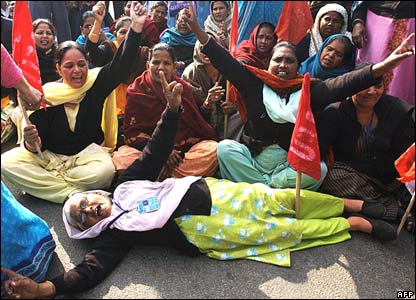
Airport employees are on a nationwide indefinite strike against government's plan to privatise Mumbai and Delhi airports.
Woah. Aunties on the move. I have much respect for them to be able to go out and do this. The strike was called off on the 4th of February. Regardless, apparently, these guys ween't quite as impressed:
Riot police have been deployed at airports. Strikers have now been ordered to keep 500 metres away from terminals.
But on the other hand, I'm impressed by these guys: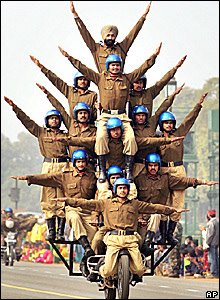
Dare Devils from the Indian Border Security Forces show off their skills.

Feb 14, 2006
With Love.
Amardeep posted up a couple of lists of V-Day music. Good idea, regardless of my thoughts about the day. Still, I may be full o' rage, but I ain't nothing like the list of nations around the world who can't stand Valentine's day, with India leading the charge. I can't remember if Europe feels about Valentine's day as it does Halloween (it's funny that we have to look to Europe when it comes to someone trying to put the brakes on the coca-colonization of the world's cultures, but I guess we could write reams about the privilege to resist and all that, but back to love).
Don't have time to think of a full list, but here are some personal faves - not too obscure, but beyond the most obvious...
1. In a Sentimental Mood, Duke Ellington & John Coltrane.
2. Please Forgive Me, David Gray.
3. Her Majesty, The Beatles.
4. Wonderin' Aloud, Jethro Tull.
5. Cool Drink of H20, Kevin So.
6. Ascension (Don't Ever Wonder), Maxwell.
7. Somebody to Love, Queen.
8. The Sweetest Taboo, Sade.
9. World Without Love, Anything Box.
10. Try, Nelly Furtado.